
Two Panels, Same Price, Ten Years Apart in Life: Reading an LT Panel Spec
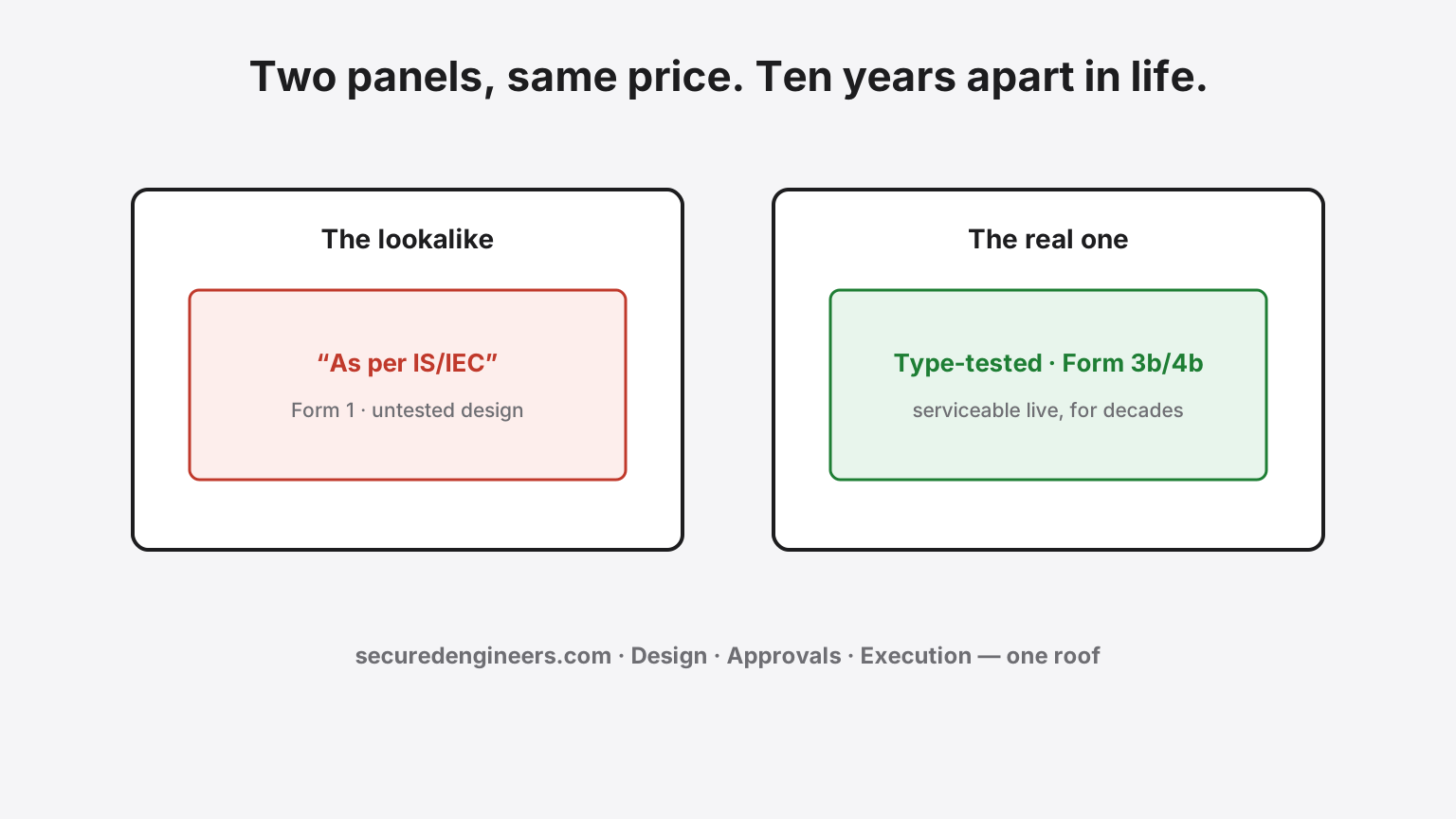
Put two LT panel quotations side by side and they look interchangeable: same incomer rating, same feeder count, both "as per IS/IEC standards", one conveniently cheaper. Ten years later one of them is still being worked on live-front with confidence, and the other is the board electricians quietly refuse to open under load.
The difference was visible on day one — in four specifications most buyers never read past.
1. Form of separation: what happens when someone opens the door
IEC 61439 classifies how a panel's internals are compartmentalised, from Form 1 (no internal separation — one open volume) through Form 2 (busbars separated from functional units) to Form 3 and Form 4 (each functional unit — and in Form 4, each unit's terminals too — in its own compartment).
- Form 1/2 means maintaining one feeder exposes the technician to everything else, so honest maintenance needs a full shutdown — which in practice means maintenance gets skipped.
- Form 3b/4b means one outgoing feeder can be isolated, opened and worked on while the rest of the board stays live and shielded — the difference between a panel that gets maintained and one that does not.
For a factory main PCC or any board feeding a running plant, higher forms of separation are not gold-plating; they are what makes the board serviceable inside your production calendar. Distribution boards for small mixed loads can honestly live with less. Specify the form per board's role, and make the quote state it.
2. IP rating: match the enclosure to the room it actually lives in
The IP number promises protection against ingress — dust (first digit) and water (second). The trap is specifying for the electrical room you drew, not the one the panel will inhabit.
| Location reality | Sensible enclosure class | What goes wrong otherwise |
|---|---|---|
| Clean, ventilated electrical room | IP42-class indoor build | — |
| Shopfloor edge, grinding/textile dust | IP54-class, gasketed, filtered ventilation | Conductive dust settles on busbars; tracking and flashover follow |
| Wash-down areas, chemical plants | IP55+ / corrosion-resistant finish | Ingress corrodes terminations; nuisance earth faults |
| Outdoor / lean-to sheds | IP55-class with canopy and heaters where humid | Condensation cycles destroy insulation resistance |
Remember the thermal trade: sealing a panel tighter traps heat, so higher IP demands honest ventilation/derating design — filtered louvres, forced cooling, or generous sizing. A sealed panel specified without the thermal math cooks its own components.
3. Fault withstand and type-testing: the paperwork that is actually structural
- Short-circuit withstand (Icw) must match the fault level your transformer and network can deliver — a panel rated below the real fault level is a bomb with bus supports as the fuse. Get the fault level calculated, not assumed.
- Type-tested vs "built to" designs: a genuinely type-tested assembly (design verified per IEC 61439 — in India often evidenced by CPRI test reports for the design) has proven its busbar bracing, temperature rise and clearances as a system. A fabricator's lookalike copies the geometry without the verification. Ask for the test reports for this design at this rating, and expect the cheaper quote to go quiet.
- Temperature-rise behaviour is part of that verification — undersized busbars pass an inspection and fail a summer.
4. The small print that predicts panel life
- Busbar material and sizing declared in mm², with joints silver-/tin-plated and torque-marked — not "adequate busbars".
- Spare feeder ways (20% is a sane floor) and physical space to add them — the cheapest expansion you will ever buy.
- Metering and protection relays named by model, not "reputed make" — this is where lookalike quotes hide their savings.
- Cable alley dimensions and gland-plate detail — a panel you cannot terminate cleanly stays messy for life.
- Labels engraved, drawings in the door pocket, torque values recorded at commissioning — the habits that make the next twenty years maintainable.
Panel ratings start from honest load numbers upstream and downstream: size the source with our Transformer Sizing calculator and the outgoing runs with the Cable Size calculator — and if your PF correction lives inside the panel, get the kVAr right with the Power Factor Correction calculator.
What we do differently
Our electrical scope writes panel specifications the way audits read them: form of separation per board's duty, IP class per real environment with the thermal design shown, fault levels calculated and Icw matched, type-test evidence demanded — and commissioning that torque-marks and thermographs before handover. The panel that comes out costs what it should and lasts like it must.
The three takeaways
- Form of separation decides whether the board is maintainable live — specify it per board, in writing.
- IP rating is an environmental match plus a thermal design, not a bigger number.
- Type-test evidence and declared Icw are non-negotiable — they are the difference between a panel and its photograph.
Panel package on your desk? Book a Free Project Blueprint & Statutory Approvals Roadmap or call +91 70099 85817 — we will read the two quotes with you and show you the ten-year difference.
Related services
More insights
LT vs HT Connection for a Factory: Choosing the Supply for an Expansion
Whether a factory is supplied at LT or HT is set mostly by its contract demand and the state supply code. What changes when you cross the line — equipment, space, inspection, charges — and where to check.
ElectricalFactory Power Factor Correction: Read the Bill, Size the kVAr, Check for Resonance
Before adding production load, find out what power factor costs you under your tariff and how much transformer and contract-demand headroom it uses. Read the bill terms, size kVAr from measurements, and review harmonics first.
More on Electrical & Power · all insights