
LT vs HT Connection for a Factory: Choosing the Supply for an Expansion
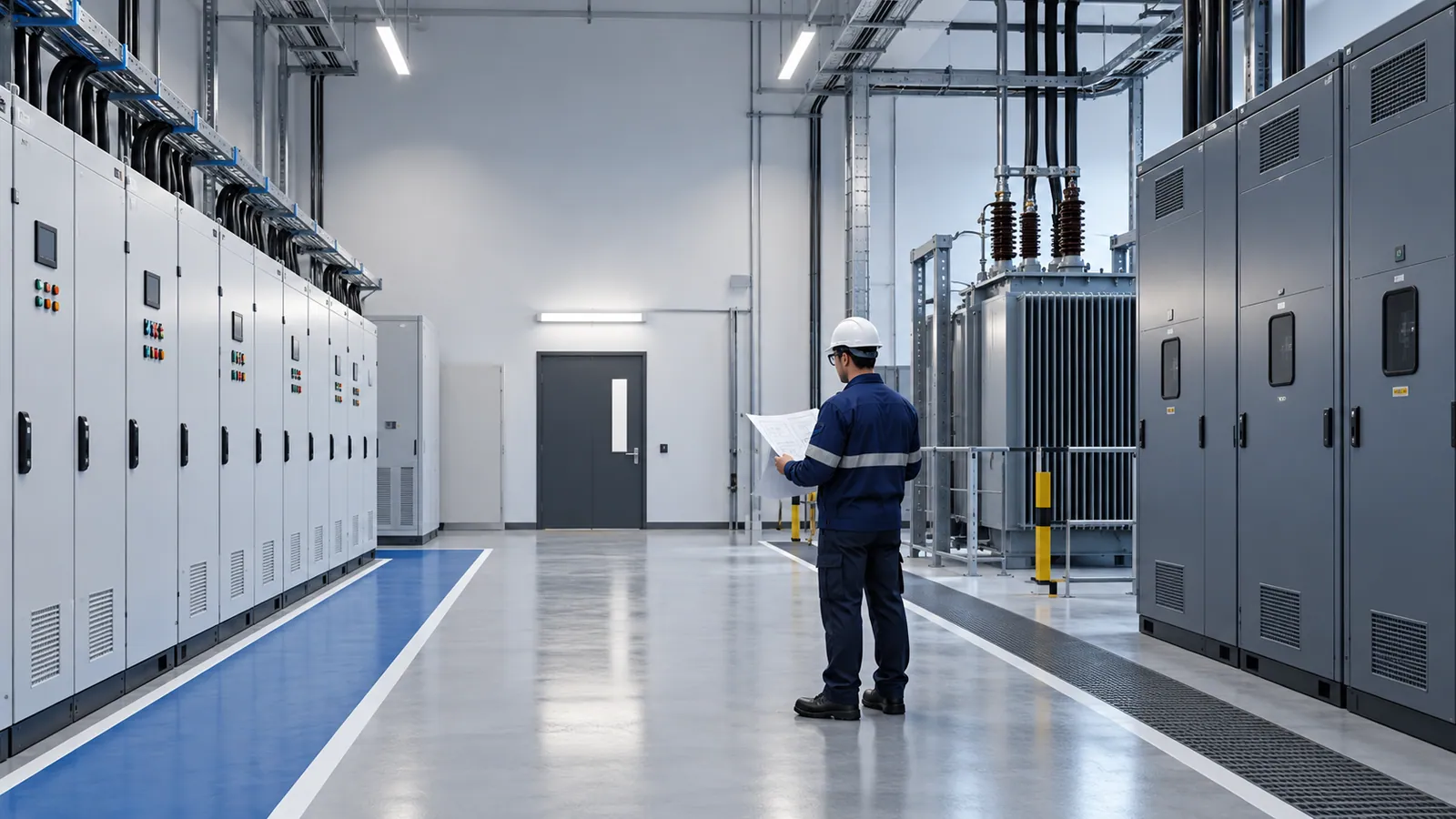
Somewhere in a factory's growth, the electricity supply changes from LT — low tension, at 415 V from the DISCOM's transformer — to HT, at 11 kV or above, through a transformer and substation the factory owns. The choice is narrower than it looks: above a demand set in each state's supply code, the DISCOM supplies only at HT. What remains to decide is when to make the move, how to size it, and what it commits the factory to.
Utility supply categories
Three separate classifications meet at this decision, and it helps to keep them apart:
- Supply voltage — set by the supply code for a given demand. PSPCL's FAQ, for example, describes an LT consumer as one supplied at not more than 650 V, and says demand up to 100 kVA is usually given an LT connection, demand above 100 kVA and up to 5,000 kVA an HT connection (above 650 V, up to 33 kV), and demand above 5,000 kVA an EHT connection.
- Tariff category — set by the tariff order. In Punjab's FY 2026-27 tariff structure, industry up to 50 kVA is Small Power, above 50 kVA and up to 100 kVA Medium Supply, and above 100 kVA Large Supply, each with fixed charges per kVA and energy charges per kVAh.
- Inspection regime — set by the CEA 2023 regulations and the voltage your state has notified. Above it, the Electrical Inspector inspects before supply and periodically; at or below it, the owner self-certifies.
Voltage and tariff interact. PSERC's general conditions of tariff in its FY 2024-25 order (condition 13) levied a surcharge on the energy charges of consumers supplied below the voltage the supply code specifies for their demand — 15% for supply at 400 V against a specified 11 kV — and allowed rebates for supply at higher voltages in some categories. Check the order in force for the current figures; the principle that staying at the wrong voltage has a running cost is the point.
| Question | Where to find the answer | Why it matters |
|---|---|---|
| What supply voltage does the code specify for our demand after the expansion? | State supply code; the DISCOM's FAQ or portal | Decides whether HT is a choice or a requirement |
| Which tariff category will the expanded demand fall into? | The current tariff order and the DISCOM's tariff circular | Fixed and energy charges, ToD terms |
| Is there a surcharge for staying at a lower voltage, or a rebate for a higher one? | General conditions of tariff | The running cost of not converting |
| What will the DISCOM charge to connect or extend? | Schedule of general charges; standard cost data; the demand notice | Security deposits, line and bay works, metering |
| Where will the DISCOM meter, and on which side of the transformer? | Supply code; general conditions of tariff | HT-side metering bills your transformer's losses to you |
| What is our state's notified voltage for inspection? | The state Electrical Inspectorate | Who inspects — before supply and periodically |
| Will total demand need a feasibility clearance or network works? | The DISCOM | Adds a step, and possibly augmentation, before sanction |
Lifecycle components: what an HT connection adds
An LT consumer's installation starts at its main LT panel; an HT consumer's starts at the DISCOM's line. Everything in between becomes the factory's to buy, house, test and maintain. PSERC's FY 2024-25 general conditions, for instance, provide for HT metering normally on the HV side of the transformer, which puts the transformer's losses on your bill.
| Component | LT connection | HT connection | Lifecycle duty |
|---|---|---|---|
| Transformer | The DISCOM's | Yours: rating, losses, cooling | Condition monitoring; oil testing where oil-filled; a spares plan |
| HT switchgear and protection | — | Yours: breaker or ring main unit, relays | Relay settings from a study; periodic testing |
| Metering | LT meter at your panel | HT metering with CTs and PTs, in an enclosure the supplier can always reach | Seal integrity; access for the DISCOM |
| Earthing | LT system earthing | Substation earthing and equipment bonding | Measured and recorded earth resistance |
| Civil works | A panel room | Transformer yard or room, cable trenches, plinths, an oil soak pit where required | Drainage, access, fire separation |
| Inspection | Self-certification at or below the notified voltage | Electrical Inspector before supply and periodically, above the notified voltage (regulations 32 and 45) | Records kept ready for the inspector |
| People | — | Designated persons, and an Electrical Safety Officer for a factory above 250 kW connected load (regulation 5(3)) | Training, and a register of designated persons |
None of this is unusual for an industrial plant, but all of it belongs in the comparison with its cost and its people counted. Our CEIG approval guide covers the inspection file.
Space and maintenance
Regulation 46 of the CEA (Measures relating to Safety and Electric Supply) Regulations, 2023 sets physical requirements for installations above 650 V that decide where a substation can go:
- a separate building, or a locked, weatherproof and fireproof enclosure, housing the supplier's apparatus and metering, with access for the supplier at all times — or segregation where that is impracticable;
- safety clearances to the relevant standards, so equipment can be operated and maintained without hazard, with adequate ventilation and no encroachment below the installation;
- no substation with more than 2,000 litres of oil in a basement where proper oil drainage cannot be provided; separation walls and an oil soak pit for oil-filled apparatus holding more than 2,000 litres; and automatic fire fighting for transformers of 10 MVA and above;
- indoor oil-filled transformers in buildings other than residential or commercial ones on the ground floor or not below the first basement, and only dry-type transformers inside residential and commercial buildings.
Plan the access as well: a route for a crane or vehicle to replace the transformer, cable entries that do not cross production areas, and room in the switchboard and the yard for the next expansion. The most expensive substation is the one rebuilt because it was boxed in.
State-specific applicability and fee sources
Thresholds, charges and procedures differ by state and change with each order. Work from the published documents, dated, rather than remembered figures:
| What you need | Punjab | Uttar Pradesh | Other states |
|---|---|---|---|
| Supply voltage for a demand | PSERC Supply Code 2024; PSPCL's FAQ on new connections | UPERC's supply code; UPPCL | The state commission's supply code |
| Tariff category and charges | PSPCL Commercial Circular 09/2026 (FY 2026-27, under the PSERC order of 6 March 2026) | UPERC's current tariff order | The current tariff order |
| Connection and extension charges | Schedule of general charges; standard cost data | UPPCL's schedule of charges | The DISCOM's schedule of charges |
| Application inputs | The state industries portal's Common Application Form, or PSPCL's single window | UPPCL's industrial connection application | The DISCOM's portal |
| Inspection | Punjab's Electrical Inspectorate | UP's Directorate of Electrical Safety | The state Electrical Inspectorate |
When LT or HT fits
| Situation | Points towards | Why | Check |
|---|---|---|---|
| Expanded demand stays well within the LT limit, load is stable | Stay on LT | A substation adds cost and duties you do not need | That the next expansion is not already planned |
| Expanded demand crosses the LT limit | HT — required | Above the threshold the DISCOM supplies only at HT | Supply voltage, charges, and sequencing so the substation does not hold up production |
| Demand near the limit, further growth likely | Plan HT now | Building the end state once avoids converting with production running | Transformer rating and bay space for the end-state load |
| A process sensitive to power quality | HT worth evaluating | Your own transformer separates you from other consumers on a shared LT network | Harmonic and voltage measurements from your own supply |
| Leased premises, short horizon | Stay on LT where the code allows | Substation capital is hard to recover within a short tenancy | Landlord consent, and what happens to the asset when you leave |
A worked decision: the expansion case
A Punjab unit runs at a contract demand of 90 kVA on LT (example inputs throughout). A new line will add an estimated 60 kVA to the measured peak, taking the expanded demand to about 150 kVA. Three questions decide it, in order:
- Does the expanded demand cross the LT limit? At about 150 kVA, PSPCL's FAQ points to an HT connection, and where additional demand changes the supply voltage from LT to HT, the expenditure is charged as for a new connection. The decision is made; what is left is sequencing the substation so it does not hold up the line.
- What will the bill look like? At that demand the unit moves from Medium Supply to Large Supply in the FY 2026-27 tariff structure, with different fixed and energy charges — model the new bill, not the old one.
- What does the next expansion look like? If another line is plausible, size the transformer, switchgear and yard for it now. Equipment bought once costs less than a substation extended in a hurry.
Notice what is absent: any single ₹-per-unit comparison. Tariffs change with every order, so the comparison runs on your own bills and the order in force. The factory electrical spare-capacity calculator and the transformer sizing calculator give first numbers; our guide to contract demand and ToD tariffs shows how billed demand behaves on a demand-based tariff, and our note on undersized substations explains the cost of building too small. If the expansion also needs a load enhancement, see electrical load enhancement for a factory expansion.
Secured Engineers' electrical infrastructure service designs and builds LT and HT installations, and its design and approvals team prepares the filings. More guides are on the Insights page; to compare LT and HT for your plant, share the single-line diagram, the equipment schedule and recent demand records through a scope review request.
Sources and how to verify
- Central Electricity Authority — CEA (Measures relating to Safety and Electric Supply) Regulations, 2023, notified 8 June 2023: regulations 5(3), 32, 45 and 46.
- Punjab State Power Corporation Ltd — FAQs on new connection and extension of load (refers to the Supply Code 2024; read 6 Oct 2026).
- Punjab State Power Corporation Ltd — Commercial Circular 09/2026: tariff structure for FY 2026-27, under the PSERC tariff order of 6 March 2026.
- Punjab State Electricity Regulatory Commission — general conditions of tariff, Annexure I to the FY 2024-25 tariff order (conditions 11 to 13: metering, voltage surcharge and rebate).
- Uttar Pradesh Power Corporation Ltd — application form for an industrial electricity connection (read 6 Oct 2026).
Confirm locally: the supply code, tariff order and schedule of charges in force in your state on the date you apply, and your state's notified voltage for inspection and self-certification.
Frequently asked
What information do I need before choosing between LT and HT supply?
Your present contract demand and twelve months of recorded maximum demand; the demand the expansion will add, measured rather than summed from nameplates; the supply code and tariff order for your state; the space available for a transformer and HT switchgear; and how long you expect to stay on the site. With those, the choice is usually clear before any equipment is priced.
Which site conditions could change the LT/HT decision or its cost?
The distance to the DISCOM’s HT line and the capacity of the feeding substation; whether a separate, accessible enclosure for the supplier’s metering can be provided; space and access for a transformer and its eventual replacement; soil conditions for substation earthing; whether the premises are owned or leased; and a process that is sensitive to power quality. Each moves either the cost of HT or the case for it.
What should I send an engineer to compare LT and HT for my plant?
The single-line diagram, the equipment schedule including the expansion, and recent demand records — bills and, if available, the meter’s interval data. An engineer can then check the expanded demand against your state’s thresholds and size the substation if one is needed.
When is a factory required to take an HT connection?
When its demand exceeds the limit up to which the state’s supply code allows LT supply. The limit is state-specific: PSPCL’s FAQ, for example, says demand up to 100 kVA is usually given an LT connection and demand above it an HT one. Growing factories usually meet the threshold at an expansion, so check it before the machine order.
Does an HT connection need Electrical Inspector (CEIG) approval?
Under the CEA 2023 regulations, installations above the voltage your state has notified are inspected and tested by the Electrical Inspector before supply commences and periodically afterwards; at or below that voltage, the owner self-certifies. Which applies to your HT installation depends on your state’s notified voltage — confirm it with the inspectorate.
Is HT power cheaper than LT?
It depends on the tariff order, not on the voltage alone. Categories, fixed and energy charges, voltage surcharges and rebates, and ToD terms differ by state and by year; against them sit the capital and running cost of a substation. Compare the two bills on your own load under the order in force before deciding on cost grounds.
Related services
More insights
UPS Planning for Critical Factory and Office Loads: Size the Gap, Not the Outage
A UPS earns its cost in the seconds and minutes between a disturbance and the DG or grid taking over. Plan it from a load and autonomy schedule, keep the load within both its kW and kVA limits, choose topology and bypass for the duty, and size the battery for its end of life.
ElectricalFactory Electrical Load Enhancement: From Measured Demand to an Approved Connection
A load enhancement is sized from measured maximum demand, not the sum of nameplates — and it can change your supply voltage, your transformer and your protection. What to measure, what to file, what to check.
More on Electrical & Power · all insights