
A Solar Array Cannot Be Switched Off From Below. Design for That.
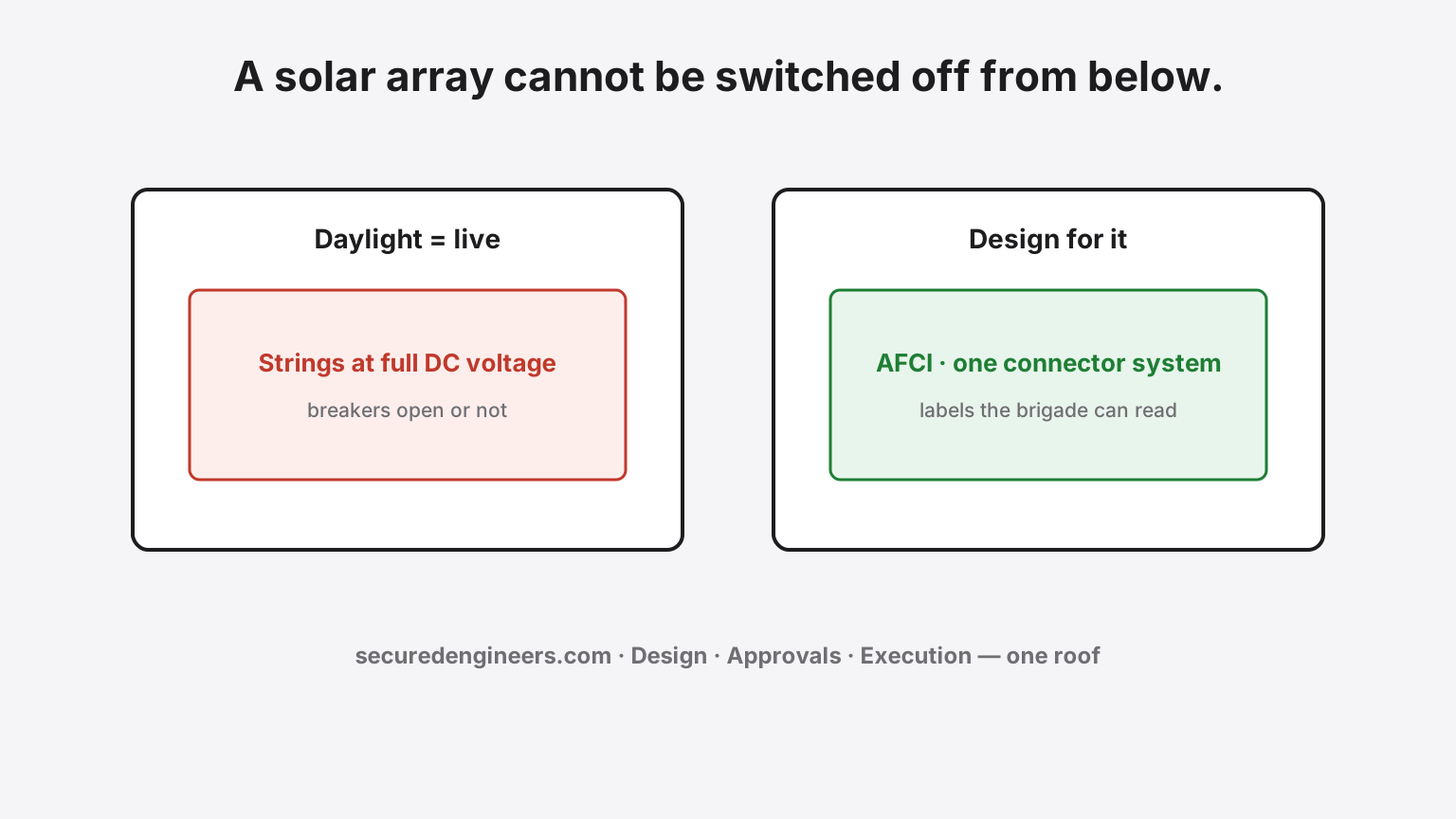
Here is the property of photovoltaics that every fire plan must absorb: you cannot de-energise a module while light falls on it. Open every breaker in the plant and the strings above the roof still sit at their full DC voltage — commonly several hundred volts in C&I designs — from panel to wherever the conductors were cut or faulted.
Combine that with the second property — DC arcs do not self-extinguish. An AC arc gets a hundred zero-crossings a second to die; a DC arc, once struck across a failing joint, burns steadily like a welder. This pair explains nearly every solar fire that makes the news, and it defines what a safe rooftop plant looks like.
Where rooftop solar fires actually start
| Origin | Mechanism | The design/O&M answer |
|---|---|---|
| Connector faults (the #1 cause) | Cross-mated “compatible” connectors from different makers, field-crimped without the right tool, or half-clicked — resistance rises, joint cooks, arc strikes | Same-manufacturer pairs only; factory leads preserved; proper crimp tooling; torque/click discipline audited during install |
| DC cable damage | Insulation abraded on sharp edges, UV-degraded ties, cables lying in standing water | UV-stable routing in trays/conduit, edge protection, no cable on bare roof |
| Isolator/combiner failures | Underrated or moisture-ingressed DC isolators burning internally | Genuinely DC-rated, IP-appropriate devices; thermography on the annual scope |
| Ground faults left standing | First fault sits undetected; second fault completes a fire circuit | Inverter ground-fault alarms treated as urgent, not as noise |
| Hot spots on modules | Shading/soiling/cell damage concentrating heat | Cleaning regime plus periodic IR scan of the array |
The protection stack a serious design carries
- Arc-fault detection (AFCI): modern string inverters increasingly ship with DC arc-fault detection that trips the affected input on the arc signature. Context worth knowing: the US code (NEC) has mandated PV arc-fault protection for years — it is not a blanket Indian mandate, which makes it a specification decision. Specify it anyway; it targets the top failure mode directly.
- String-level monitoring: a slowly degrading joint announces itself as a string underperforming weeks before it burns. Monitoring granularity is fire prevention wearing a performance hat.
- Clear DC zoning + labelling: conduit routes marked, “energised in daylight” warnings at access points, single-line at the fire panel location — the fire brigade’s first questions, answered in advance.
- Rapid-shutdown context: module-level rapid shutdown (collapsing string voltage near the array on command) is, again, a US-driven requirement — not generally mandated in India. For high-value roofs and occupied buildings it is worth pricing; at minimum, place DC isolators to segment the roof sensibly.
- Firefighting compatibility: maintained access pathways between array blocks, setbacks from edges and smoke vents preserved, and the site emergency plan updated to say what stays live. A roof carpeted edge-to-edge with modules is a roof the brigade works around, not on.
- Earthing & lightning coordination: array frames bonded per the plant’s earthing design and coordinated with the building’s lightning protection — induced surges are an ignition path too (SPDs on DC and AC sides accordingly).
O&M: where fire prevention actually lives
- Annual IR thermography of connectors, combiners and isolators under load — heat is the pre-fire signature and it photographs beautifully.
- Ground-fault and arc alarms with a response SLA — an alarm policy of “reset and observe” is how faults get their second chance.
- Post-monsoon inspection — water finds every optimistic gland and low-lying junction box.
- Change control: any repair uses matching connectors and rated components — the fire six years in often traces to a two-rupee mismatch during a one-hour repair.
Fire on the roof also re-opens your building’s own compliance picture — confirm with the fire authority whether the change affects your approval, and keep the paperwork in order with the Fire NOC document readiness checklist. And prevention-grade O&M is exactly what a proper maintenance contract buys: see what it should cost for your plant size with the Solar AMC Cost calculator.
What we do differently
Our solar EPC scope treats the DC side as the safety-critical system it is: one connector ecosystem across the plant, AFCI-capable inverters specified by default, string monitoring standard, brigade-readable labelling — and because we are also a fire protection contractor, the array layout is coordinated with the building’s fire scheme rather than argued with it later. Under our AMC, the annual thermography actually happens.
The three takeaways
- Daylight = energised. Every layout, label and emergency plan must assume live DC on the roof.
- Connectors are the fire origin story — discipline there buys more safety than any accessory.
- AFCI, string monitoring and annual IR scans turn smouldering faults into maintenance tickets.
Own a roof plant nobody has thermographed? Book a Free Project Blueprint & Statutory Approvals Roadmap or call +91 70099 85817.
Related services
More insights
How to choose a solar EPC company in India — the checks that actually matter
Search that phrase and you get 'Top 10' lists written by solar companies about themselves. Here is the evaluation checklist instead — the one we'd want a buyer to run on us.
Solar EnergyYour Quote Says TOPCon Now, Not PERC. Here's What Actually Changed.
Most commercial and industrial solar quotes in 2026 default to TOPCon modules rather than the PERC panels standard a few years ago. The efficiency number moved, but the number that matters more for a 25-year asset is the degradation curve — and that's where N-type genuinely earns the switch.
More on Solar & Renewables · all insights