
Your Quote Says TOPCon Now, Not PERC. Here's What Actually Changed.
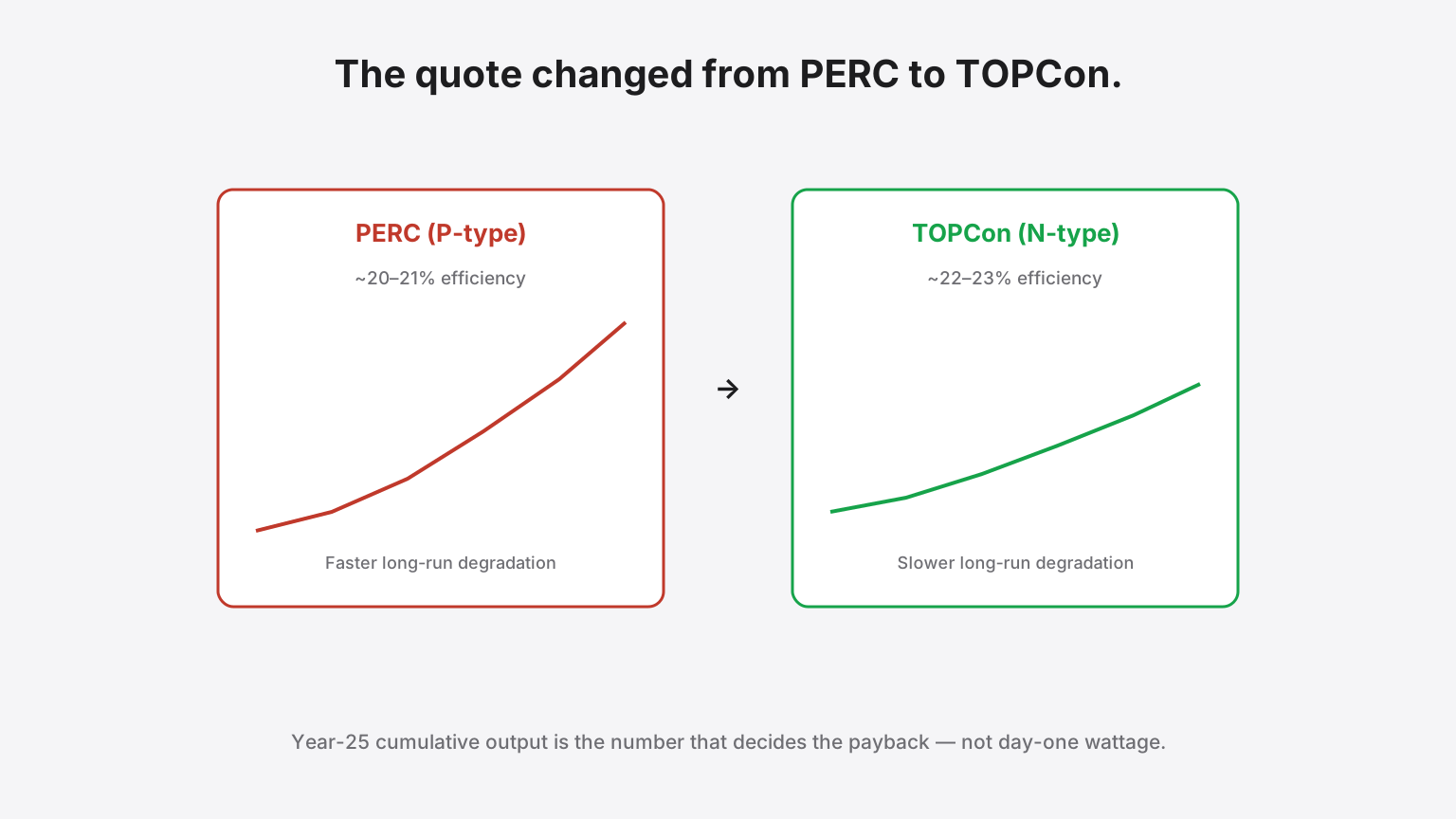
Ask for a commercial solar quote today and, unless you specifically request otherwise, the module line will say TOPCon. Two years ago it would have said PERC. Nobody sent an announcement — the market simply moved, the way it moved from polycrystalline to mono-PERC before that. Buyers who last priced solar before 2024 are often unaware the default technology under their quote has changed, or why.
P-type vs N-type, in one paragraph
PERC (Passivated Emitter and Rear Cell) is built on p-type silicon wafers. TOPCon (Tunnel Oxide Passivated Contact) is built on n-type wafers with an added thin tunnel-oxide and doped polysilicon layer at the rear contact. The practical result: TOPCon cells run a couple of efficiency points higher, and — more importantly for a rooftop asset — degrade slower over decades, because n-type silicon isn't subject to the light-induced degradation mechanism that p-type cells are.
Why this matters more than the efficiency number
| PERC (P-type) | TOPCon (N-type) | |
|---|---|---|
| Typical module efficiency | ~20-21% | ~22-23% |
| First-year degradation | Higher, from light/elevated-temperature induced degradation | Lower — the mechanism that causes it in p-type largely doesn't apply |
| Annual degradation thereafter | Higher long-run average | Lower long-run average |
| 25-year cumulative yield | Lower, from the compounding degradation gap | Higher — this is where the real payback difference sits |
A percentage point of module efficiency changes your day-one system size on a fixed roof. A lower degradation curve changes what that system still produces in year 20 — and a 25-year asset spends most of its life past year one. That second number is the one worth asking your EPC contractor to show, not just quote.
What to actually check in a quote
- ALMM listing — TOPCon is now widely ALMM-listed, but confirm the specific SKU, not just the manufacturer brand, is on the current list. See our ALMM List-II explainer — from June 2026 this extends to the cells inside the module, not just the assembled panel.
- Bifacial vs monofacial TOPCon — many TOPCon modules are offered bifacial by default; whether the rear-side gain applies to your installation depends on mounting and ground surface. See our bifacial payback explainer.
- Warranted degradation curve, not just year-one output — the manufacturer's datasheet should state the annual degradation rate and cumulative output guarantee at year 25, not only the day-one wattage.
- Temperature coefficient — TOPCon generally handles Indian rooftop heat better than PERC; the datasheet states this as %/°C above 25°C, and it is worth comparing across bids on a hot roof.
What we do differently
Our Solar EPC quotes state module technology, ALMM status and the manufacturer's warranted degradation curve explicitly, so you're comparing bids on a 25-year output basis rather than a day-one wattage number that looks similar across very different modules.
More insights
Green Hydrogen Needs a Lot More Solar Than the Slide Deck Shows.
Green hydrogen — solar power run through an electrolyzer to split water — is the path being discussed for decarbonising steel, fertiliser and other hard-to-electrify heavy industry. For most Indian industrial buyers today it's a genuine future direction, not a retrofit decision, and the honest reason why is the scale of solar capacity it actually requires.
Solar EnergyWhy Most Industrial Solar Underperforms (It Starts on Day 1)
Solar is not a product you buy — it is an engineering outcome. The decisions made before a single panel goes up quietly decide whether your plant saves money or loses it for 25 years.