
The Chiller Gave Three Weeks of Warning Before It Failed. Nobody Was Listening.
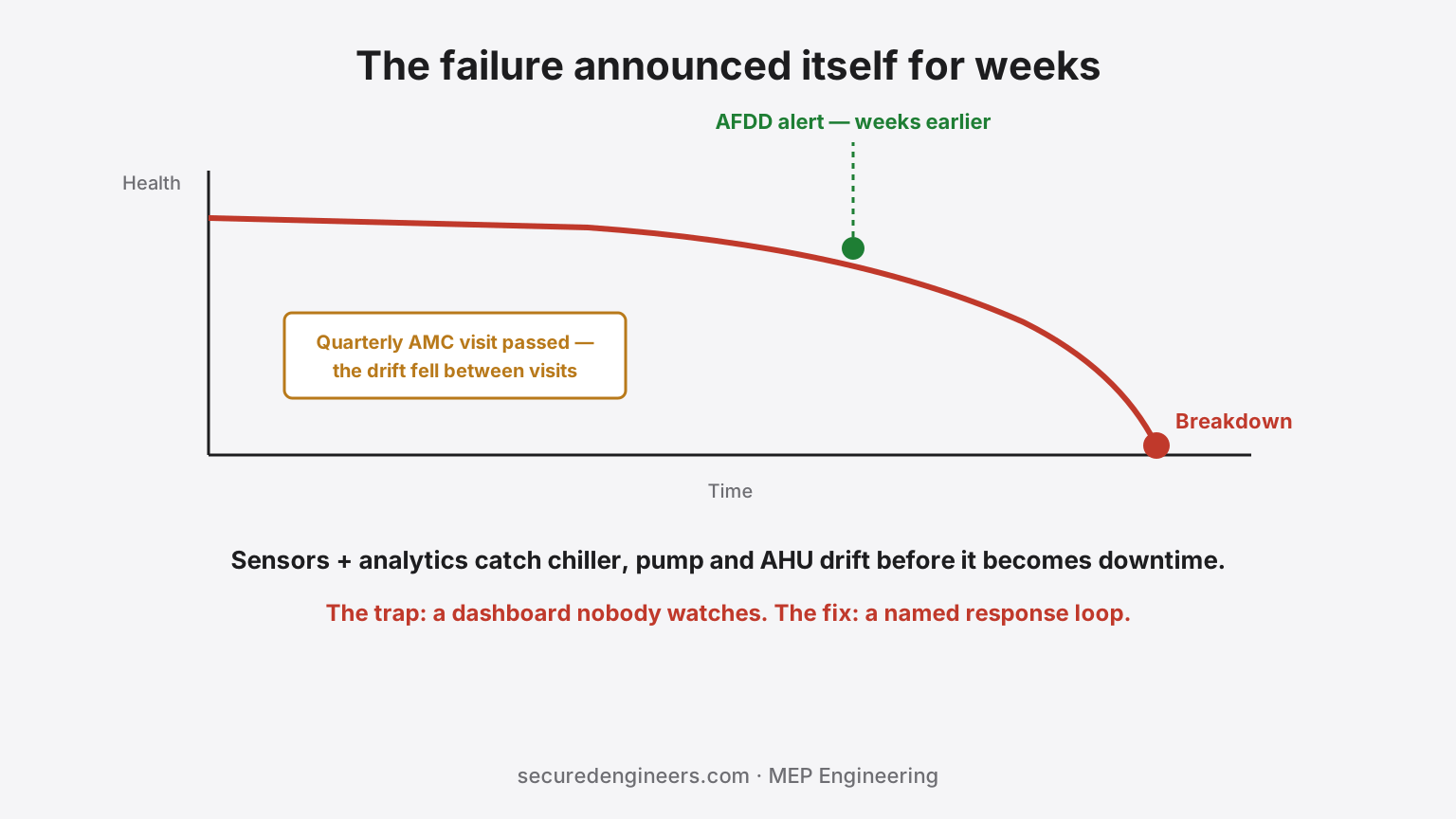
Most plant-room failures are not sudden. A chiller losing refrigerant charge, a pump bearing wearing, an AHU filter loading up or a belt slipping — each shows up in the data long before it shows up as a breakdown: approach temperatures drifting, power draw creeping for the same output, vibration signatures changing. The equipment has been announcing its decline for weeks. Traditional maintenance simply has nobody listening between quarterly visits.
Automated fault detection and diagnostics (AFDD) — sensors on the plant, analytics watching the streams continuously, alerts when patterns drift from healthy baselines — closes that gap. Through 2025–26 it moved from an enthusiast's add-on to standard practice at serious Indian operators: IT parks, hospitals, pharma and cold-chain facilities where a chiller failure is measured in lost revenue or spoiled product, not just discomfort. Falling sensor and connectivity costs did half the work; the other half was operators simply getting tired of paying for preventable failures.
Why this beats schedule-based maintenance
A conventional AMC services equipment on a calendar: quarterly visit, standard checklist, regardless of condition. That model both over-services healthy equipment and under-services degrading equipment — the failure that matters usually falls between visits. Condition-based maintenance inverts it: the data decides what gets attention. The economics of this shift are an extension of the AMC-structure question covered in our AMC economics guide — the contract stops buying visits and starts buying uptime.
What a retrofit actually needs
| Layer | What it is | Common gap |
|---|---|---|
| Metering & sensors | Energy meters per major machine; temperature, pressure, flow and vibration points on chillers, pumps, AHUs | Older plants often have one incomer meter and nothing per-machine — no baseline, no diagnostics |
| Connectivity | Getting data off the plant — BMS integration where one exists, gateways where it doesn't | Proprietary BMS protocols that won't share data without the original vendor's paid involvement |
| Analytics | The AFDD layer that learns baselines and flags drift, with fault libraries for common HVAC failure modes | Chosen on demo-day dashboards rather than on the quality of its fault rules |
| Response loop | A named person or AMC contractor whose job is to receive, triage and act on alerts | The most commonly missing layer — and the one that determines whether anything above it was worth buying |
The connectivity row deserves emphasis: buildings with locked-down proprietary BMS platforms discover that their own operating data is hostage to the original vendor — a problem we dissected in the BMS vendor lock-in trap. Open protocols specified at day one make an AFDD retrofit a wiring exercise; a closed BMS makes it a negotiation.
The dashboard nobody watches
The predictable failure mode of these projects isn't technical. A system gets installed, produces a handsome dashboard, generates alerts — and six months later nobody has logged in for weeks, because alert fatigue set in (too many low-value notifications) or because no one's job description ever included acting on them. An AFDD system without a response loop is an expensive way to document failures you still didn't prevent. The fix is organisational: tuned alert thresholds so that a notification means something, and a contract — internal or AMC — that names who responds, how fast, and what gets logged. When the analytics and the maintenance contract live with the same party, the incentive to act on warnings is built in rather than hoped for.
Where to start
Not with the whole building. Instrument the plant room first — chillers, pumps, cooling towers and the main AHUs are where the money and the failures concentrate — and expand only once the response loop demonstrably works. Our AMC & maintenance team structures condition-based contracts around exactly this progression, and our Low Voltage & ELV scope covers the metering, sensor and connectivity layer that makes it possible. The equipment has been talking all along; the retrofit is really about finally hiring someone to listen.
More insights
Why the 3rd Floor Gets a Trickle, the 1st Floor Gets a Jet, and the Pipes Bang at Night
Height converts quietly into pressure — one bar for every ten metres of water column. Un-zoned high-rise plumbing gives the lowest floors destructive pressure and the highest floors none, then adds water hammer as percussion. The fix is architecture, not bigger pumps.
MEP EngineeringMEP vs MEPF: What Indian Developers Should Look For in an MEP Contractor
MEP or MEPF? What the terms mean, why 'MEP contractor' is the global standard, and why the 'F' — fire protection — is what separates a safe building from a risky one.