
Busbar or Cable? The Rising-Mains Decision You Only Get to Make Once
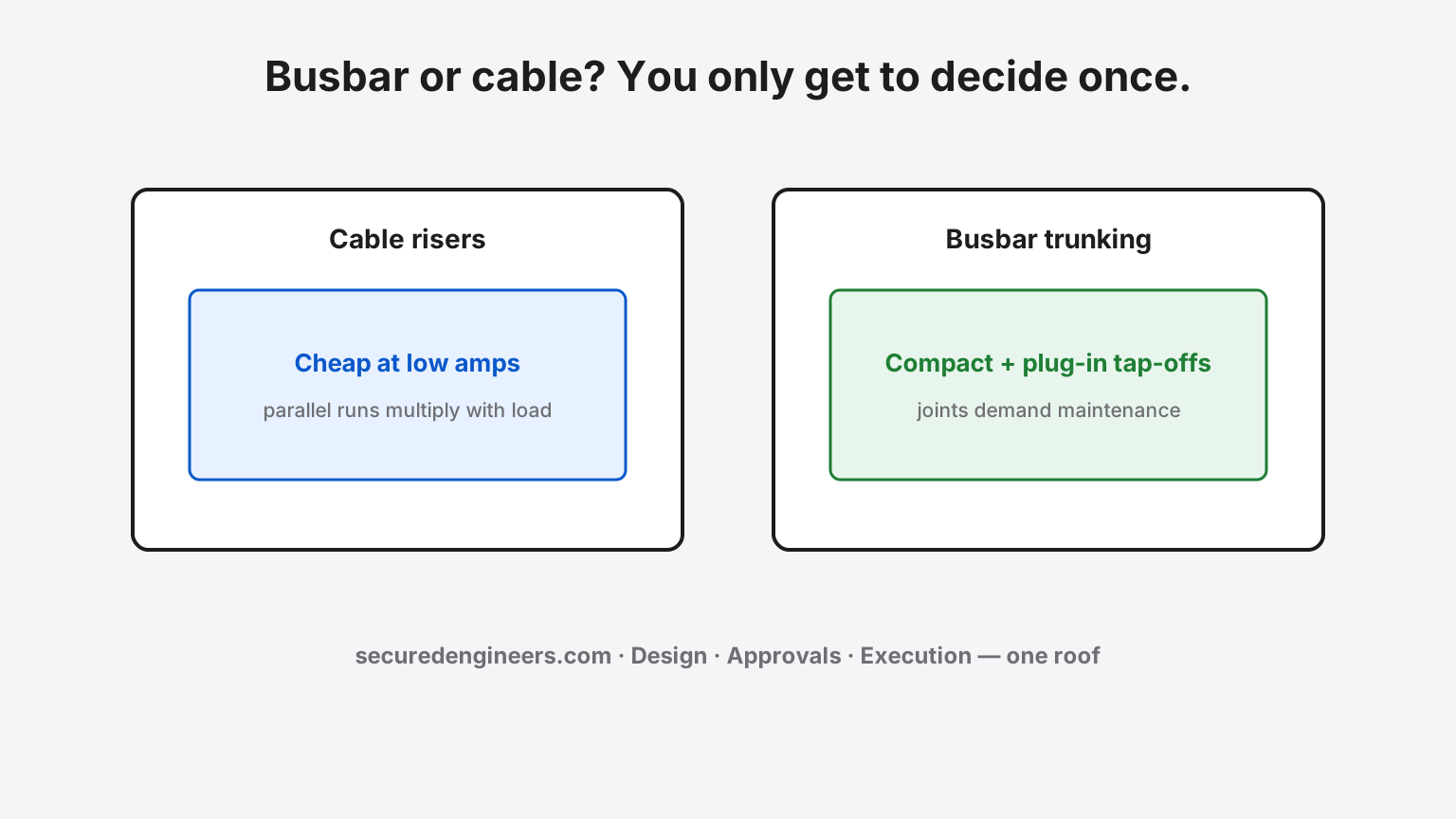
Every multi-storey building and every long shopfloor faces the same distribution question: carry the power on cables — the default everyone knows — or on busbar trunking, the prefabricated aluminium or copper conductor system that arrives as bolt-together lengths with plug-in tap-off points.
The decision is close to irreversible. Shaft sizes, floor cut-outs, panel locations and even slab loading are set around it. And because the crossover between the two is genuinely load-dependent, the wrong default in either direction costs real money: busbar where cable was fine is capital wasted; cable where busbar was right is a shaft full of copper you can never cleanly modify.
The honest comparison
| Criterion | Cable risers | Busbar trunking |
|---|---|---|
| Sweet spot | Lower ampacities and short runs — indicatively below the several-hundred-amp range | High ampacities and long vertical/horizontal runs, where paralleled cables multiply |
| Space | Multiple parallel runs per phase at high ratings — wide trays, big bends, congested shafts | One compact enclosure; shaft width shrinks visibly at 1000 A+ |
| Derating | Grouped, tray-stacked cables derate hard; the 12th cable in a shaft carries far less than its catalogue rating | Type-tested thermal performance as a system; ratings hold as installed |
| Tap-offs / future loads | New load = new cable, pulled the whole way, often through live congested containment | Plug-in tap-off boxes at regular intervals — a new floor load is an afternoon's work |
| Joints & failure points | Terminations at each end only — but many parallel terminations at high ratings | A bolted joint every few metres; joint torque and inspection discipline is the system's lifeline |
| Fault behaviour | Fault damage local to one cable; repair = replace length | Higher fault-withstand as a tested assembly; but a damaged length means sourcing a matching section |
| Fire performance | Depends wholly on cable class (FR / FRLS / fire-survival where circuits must live) | Metal-enclosed, low fire load; fire barriers at floor crossings are standard accessories |
| Installation time | Familiar to every contractor; slow at scale | Fast erection, but unforgiving of civil misalignment — coordination with structure is non-negotiable |
| Cost behaviour | Cheap at small ratings; cost climbs steeply as parallel runs multiply | Higher entry cost; typically crosses over against multi-run cable somewhere in the high hundreds of amps — run the comparison on your actual load, not a rule of thumb |
Where each one wins in real Indian projects
Busbar earns its keep when:
- Rising mains in multi-storey buildings — one riser, plug-in tap-off per floor, metering at the tap-off; the shaft stays walkable and future tenant loads don't mean new vertical cable pulls.
- Long shopfloors with machine rows — overhead busbar with tap-offs every few metres turns machine relocation from a cabling project into a plug move. If your layout changes yearly, this is the whole argument.
- Transformer-to-panel interconnections at high current — where a cable solution means a wall of parallel single-cores and every termination is a future hot spot.
Cable stays the right answer when:
- Ratings are modest and runs short — the busbar system's fixed costs never pay back.
- The route is tortuous — busbar wants straight, planned runs; cable forgives geometry.
- Site conditions are corrosive or wash-down — cable in sealed containment can be simpler to protect than joint-rich trunking (IP-rated and epoxy busbar exists, at a price).
- Your maintenance culture will not sustain joint torque checks and periodic thermography — an unmaintained busbar joint is a slow-cooking fault; be honest about this.
Specification notes that prevent regret
- Insist on type-tested assemblies (IEC 61439-6) with declared fault withstand — not fabricated lookalikes.
- Match aluminium vs copper conductors to your space and budget honestly; aluminium at the right size is legitimate engineering, not a shortcut.
- Detail fire barriers at every floor penetration and expansion joints on long runs at design stage — retrofitting either is miserable.
- Order spare tap-off boxes with the original supply; matching them years later against a discontinued series is a known trap.
- Put joint thermography on the annual audit scope from year one.
The riser decision starts from the load. Size the feeder honestly with our Cable Size calculator — if your answer is coming out as many parallel runs per phase, that is the signal to price busbar seriously. Upstream of it, sanity-check the source with the Transformer Sizing calculator.
What we do differently
Our electrical infrastructure scope runs the cable-vs-busbar comparison on your actual load schedule and layout — with the shaft sizing, civil coordination and fire-barrier detailing owned by the same team that will erect and test it. No vendor bias either way: we install both, so the recommendation is engineering, not catalogue.
The three takeaways
- The crossover is load- and layout-specific — run it on your numbers; don't inherit a default.
- Busbar buys space, derating honesty and future tap-offs; it charges you in joints that must be maintained.
- Decide before the shafts are cast — this is a day-one decision wearing a procurement disguise.
Deciding a riser this quarter? Book a Free Project Blueprint & Statutory Approvals Roadmap or call +91 70099 85817 and put your load schedule in front of an engineer, not a salesman.
Related services
More insights
The Building Isn't Open Yet. The EV Mandate Already Applies.
Delhi's draft EV Policy 2026 requires all new infrastructure projects to be EV-charging ready from day one — not retrofitted later, designed in from the start. Delhi has roughly 8,850 charging points against a stated need of over 36,000, and the policy is closing that gap by pushing the requirement upstream, onto every new building's electrical design. If you're breaking ground on a new project, this isn't an optional add-on anymore.
ElectricalThe DG Set Is Installed and Tested. The Inspectorate Still Has Not Cleared It.
A DG set is commonly treated as equipment you buy and commission. Where it falls within the electrical inspectorate scope, it is an installation requiring approval before energisation — and the drawings, not the machine, are what get scrutinised.
More on Electrical & Power · all insights