
Cold Storage Expansion Requirements: Refrigeration, Power and NCCD Checks
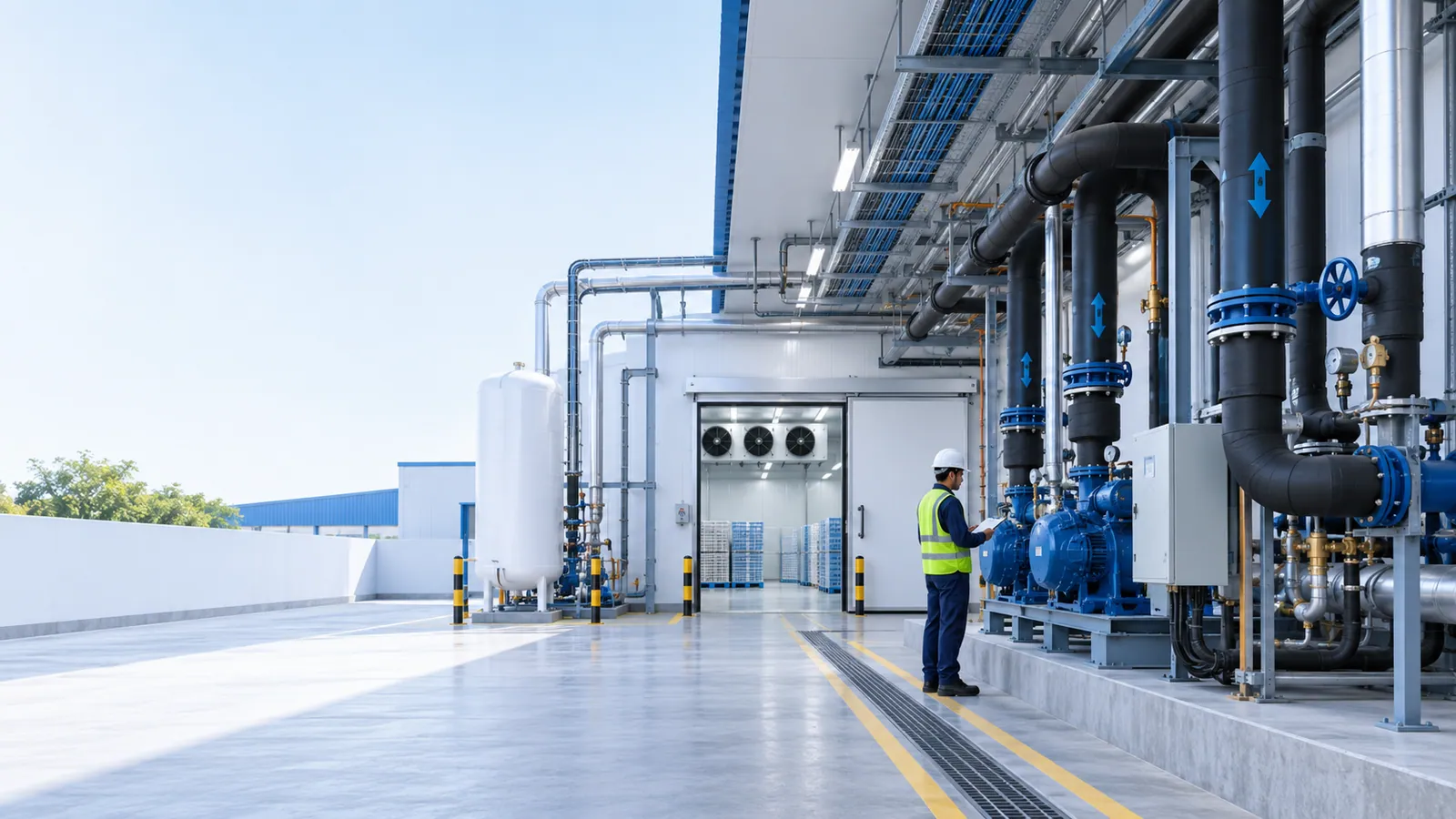
A common way to expand a cold store is to add chambers, extend the existing refrigeration lines to them and switch on. The trouble shows up in the first loading season: the old chambers drift warm while the new ones are being filled, the compressors never unload, and the electricity and DG fuel bills both jump. The plant was sized for a holding load; the expansion added a loading load.
A cold store is sized by how much product arrives each day, how warm it arrives and how quickly it must reach storage temperature — not by chamber volume. That is why the basic data sheets in NCCD's engineering guidelines ask for the produce loading rate in kg per day, the incoming produce temperature, the ambient temperature and the pull-down time alongside room temperature and humidity. This checklist covers those inputs, the room conditions, the refrigeration and electrical reserve, and what NCCD requires of an expansion seeking central assistance.
Product throughput and pull-down
Start with the season, not the chamber. For each product, record the peak daily intake, its arrival temperature, the temperature and humidity it must be held at, and the hours the operation can allow to bring it down. Live produce keeps generating respiration heat, and crates, cartons and pallets have to be cooled with the product.
The sensible heat to be removed from the product is simple arithmetic:
Product load (kW) = mass (kg) × specific heat (kJ/kg·K) × temperature drop (K) ÷ (pull-down time in hours × 3,600)
An illustrative case, not a design: 20,000 kg a day of produce arriving at 30 °C and held at 5 °C, with its specific heat taken as 3.8 kJ/kg·K, carries 20,000 × 3.8 × 25 = 1.9 million kJ to be removed. Spread over 24 hours that is about 22 kW of refrigeration; pulled down in 12 hours it is about 44 kW. Halving the pull-down time doubles the product load — before respiration, infiltration, fans, lights, people and defrost are added. At NCCD's 3.5 kW per ton of refrigeration, that is roughly 6 TR against 12.5 TR. Use your own product's specific heat and intake figures.
Two cases deserve special care. Pre-coolers are batch rooms meant to strip field heat fast — NCCD's guidelines describe pre-coolers in pack-houses and collection centres designed for a pull-down of 4–6 hours at most — so their load per tonne is far above a holding chamber's. Ripening chambers (NCCD category CS-3) run their own cycle of temperature, ethylene and ventilation. Neither should be "just another chamber" on the existing plant.
Product throughput and pull-down checklist
| Item | What to record | Why it changes the design |
|---|---|---|
| Products and storage regime | Each product, its storage temperature and humidity, storage period | Products with different regimes need separate chambers |
| Peak daily intake | kg or tonnes per day in the busiest weeks, per product | Sets the product load; annual averages hide the peak |
| Incoming temperature | Product temperature at the dock, by season | The temperature drop drives the load directly |
| Pull-down time | Hours allowed to reach storage temperature | Halving it doubles the product load |
| Respiration and ripening | Live produce, ripening protocol, ethylene or controlled-atmosphere needs | Adds continuous heat and special systems |
| Packaging and stacking | Crates, cartons or bags; pallets; racking; air paths | Packaging is cooled too; stacking decides the airflow |
| Loading pattern | Door openings per hour, dock arrangement, loading hours | Warm, humid air entering at the door adds load and frosts the coils |
| Ambient design conditions | Summer dry-bulb and wet-bulb temperatures at site | Sets the condensing temperature and the real compressor capacity |
| Existing refrigeration | Compressors, condensers, evaporators, refrigerant, running hours, capacity at actual conditions | Decides what, if anything, can be shared |
| Electrical supply | Contract demand, transformer rating, 12 months of maximum demand, DG rating | New compressors, fans and defrost must fit both the supply and the backup |
| Condenser water | Evaporative condenser or cooling-tower make-up, source and storage | Water-cooled plant needs a reliable make-up supply |
Room conditions and infiltration
Each product's temperature and humidity set the room conditions; NCCD's guidelines tabulate commodities by temperature band, humidity and holding time. Mixed products in one expansion usually mean several chambers at different conditions — NCCD's CS-2 model (multi-product, multi-temperature) rather than CS-1 (single product, bulk long-term storage).
During the loading season the door is the biggest variable: warm, humid air enters every time it opens, adding load and frosting the evaporators. Strip curtains, air curtains, ante-rooms, sealed docks and fast-acting doors all reduce it, and NCCD's guidelines refer to several of them. Fix the dock and door arrangement before the plant is sized.
Three envelope points catch expansions out:
- Changing a chamber's temperature. Converting chilled storage to frozen needs thicker insulation, a sound vapour barrier, door heaters and protection of the floor against ground freezing; the existing envelope may not be fit for it.
- Joining old and new structures. Thermal bridges, mismatched panel systems and different floor levels at the junction need detailing, or they become lines of condensation and ice.
- Humidity. Produce stored at high relative humidity needs evaporators selected for a small temperature difference; the wrong coil dries the product however cold the room is.
Refrigeration and electrical reserves
The refrigeration question is whether the new chambers get their own plant or share the old one. Sharing can work for a self-financed project, but only after checking:
- compressor capacity at the summer condensing temperature the site actually sees, not the catalogue rating;
- condenser capacity at the design ambient, and whether a standby compressor still exists once the new load is added;
- whether the evaporating temperatures the new chambers need suit the existing suction groups;
- the refrigerant. A plant on an ozone-depleting or high-GWP refrigerant is a poor foundation for growth: NCCD's 2025 guidelines do not allow refrigerants with ozone-depletion potential or a GWP above 1,500 — they name R22 and R404A — in conventional storage at 0 °C and above for assisted projects. Ammonia (R717) plants carry their own obligations for plant-room safety, gas detection and ventilation.
The electrical side follows. List every new load — compressors with their starting method, condenser and evaporator fans, defrost heaters, lighting, dock levellers, material-handling chargers — and add it to the measured maximum demand, not the connected load. Our transformer sizing calculator turns the result into a kVA check, and the DG preliminary load calculator gives a steady-state figure for backup: a cold store's generator has to hold temperature through an outage, so decide which compressors run on DG and have the manufacturer check their starting. NCCD's cold-storage chapters list an automatic power-factor correction panel among the electrical installations, and DG sets — one small and one large, together matching the store's total load — chosen in line with pollution control board rules.
Two approvals sit on the electrical path. Under Regulation 45(6) of the CEA (Measures relating to Safety and Electric Supply) Regulations, 2023, the addition is not connected until the Electrical Inspector approves it in writing or the owner self-certifies it, depending on the voltage the state has notified. If contract demand must rise, the DISCOM's load-extension process joins the schedule. Neither can be timed in advance.
Current NCCD project-category requirements
If the expansion will seek central assistance — through the Mission for Integrated Development of Horticulture (MIDH) or the National Horticulture Board (NHB) — NCCD's Engineering Guidelines & Minimum System Standards (Edition May 2025, second print) apply, and they treat expansion strictly:
- Categories. Cold storages are classed as CS-1 (single product, bulk long-term), CS-1-Onion, CS-2 (multi-product, multi-temperature), CS-2-CA (controlled atmosphere), CS-3 (ripening chambers) and CS-4 (dry spices and raisins). The existing facility's category and the proposed one are both recorded.
- Expansion means new equipment. NCCD defines expansion as adding capacity by creating new chambers with new installation of essential refrigeration and electrical equipment, and regards it as an entirely new project. Only the plant room, admin block, office and similar spaces may be shared between the existing and the expanded facility.
- Timing. An expansion can be applied for only after the existing project has completed at least three years from the start of commercial operation.
- Chamber configuration. New chambers follow capacity rules set by the total capacity after expansion. For CS-1 and CS-4 projects of about 500 to 5,000 tonnes under MIDH, for example, chambers fall between 500 and 1,500 tonnes each.
- Submittals. The basic data sheet; the expansion annexure (drawings of the existing and new facility, years of operation, the previous data sheet and subsidy record, capacities and types, and a NOC from the previous department); a heat-load calculation; drawings; equipment performance data; an energy-efficiency sheet.
- Inspection. NCCD's Joint Inspection Team checklist for expansion and modernisation projects records, among other items, whether old and new systems are physically separated, whether the refrigeration system is new or augmented, how many compressors and evaporators are new, and whether a new plant room was provided.
The guidelines also advise against over-designing an existing project for a future expansion, since only new equipment is allowed when it comes. None of this decides eligibility: confirm the current guidelines, cost norms and procedure with NCCD, NHB or the state horticulture mission before the design is fixed. For a self-financed project, the same guidelines remain a sensible benchmark.
Expansion plant decisions
| Decision | Option | Fits when | Check before committing |
|---|---|---|---|
| Refrigeration for the new chambers | Extend the existing central plant | Self-financed; the plant has capacity and standby at summer conditions; the refrigerant is acceptable | Capacity at the actual condensing temperature; suction compatibility; what stops if it trips |
| Refrigeration for the new chambers | New central plant | An assisted project, or the old plant is at its limit or on an unacceptable refrigerant | Plant-room space; condenser location; NCCD's separation rules |
| Refrigeration for the new chambers | Individual condensing units | Small chambers, ripening rooms, staged growth | NCCD's limits on individual units in assisted expansions; energy efficiency |
| Temperature regime | Same as the existing chambers | Same products and storage period | Peak intake still met during the loading season |
| Temperature regime | New regime — frozen, controlled atmosphere or ripening | New product lines or markets | Envelope, floor protection, special systems, category under the guidelines |
| Electrical supply | Within the existing contract demand | Measured peak plus new coincident load fits with margin | Transformer loading in the loading season; protection settings |
| Electrical supply | Load extension or new transformer | The margin is gone | DISCOM process on the critical path; inspection or self-certification of the addition |
| Backup power | Add or upsize DG capacity | Product cannot tolerate an outage longer than the room can hold temperature | Which compressors run on DG; starting kVA; pollution-board rules for DG sets |
| Funding route | Self-financed, or MIDH or NHB assistance | Depends on scheme eligibility and timing | Current NCCD guidelines and scheme norms; the three-year rule; the previous subsidy record |
The failure side is covered in why cold storage loses product to MEP, and our cold storage page describes the facility scope. Our Design & Approvals service covers load calculations, system sizing and the statutory filings for building expansions. To have the plan reviewed, request a scope review with the products, the intake plan and the existing equipment list; more guides for expansion projects are grouped under Plan by project stage.
Sources and how to verify
- Engineering Guidelines & Minimum System Standards for Implementation in Cold Chain Components — National Centre for Cold-chain Development, Edition May 2025 (second print). Chapter 23 (Expansion & Modernisation), the cold storage chapters, the basic data sheets and Annexure IX.
- JIT checklist for Expansion and Modernisation Projects — NCCD.
- NCCD — the current guidelines, checklists and scheme links.
- Guide for Using National Building Code of India 2016 — BIS. NBC 2016 Part 8 Section 3 includes refrigeration for cold stores.
- CEA (Measures relating to Safety and Electric Supply) Regulations, 2023 — Central Electricity Authority. Regulation 45 (approval or self-certification of additions).
Confirm locally: scheme norms and eligibility with NCCD, NHB or the state horticulture mission; load extension with the DISCOM; the electrical approval route with the Electrical Inspectorate; DG-set conditions with the State Pollution Control Board; fire requirements with the state fire service.
Frequently asked
What do I need to know before planning a cold storage expansion?
The peak-season daily intake of each product, its arrival temperature, the storage temperature and humidity, the pull-down time you can allow and the storage period — plus the existing plant’s equipment list, refrigerant and running records, a year of electricity bills and drawings of the present facility. Without intake and pull-down figures, the refrigeration cannot be sized honestly.
Which site conditions change the scope or cost of expanding a cold store?
Those that force new plant or new supply: a transformer or contract demand with no margin, an existing plant on a refrigerant the guidelines no longer accept, no room for condensers or a plant room, a chamber converted to a lower temperature, unreliable water for evaporative condensers and, for assisted projects, the rule of new equipment and physically separated systems.
What should I send an engineer to review a cold storage expansion?
The facility use and products, the proposed capacity and chamber layout, the throughput and pull-down figures, the existing equipment list and drawings, the single-line diagram and recent electricity bills, and any basic data sheet or correspondence with NCCD, NHB or the horticulture mission if you are seeking assistance.
Can the new chambers share the existing refrigeration plant?
For an expansion seeking MIDH or NHB assistance, NCCD’s 2025 guidelines require new refrigeration and electrical equipment, with only the plant room, admin block and office shared. For a self-financed project it is possible, but only if the plant has capacity and standby at real summer conditions and runs on an acceptable refrigerant.
Related services
More insights
STP Expansion: Check Hydraulic and Organic Load
A sewage treatment plant rated in KLD has two separate limits: the flow every unit can pass at the peak hour, and the BOD and nitrogen load the biology can treat each day. How to measure both, forecast shifts and occupancy, and set treatment and reuse acceptance criteria before you expand.
IndustrialWater Reuse in Factories: Building a Savings Case That Holds Up
Treated water saves money only when it replaces water you would otherwise buy or pump, at the quality and time the use needs. A savings case built on matched demand, the full cost of treatment and pumping, and an honest allowance for downtime and monitoring.
More on Project Delivery & Commercial · all insights