
One Blown Fuse, Forty Burnt Motors: The Anatomy of Single Phasing
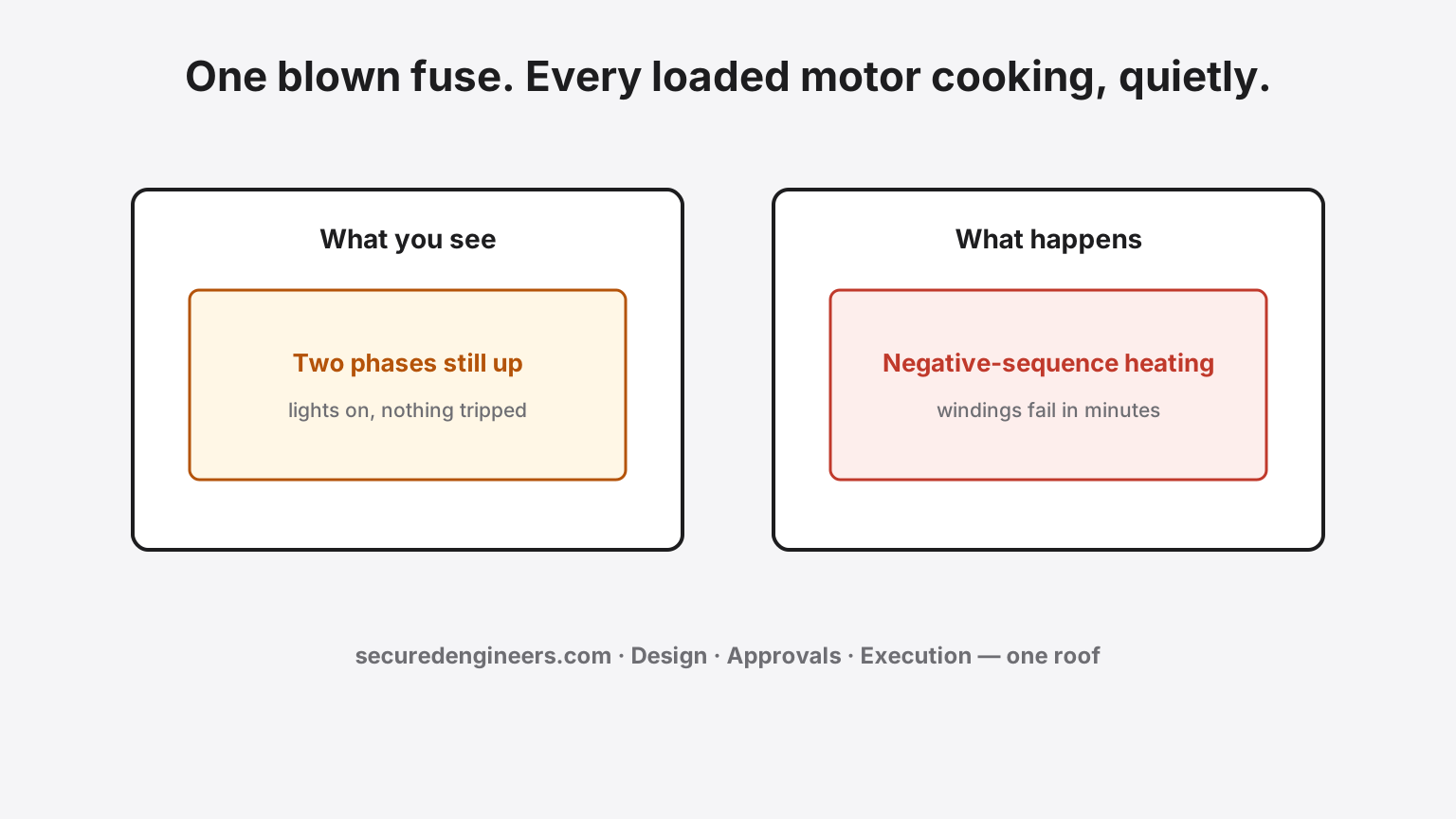
The event is almost boring: a fuse blows on one phase of an incoming feeder, or a loose jaw on a changeover contact opens R-phase somewhere upstream. Nothing trips. The lights on two phases stay on. And across the shopfloor, every loaded three-phase motor quietly begins to die.
This is single phasing, and it is one of the largest preventable causes of motor failure in Indian industry — precisely because it does not look like a fault while it is happening.
The physics: why a motor cooks instead of stopping
A three-phase induction motor under load, deprived of one phase, does not stall — it keeps producing torque on the remaining two phases. But the supply is now severely unbalanced, and an unbalanced supply feeds the motor negative-sequence current: a component that rotates against the rotor, does no useful work, and converts itself almost entirely into rotor and stator heat.
- Current in the surviving phases climbs steeply — for a loaded motor, well beyond nameplate.
- Heating rises with the square of current, so winding temperature runs away in minutes, not hours.
- Even modest sustained voltage unbalance is punished the same way — a few percent of voltage unbalance produces a disproportionately large current unbalance, which is why chronically unbalanced feeders shorten motor life even without a full phase loss.
The insulation does not explode; it ages in fast-forward. Motors "randomly" failing weeks after a supply event were often cooked in those minutes.
Why your existing protection probably misses it
| Device | What it protects against | Why it misses single phasing |
|---|---|---|
| MCB / MCCB / fuse at the starter | Short circuit, heavy overload | Phase-loss current may sit below the trip curve long enough to destroy the winding |
| Plain thermal overload relay | Balanced overload | Slow, and calibrated for three healthy phases; marginal on unbalance |
| Star-delta starter | Starting current | Actively worse: in delta, a lost line can leave windings misloaded while the motor runs on — and a phase lost during the star stage may simply stall-heat the motor |
| Contactor + push-button logic | Nothing electrical | Holds in happily on two phases |
The devices that do catch it are cheap and specific: phase-failure / phase-sequence relays on the board, electronic overload relays with unbalance and phase-loss elements at each starter, and for larger machines, motor protection relays that measure negative-sequence current directly and trip on it. VFD-driven motors get this protection inherently — the drive's input stage detects the loss — which is an underrated argument for drives on critical machines.
A protection audit you can run this month
- List motors above a few kW and mark their protection class — plain thermal bimetal vs electronic with phase-loss. The plain-bimetal list is your exposure.
- Fit phase-failure relays at distribution boards feeding motor groups — one relay guards the whole board when the loss is upstream.
- Check auto-restart behaviour: after a phase event, machines must not slam back on when the phase returns — reclosing into a hot, tripped line multiplies damage and is a safety issue.
- Log voltage unbalance at the incomer across a week. Persistent unbalance is a DISCOM conversation and a motor-life issue even with no outage at all.
- After any single-phasing event, thermograph the survivors — winding damage shows up as hot spots long before failure.
Chronic unbalance and poor power factor often travel together, and both show up on your bill. If your factory is paying PF penalties alongside burning motors, size the correction with our Power Factor Correction calculator — and if your transformer is running near its limit, check it against the Transformer Sizing calculator, because overloaded transformers and voltage unbalance are old friends.
What we do differently
Our electrical scope specifies motor protection by motor class, not by habit — electronic overloads with phase-loss elements as the floor, protection relays where the machine justifies them, and restart logic that fails safe. These are the checks that catch the exposure: unbalance logging at the incomer, protection-class inventory at the starters, thermography at the boards. One team, one accountability, and the burn-out season ends.
The three takeaways
- A motor losing one phase keeps running while it cooks — breakers and bimetal overloads are not designed to catch it.
- Phase-failure relays and electronic overloads are cheap insurance against a one-event fleet loss.
- Chronic voltage unbalance is slow single phasing — log it, and take the data to your DISCOM.
One burnt rewinding costs more than the audit. Book a Free Project Blueprint & Statutory Approvals Roadmap or call our electrical engineers on +91 70099 85817.
Related services
More insights
LT vs HT Connection for a Factory: Choosing the Supply for an Expansion
Whether a factory is supplied at LT or HT is set mostly by its contract demand and the state supply code. What changes when you cross the line — equipment, space, inspection, charges — and where to check.
ElectricalElectrical Safety Audit Before a Renovation or Expansion
An uneventful electrical system is not a verified one. Before a renovation or expansion adds load, document the installation, have competent people test it, and turn the findings into an evidence-ranked rectification scope — the additions themselves need inspector approval or self-certification before they are connected.
More on Electrical & Power · all insights