
The Cable Tray Was Full on Day One. Every Change After That Cost Money.
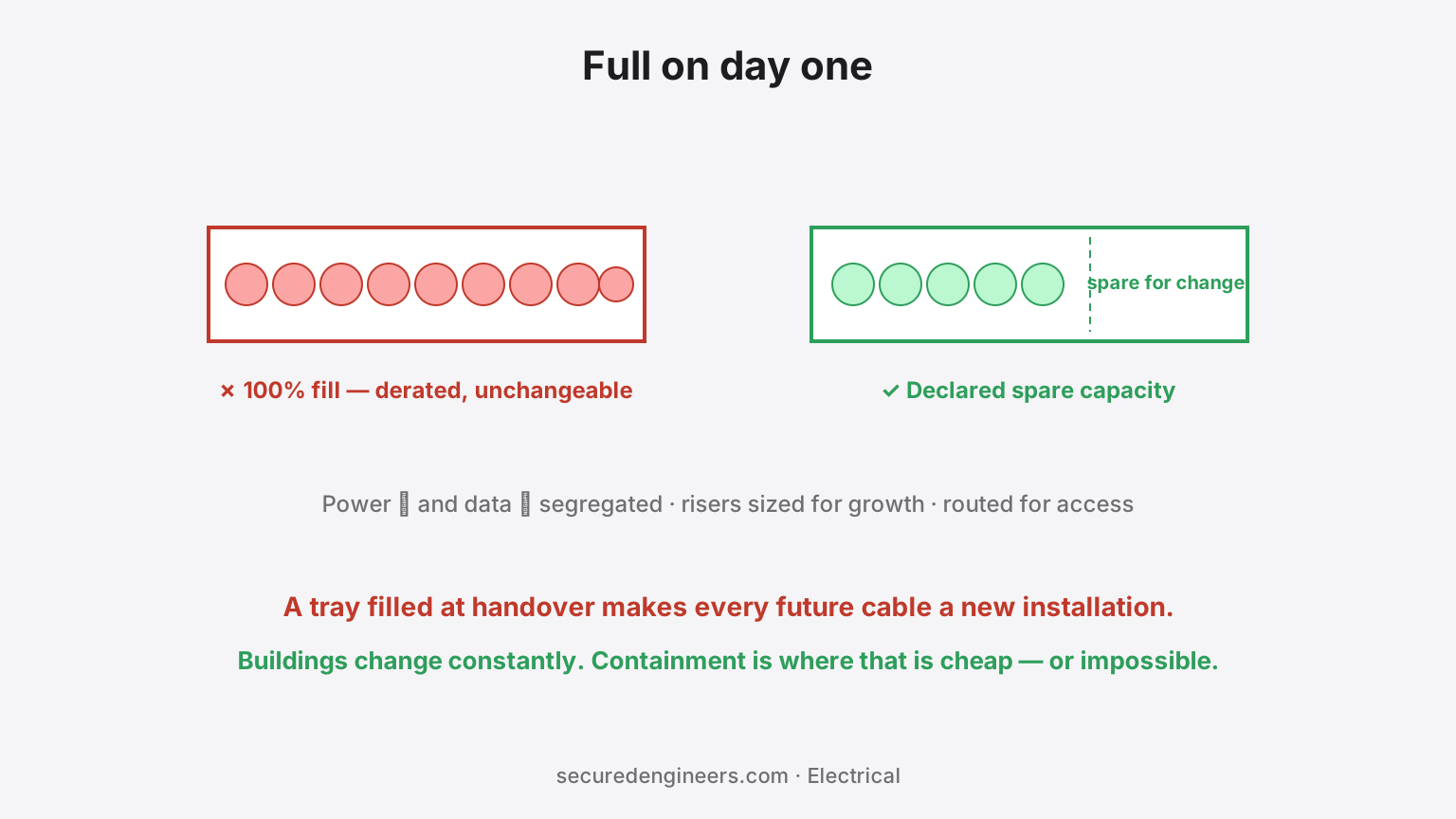
Cable containment is the least glamorous line in an electrical BOQ and one of the easiest to value-engineer. Trays, ladders, raceways and conduit are bought by the metre on rate, and a tray one size smaller across a large building is a visible saving that nobody appears to lose anything by taking.
What it actually buys is a building whose electrical system is finished. Containment sized with no spare capacity means every subsequent cable is a new installation rather than an addition — and buildings change constantly.
Fill is not the same as fit
A tray that physically accommodates today's cables is not a tray that is correctly sized. Three separate constraints apply:
- Spare capacity for change — an industrial or commercial building will add machines, extend circuits and re-feed panels many times. Containment planned at full fill on day one forces new routes for each change, at far higher cost than pulling into spare tray.
- Derating from grouping — cables bundled tightly in a full tray run hotter and carry less current than their standalone rating. A tray packed to its physical limit can quietly derate the circuits inside it, which is an electrical problem rather than a logistics one.
- Segregation — power and ELV or data cabling sharing containment invites interference and, depending on the systems involved, may not be acceptable at all. Fire-survival circuits have their own separation requirements.
The route matters as much as the size
| Route decision | What it costs later |
|---|---|
| Tray routed above fixed plant or ductwork | Cables cannot be added or replaced without dismantling something else |
| No access from a walkway or platform | Every future pull needs scaffolding or a lift, which is why it does not get done properly |
| Containment crossing a fire compartment without sealing | Breaches the compartmentation the fire scheme was approved on |
| Power and ELV in shared containment | Interference on data and control systems, discovered after commissioning |
| No spare capacity in vertical risers | The hardest and most expensive place in the building to add anything |
Why risers are the expensive mistake
Horizontal tray in a plant room is comparatively easy to extend. A vertical riser is not — it passes through floor slabs, it is fire-sealed at every level, and it is usually enclosed in a shaft sized to fit exactly what was originally planned. Under-provisioning a riser is the containment decision with the longest and most expensive consequences, and it is invisible on a rate comparison because a riser is a small quantity of the same material.
What to specify
Fix spare capacity as a requirement rather than a hope — a defined percentage of free tray width, and riser shafts sized for growth rather than for today's cable schedule. Segregate power from ELV and data at the containment stage rather than resolving it on site. Route for access, on the assumption that every cable in the building will eventually be replaced by somebody standing on a walkway. Conductor sizing itself is a separate question and often the one that decides the tray width — our cable size calculator covers ampacity and voltage drop together.
What we do differently
Containment is designed under our Electrical Infrastructure scope with declared spare capacity and segregation from the ELV systems design, so the building can be changed after handover without a new route for every cable.
More insights
The Plant Is Ready. The Power Isn't. Decoding HT Connection Delays in North India.
Machines installed, staff hired, trial orders waiting — and the HT connection is "under process" for the fourth month. Where connections actually get stuck at PSPCL, UHBVN/DHBVN and UPPCL/NPCL, which delays are the applicant's own fault, and how to run power as a critical path.
ElectricalNothing Has Tripped in Years. That Is Not the Same as Safe.
Factories treat an uneventful electrical system as a healthy one. An audit measures what an absence of incidents cannot tell you — and the findings are usually the same handful of things, quietly getting worse.