
Your Most Expensive Utility Is Whistling Away Through a Hundred Small Holes
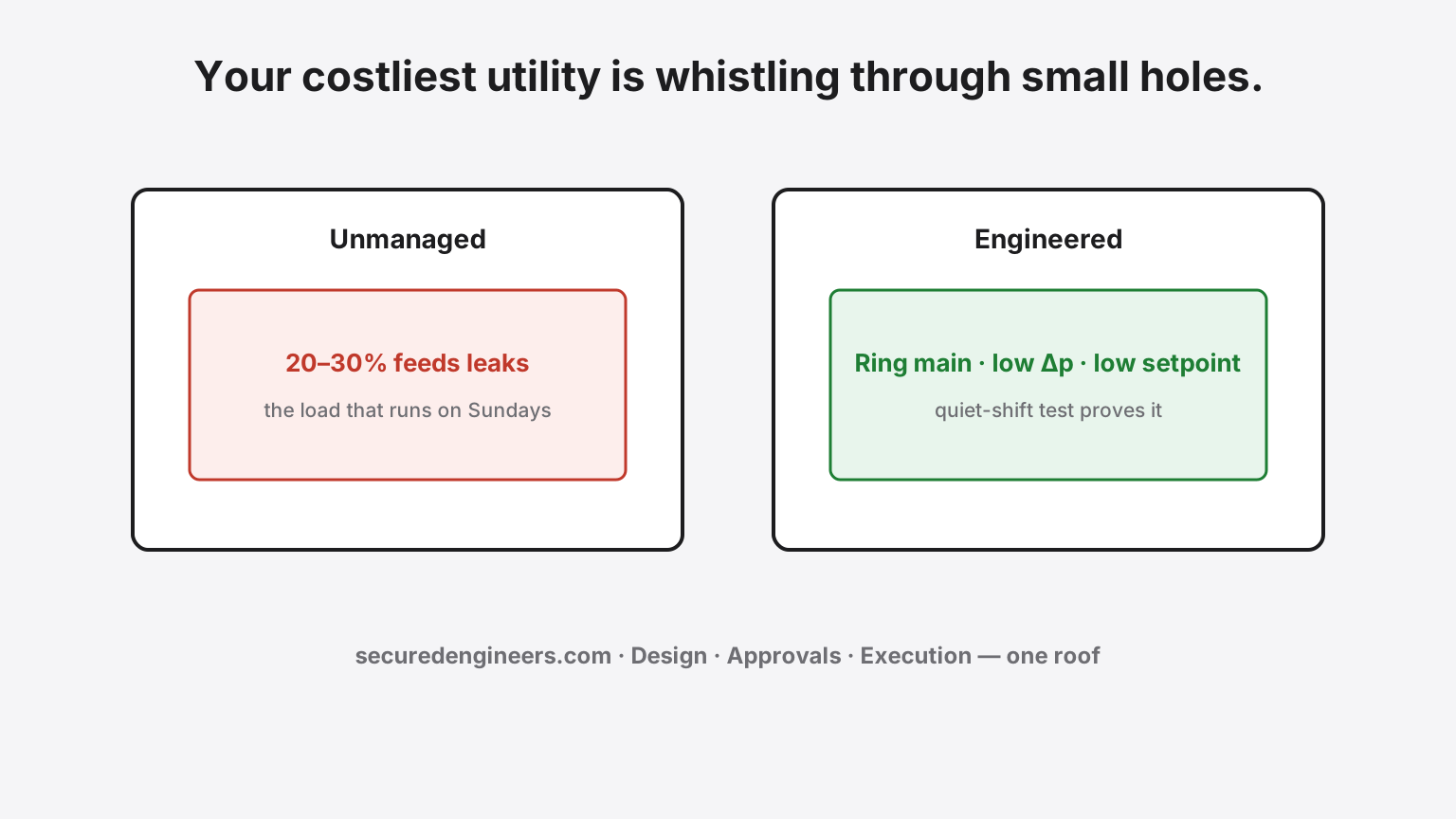
Nobody budgets compressed air. It has no meter of its own, no monthly bill, no line item — it hides inside the electricity bill as “compressor load” and inside the plant’s mental model as free. The engineering reality is the opposite: after motors and losses, only a small fraction of the electrical energy fed to a compressor comes out as useful work at the tool — compressed air is typically the most expensive form of energy a factory uses.
Which is what makes its two chronic diseases so costly: leaks, and pressure-drop-driven over-pressurisation. Both are curable with unfashionable engineering.
Leaks: the load that runs on Sundays
- The scale is not trivial: energy-audit experience across industries repeatedly finds 20–30% of compressor output feeding leaks in plants without a leak programme (an indicative band — measure your own, below). A single 3 mm hole at typical line pressure bleeds air worth lakhs of rupees a year in compressor energy.
- Measure it in one quiet shift: with production idle and all use-points closed, log how often and how long the compressor loads to hold the header pressure. The load/unload duty in that state is your leak fraction, near enough — a free audit any electrician can run.
- Find them systematically: ears find the big ones after hours; an ultrasonic leak detector finds the rest in a running plant — fittings, quick couplers, hoses, drain traps and thread joints are the usual suspects. Tag, list, fix, and re-run the quiet-shift test to bank the number.
- Keep them fixed: leaks regrow — quarterly ultrasonic walks and a norm that hissing is a defect, not ambience.
Pressure discipline: every extra bar taxes everything
Plants habitually raise header pressure to cure a starving machine at the far end. The tax is systemic: higher pressure increases compressor energy for every consumer and inflates every leak’s flow — as a working rule, each additional bar of generation pressure costs a mid-single-digit percentage of compressor energy, plus the enlarged leakage. The starving machine’s real problem is almost always pressure drop, which is a piping problem:
| Piping sin | What it does | The design answer |
|---|---|---|
| Long dead-end (radial) runs | Far machines see low pressure at peak flow | Ring main around the shop — flow reaches loads from two directions, halving effective drop |
| Undersized headers | Velocity and friction climb; drop grows with the square of flow | Size headers generously — pipe is cheap once; design to keep total drop from compressor to point-of-use small (a fraction of a bar, not a bar) |
| Hose-and-coupler jungles at machines | The last three metres eat more pressure than the last three hundred | Hard-pipe close to the machine; right-sized FRLs; couplers rated for the flow |
| No receivers near surge loads | Bursts drag the whole header down | Local receivers absorb bursts; the header sees the average |
| Moisture in the line | Corrosion, tool damage, product rejects | Dryer sized to actual dew-point need; sloped piping, top-entry take-offs, auto drains that are tested |
Fix the drops, then lower the setpoint stepwise until the most demanding machine defines it — that final setpoint reduction is where the money lands.
Generation-side sanity, briefly
- Match the trim machine to the load curve: a VFD compressor trimming on top of fixed-speed baseload machines removes the unload-run waste that eats part-load efficiency.
- Recover the heat: the overwhelming share of compressor input energy leaves as heat — ducting it to space heating, boiler make-up pre-heat or wash water is one of industry’s most boring, reliable paybacks.
- Stop misusing air: open-pipe blowing for cleaning and cooling is the single worst kWh-to-work conversion in the plant — engineered nozzles or blowers do the job for a fraction.
Compressed air rarely travels alone: the same audit that fixes it usually touches the plant’s wider electrical and mechanical services. Frame the whole-services budget with our MEPF Cost Estimator, and if the compressor house upgrade drags the electrical infrastructure with it, sanity-check the feeder with the Cable Size calculator.
What we do differently
Our mechanical utilities scope approaches compressed air as an energy system: quiet-shift leak quantification and ultrasonic survey first, ring-main and receiver redesign where the numbers demand it, setpoint rationalisation with production in the room — and the quarterly leak walk institutionalised through the AMC so the savings survive the year. One team, measured before and after.
The three takeaways
- Run the quiet-shift test this month — your leak fraction is one idle shift away from being a number.
- Cure far-end starvation with piping, not pressure — then lower the setpoint and bank it.
- Air is your costliest utility: leaks, open-pipe blowing and unrecovered heat are line items, not quirks.
Want the audit run properly? Book a Free Project Blueprint & Statutory Approvals Roadmap or call +91 70099 85817.
Related services
More insights
Land Got Expensive, So the Factory Went Vertical. The MEP Design Didn't Follow.
Multi-storey industrial buildings are becoming common as land prices push factories vertical instead of horizontal — but MEP design habits built for single-storey sheds don't automatically transfer. Fire compartmentation, vertical risers and floor-by-floor load all need rethinking.
IndustrialFactory Layout Decisions That Affect MEP Cost
A factory layout is drawn for production flow, but it also fixes cable and pipe lengths, plant-room positions, maintenance access and whether the next phase can be fed. The clearances, service routes and expansion allowances to check before the layout is frozen.
More on HVAC & Mechanical · all insights