
The Plant Is Ready. The Power Isn't. Decoding HT Connection Delays in North India.
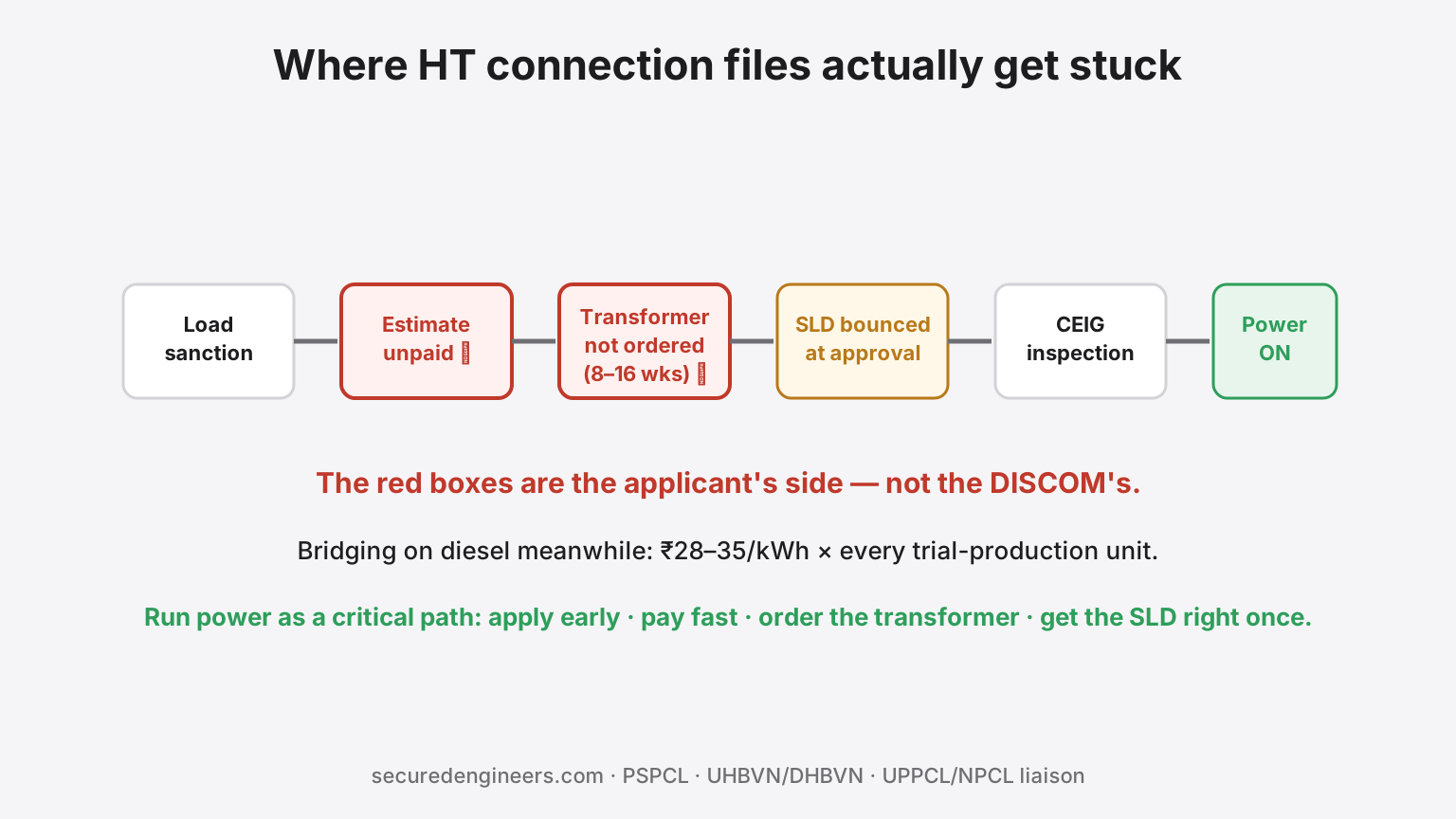
No delay in an industrial project is as expensive as the last one — and the last one is usually power. The building can be finished, the machines paid for, the fire NOC in hand — and none of it earns a rupee until the DISCOM charges your line.
HT connections across PSPCL (Punjab), UHBVN/DHBVN (Haryana) and UPPCL/NPCL (UP incl. Noida) follow the same skeleton: application → load sanction → cost estimate → your works + their works → drawing approvals → CEIG clearance → inspection → energisation. Understanding where files actually stall turns a black box into a managed critical path.
Where connections really get stuck
| Stage | Typical stall | Whose fault, honestly |
|---|---|---|
| Load sanction | Application load doesn't match the machinery list; feasibility flagged on an overloaded feeder | Applicant / network reality |
| Estimate & payment | Estimate sits unpaid while the project "finalises financing" | Applicant — silently burning weeks |
| Applicant's works | Substation civil, transformer procurement (8–16 week lead times), metering room not per spec | Applicant / vendor |
| Drawing approval | SLD bounced — protection ratings, metering arrangement, missing details | Applicant's consultant |
| CEIG | Inspection failed on earthing values, clearances, unlicensed execution | Applicant's contractor |
| DISCOM works | Line extension, bay allotment, right-of-way disputes across third-party land | DISCOM / land reality |
| Energisation | Metering (CT/PT) mismatch between what DISCOM installs and the approved SLD | Coordination gap — the classic final-week stall |
The uncomfortable audit finding: in most stuck files, more calendar days belong to the applicant's side than to the DISCOM's. The department's steps have citizen-charter clocks; your unpaid estimate and unbuilt metering room don't.
Running power as a critical path
- Apply early, against the machinery list. Load = calculated demand from real machines (with diversity), not a guess. Size the transformer with the transformer sizing calculator and keep the two consistent — mismatches between the DISCOM file, the DISH file and the CEIG drawings are self-inflicted bounces.
- Order the transformer the week the estimate is paid. It is the longest lead item you control; a plant waiting on its own transformer is not a DISCOM delay.
- Get the SLD right once. Protection coordination, metering arrangement, fault levels — a consultant who knows the local inspectorate's checklist saves two bounce cycles (ours does this daily: electrical infrastructure EPC).
- Run CEIG in parallel with construction, not after it — the drawing stage can complete while civil work runs.
- Pre-agree the metering arrangement with the DISCOM's metering wing before installation week.
- Track the file weekly, in writing, through the portal and the SDO/XEN office both — polite persistence with complete papers is the entire liaison secret.
Bridging the gap (and its real price)
Plants bridging a late connection on DG power pay the ₹28–35/kWh diesel tax on every trial-production unit — a 90-day slip on a 500 kW load can burn ₹25–40 lakh in diesel alone. That number, put in front of management early, is what gets the estimate paid and the transformer ordered on time.
FAQs
How long should a new HT connection take?
With complete papers, funded estimate and ready applicant works: commonly 2–4 months end-to-end for a standard 11 kV industrial connection; longer where line extension or ROW is involved. The variance is mostly in the applicant-side items.
What is the difference between load sanction and energisation?
Sanction approves your demand on the network; energisation is the physical charging of your metered connection after works, approvals and CEIG clearance. Everything between the two is the critical path this article maps.
Can we start on temporary/LT supply?
Often yes for fit-out loads — but running production on temporary supply or DG is an economics decision that rarely survives the arithmetic above.
Do you handle the entire power package?
Yes — substation design and build, transformer procurement, SLD and CEIG file, DISCOM liaison to energisation, as one scope with one owner. Scope it here.
Related services
More insights
The DG Set Is Installed and Tested. The Inspectorate Still Has Not Cleared It.
A DG set is commonly treated as equipment you buy and commission. Where it falls within the electrical inspectorate scope, it is an installation requiring approval before energisation — and the drawings, not the machine, are what get scrutinised.
ElectricalCan Your Existing Panels and Cables Carry the New Machines?
Whether existing panels and cables can take new machinery is decided by measured demand, the ratings and condition of what is installed, and what the extra load does to protection and fault levels — not by the spare ways on a distribution board.
More on Electrical & Power · all insights