
Your Shopfloor Is Probably Lit Wrong in Both Directions at Once
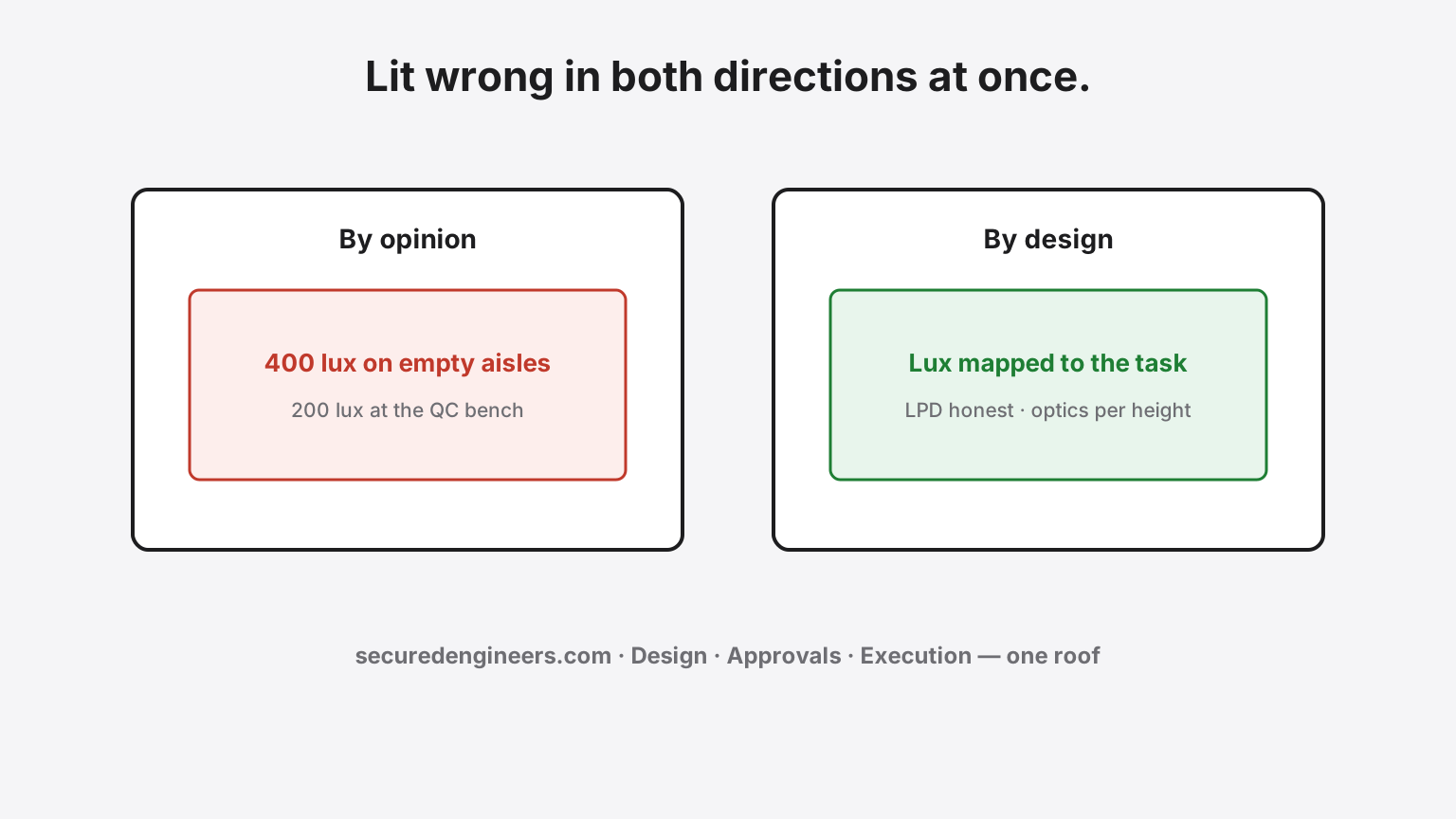
Lighting is the most democratic system in the factory — everyone has an opinion, because everyone has eyes. Which is exactly why it is usually designed by opinion: fixtures bought by wattage, spaced by symmetry, and judged by whether the shed "looks bright". A lux meter tells a different story, and it usually tells two at once: too little light where precision work happens, too much where nothing happens — paying energy for the second failure without curing the first.
Design to the task, not to the shed
Indian practice (IS/NBC-aligned illumination schedules) assigns lux by task, and the honest design maps the floor by activity before choosing a single fixture:
| Area / task | Working lux band | Notes |
|---|---|---|
| Warehouse aisles / bulk storage | 100–200 | Vertical illuminance on rack faces matters more than floor lux |
| General assembly / machine shops | 300–500 | The factory default band |
| Fine assembly / inspection / QC benches | 750–1,000+ | Deliver locally with task lighting — flooding the hall to 1,000 is the classic energy blunder |
| Packing / dispatch | 200–300 | Label-reading is the task |
| Corridors, utilities, plant rooms | 100–200 | Plus emergency-lighting coverage as its own layer |
(Bands are standard working practice — where a client specification or the notified schedule for your occupancy differs, that document governs.)
- Uniformity beats peak: a floor swinging between 150 and 600 lux tires eyes and hides defects at the transitions; aim for even coverage within each task zone.
- Glare is a design output: high-bay point sources in the sightline of forklift operators are a safety issue, not an aesthetic one — optics and mounting geometry, not diffuser films, are the fix.
- Colour rendering counts where colour is the task — paint shops, textiles, QC: specify CRI deliberately there and save the premium elsewhere.
The two numbers procurement never applies
- Maintenance factor: designs must deliver the target lux at end of maintenance cycle — after LED depreciation and, dominantly in Indian industry, dirt on fixtures. Designing at a realistic maintenance factor (dusty plants sit at the punishing end) is why a fresh install should read comfortably above target. The corollary is a cleaning schedule for luminaires: a year of shopfloor dust can eat a third of your light — the cheapest relight in existence is a cloth.
- LPD — lighting power density: the ECBC disciplines watts per square metre for covered buildings; even where your building falls outside its ambit, LPD is the honest efficiency metric. Modern LED high-bays deliver 130–160+ lm/W — if a proposal's W/m² looks generous, it is either curing bad optics with wattage or lighting the roof structure beautifully.
High-bay engineering: height changes everything
- Optics follow mounting height: narrow-beam optics from 12 m put light on the floor; wide-beam optics from the same height put it on the walls and in everyone's eyes. Aisle-optic fixtures exist precisely for racking — light the vertical faces, skip the rack tops.
- Fixture count vs wattage: fewer, bigger fixtures save capex and worsen uniformity and shadowing under crane rails and ducts; the photometric layout (a free service from any serious supplier — demand the file, not the claim) settles it honestly.
- Controls that survive a factory: daylight harvesting under sheet-roof skylights, occupancy dimming in low-traffic aisles, and circuiting that lets a half-shift run half a hall — simple relay/DALI zoning pays; fragile complexity dies in year two.
- Serviceability: every fixture at 12 m is a boom-lift event — drivers' 50,000-hour ratings matter less than whether the fitting is a sealed unit you must scrap or a serviceable one, and whether you kept spares from the original batch (LED colour drift makes mixed-batch replacements visibly patchy).
Do the arithmetic before the catalogue: our Lighting / Lux calculator turns area, target lux and fixture lumens into counts and connected load — the number your transformer and energy budget actually see.
What we do differently
Our electrical scope delivers lighting as photometric engineering: task-mapped lux schedules, layouts proven in calculation files, LPD declared against ECBC, glare and aisle optics chosen for the racking plan — and the luminaire-cleaning cycle written into the AMC, because the cheapest lumen is the one you wipe back into service.
The three takeaways
- Map tasks first, light second — local task lighting at benches beats flooding the hall, in both lux and rupees.
- Design at a realistic maintenance factor and clean on schedule — dirt is the biggest lighting downgrade in Indian industry.
- Demand the photometric file — W/m² and uniformity are calculable; brightness opinions are not.
Relighting a hall or building a new one? Book a Free Project Blueprint & Statutory Approvals Roadmap or call +91 70099 85817.
Related services
More insights
Every Meter Reads Normal. Your Neutral Is Still Overheating. That's What Harmonics Do.
VFDs, LED drivers, UPS units and solar inverters have quietly filled modern plants with non-linear loads — and the harmonic distortion they inject overheats neutrals and transformers, trips sensitive equipment and kills capacitor banks. A standard electrical audit won't see any of it; a power-quality audit is built to.
ElectricalUPS Planning for Critical Factory and Office Loads: Size the Gap, Not the Outage
A UPS earns its cost in the seconds and minutes between a disturbance and the DG or grid taking over. Plan it from a load and autonomy schedule, keep the load within both its kW and kVA limits, choose topology and bypass for the duty, and size the battery for its end of life.
More on Electrical & Power · all insights