
Every Meter Reads Normal. Your Neutral Is Still Overheating. That's What Harmonics Do.
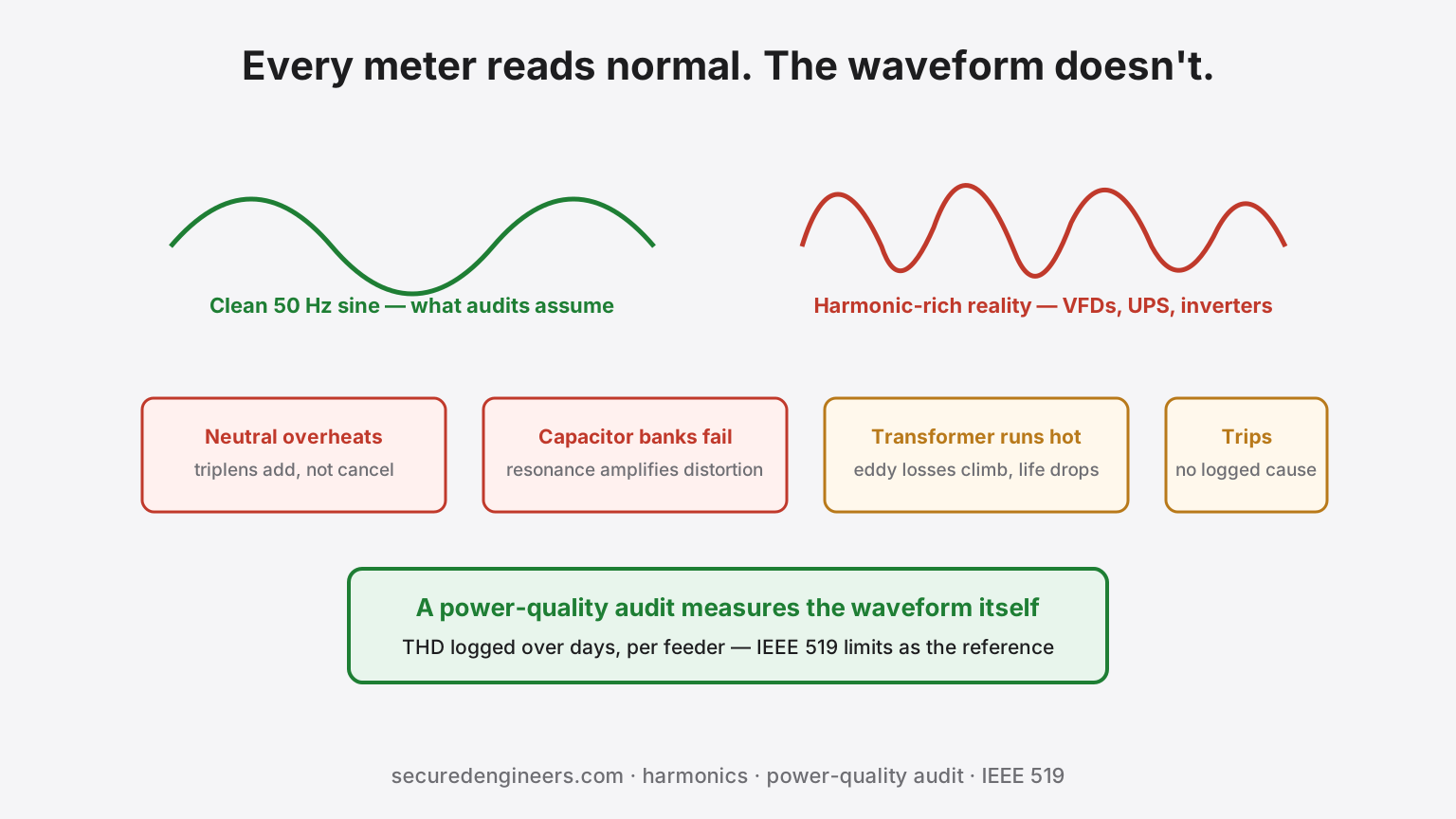
Twenty years ago a factory's electrical load was mostly motors connected straight to the supply — linear loads drawing clean sinusoidal current. Walk the same plant today and almost nothing connects directly anymore: motors sit behind VFDs, lighting behind LED drivers, IT and controls behind UPS units, and a rooftop solar plant feeds in through inverters. Every one of those power-electronic front ends chops current rather than drawing it smoothly, injecting harmonics — currents at multiples of the 50 Hz fundamental — back into your distribution system. Individually each source is small. Summed across a modern plant, harmonic distortion becomes a real electrical load that no nameplate accounts for.
What harmonics actually break
- Overheated neutrals — triplen harmonics (3rd, 9th…) from single-phase electronic loads don't cancel in the neutral the way balanced fundamental currents do; they add. A neutral conductor sized on the classical assumption of near-zero neutral current can run hotter than the phases feeding it — a failure mode adjacent to the sizing traps in our cable sizing guide, and invisible to a clamp meter reading only RMS amps.
- Transformer heating and derating — harmonic currents drive up eddy losses disproportionately, so a transformer serving a harmonic-rich load runs hotter at the same kVA and ages faster. Plants either buy K-rated capacity or unknowingly derate the transformer they have.
- Capacitor bank failures — power-factor correction capacitors present low impedance at harmonic frequencies and can form resonant circuits with system inductance, amplifying distortion into the very equipment installed to save money. Repeatedly failing capacitor cells are one of the most reliable field signatures of a harmonic problem — worth checking before simply re-sizing the bank with our power factor correction calculator.
- Nuisance tripping and control faults — distorted voltage waveforms confuse electronics that expect clean zero-crossings: CNC controls faulting without logged cause, breakers tripping below setpoint, sensitive instrumentation drifting.
- Penalties where DISCOMs meter it — harmonic limits appear in supply codes and grid-connection conditions, and metering of distortion at industrial connections is spreading. Where enforced, exceeding limits draws penalties or connection-compliance notices — one more line item that arrives without warning.
Why your last electrical audit didn't see this
A standard electrical audit measures RMS quantities — voltage, current, power factor, loading — with instruments that summarise the waveform rather than analyse it. Harmonic distortion hides inside those summaries. A power-quality audit instruments the system differently: recording analysers logging waveform data over days at the incomer and major panels, producing the numbers that actually describe the problem.
| Measurement | What it tells you |
|---|---|
| Voltage THD at incomer and panels | How distorted the supply everything shares has become; IEEE 519 — the internationally used reference — frames limits around roughly 5–8% for most industrial voltage levels |
| Current THD per feeder | Which loads are injecting the distortion — VFD banks, UPS clusters, inverter feeds — so mitigation targets the source |
| Individual harmonic spectrum | Which orders dominate; the fix differs for 5th/7th (typical of drives) vs triplens (single-phase electronics) |
| Neutral current and temperature | Direct evidence of triplen accumulation before insulation damage announces it |
The solar inverter wrinkle
Rooftop solar adds a twist worth naming, because it is now on a large share of North Indian industrial roofs. Modern string inverters are individually clean — reputable units hold their own current distortion low at rated output — but they interact with what the plant already has. Inverter output filters can resonate with existing power-factor-correction capacitors; distortion rises at low loading, so a large inverter fleet idling through a cloudy afternoon behaves differently from the datasheet's full-power figure; and the plant's harmonic profile now changes with the weather, which makes single-snapshot measurements actively misleading. None of this is an argument against solar — it is an argument for measuring power quality after a solar plant is commissioned, over days that include both clear and overcast generation, rather than assuming the pre-solar audit still describes the system. Facilities that added solar, then began losing capacitor cells or seeing unexplained trips, are describing a sequence we now hear often enough to treat as a pattern.
Fixes are targeted, not exotic
Once measured, mitigation is a menu with well-understood price points: line reactors on drives, passive tuned filters for a dominant harmonic order, active harmonic filters where the load mix shifts, detuned reactors protecting capacitor banks from resonance, oversized or doubled neutrals on electronics-heavy circuits. The engineering is in matching the fix to the measured spectrum — buying an active filter for a problem a detuning reactor would solve wastes money in exactly the way skipping the audit invites.
Power-quality instrumentation matters for precisely this reason: the failures that repeat — capacitor cells, warm neutrals, unexplained trips — are usually one measurement campaign away from an explanation.
More insights
Grid Down. DG Running at 70% Capacity. 40 Tenants. Who Gets Power First?
Your building's DG covers 70% of connected load — an entirely normal design ratio. The day the grid actually fails, that 30% gap becomes a very personal argument between 40 tenants, none of whom knew where they stood in the queue. Backup power allocation is a policy decision, not an electrical one — and most buildings never make it.
ElectricalYour DG Is a ₹30/kWh Habit. Here Is What Every Unit Actually Costs.
Factories treat the DG as free backup and the bill as fate. Line up diesel, grid and rooftop solar on one table and the picture is brutal: every DG hour is the most expensive electricity you will ever buy. The honest per-unit economics, and the load strategy that follows.