
The Leak Started in March. You Found It in the August Water Bill.
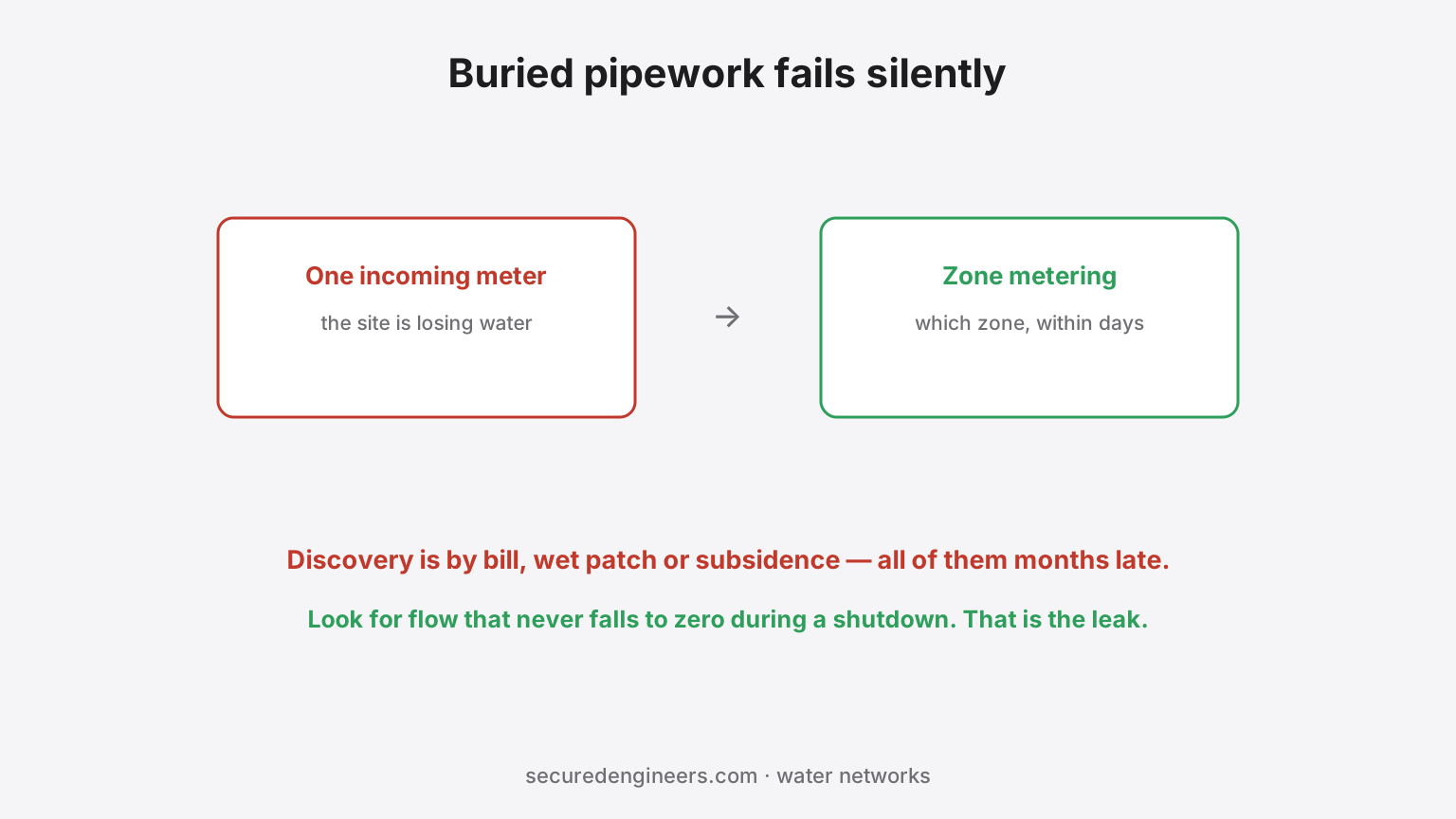
Water pipework on an industrial site runs buried across the plot, cast into slabs, and concealed in shafts. When a joint fails, nothing announces it. The water goes into the ground and keeps going.
Detection is usually accidental and late: a bill that has crept up, a soft patch of ground, subsidence near a foundation, or a pressure complaint at the far end of the site. By then the loss has been running for months, and on a buried main it may have been undermining something.
The detection method that actually works
The most reliable indicator is not a sensor on a pipe — it is consumption that never falls to zero. Almost every facility has a period with no legitimate demand: a night shift gap, a weekly off, a plant holiday. Flow during that window is, by definition, either an unclosed valve or a leak.
That is why zone metering plus continuous logging finds more than acoustic hardware alone. You are not looking for a noise; you are looking for a floor in the flow trace that should be zero and is not.
| Signal | What it usually means |
|---|---|
| Non-zero flow during shutdown | A leak, or a valve left open — both worth finding |
| Night-flow floor rising month on month | A leak developing, before it becomes visible |
| One zone's floor rising, others flat | Localises the search to a section of the network |
| Pressure dropping at the far end under normal demand | Loss upstream, or a partially closed valve |
| Sudden step change | A joint has let go rather than seeped |
Why zoning matters more than sensor count
A single meter on the incoming supply tells you the site is losing water and nothing about where. The same spend divided into zone meters — per building, per block, per process area — turns an unbounded search into a bounded one. Localisation is most of the cost of leak repair on a large plot; the digging is comparatively cheap once you know where.
What the loss actually costs
Rarely just the water. On an industrial site the compounding costs are the ones that hurt: pumping energy for water that never arrives, ground saturation near foundations and floor slabs, and — where supply is restricted or tankered — production impact when pressure fails at the wrong moment. A leak that is trivial as a volume can be expensive as a consequence.
Where to start
If the site has no zone metering, that is the first intervention rather than sensors. If it does, pull the flow trace across the last shutdown period and look for the floor. Most facilities that have never done this find something on the first attempt.
What we do differently
We design zone metering into the water network under Plumbing & Public Health so losses can be localised rather than merely observed, with monitoring integrated through ELV systems — and where a site is already losing water, an AMC survey starts with the shutdown flow trace.
More insights
Land Got Expensive, So the Factory Went Vertical. The MEP Design Didn't Follow.
Multi-storey industrial buildings are becoming common as land prices push factories vertical instead of horizontal — but MEP design habits built for single-storey sheds don't automatically transfer. Fire compartmentation, vertical risers and floor-by-floor load all need rethinking.
IndustrialYou Are Treating Water to Drinking Standard and Flushing With It.
Industrial facilities buy or extract water once and use it once. Greywater recycling separates the streams that do not need potable quality — flushing, landscape, cooling make-up — and is increasingly a consent condition rather than a choice.