
The Transformer Fit Day-One Load Perfectly. Then You Grew.
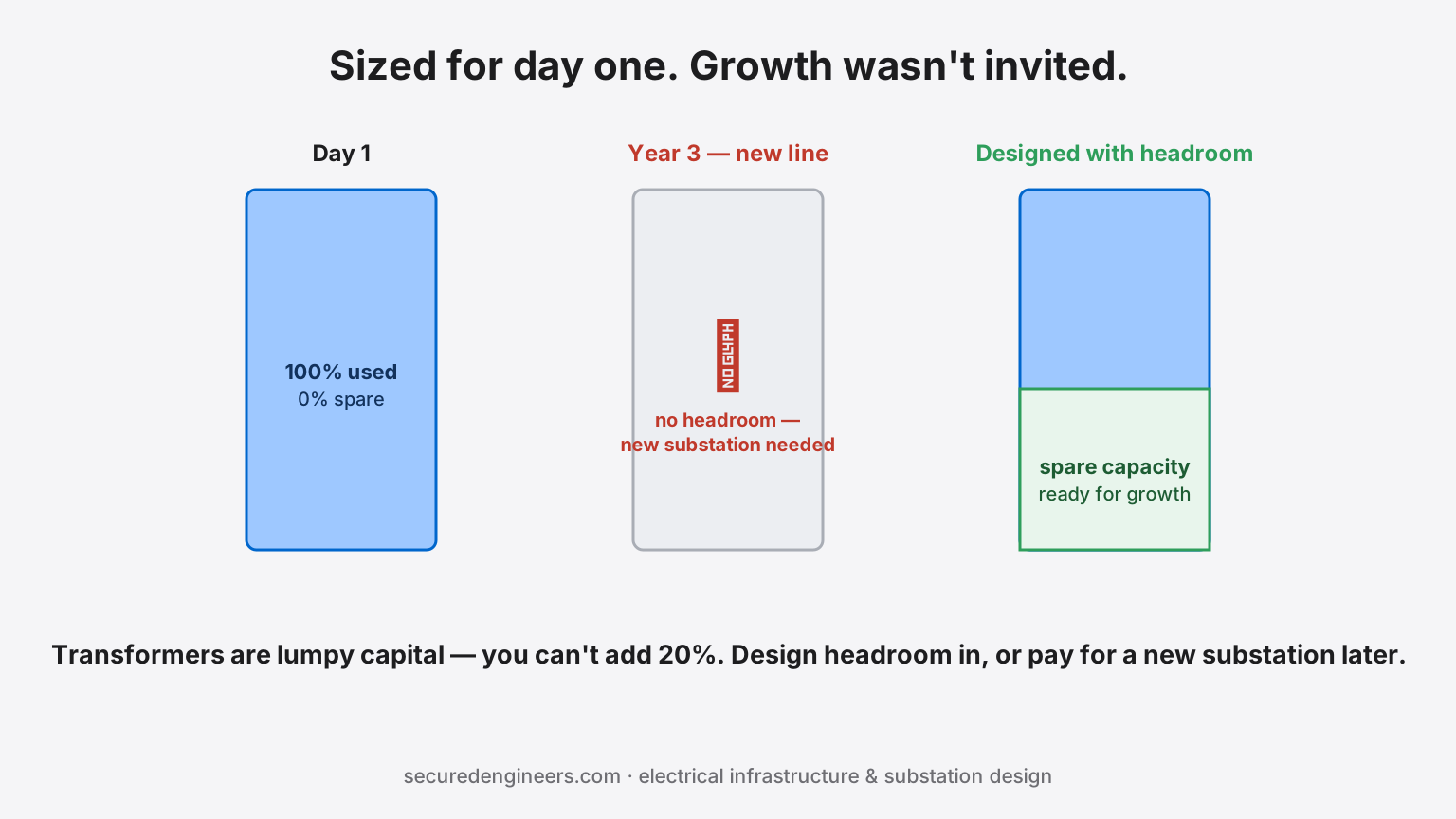
A transformer sized to exactly match a factory's opening-day connected load looks like good engineering discipline on a cost sheet — no wasted capacity, no "over-design," a tight capital number. It is also, in a very large share of industrial and commercial projects, a bottleneck with a delivery date already stamped on it: the day the business grows.
Industrial and commercial facilities grow. New production lines get added, a second shift starts, cold storage capacity doubles, a server room appears where a store room used to be. Every one of those changes needs electrical capacity — and a substation with zero headroom turns "add a line" into "build a new substation," at a cost and timeline nobody budgeted for.
Why exact-load sizing is a false economy
- Transformers are lumpy capital, not incremental. You cannot add 20% more capacity to an existing transformer — you replace it, or add a parallel unit, both of which cost far more than the marginal capacity would have cost if designed in from the start
- Substation civil works are sized around the transformer, not the other way round — a substation room, ventilation, and switchgear bay built tight to a specific transformer size often can't physically accommodate a larger replacement without civil rework
- The DISCOM connection and sanctioned load are tied to the original capacity — expanding later means re-running the load-enhancement approval process, with its own months-long timeline, on top of the physical works
- Growth is rarely announced years in advance — the second shift or the new customer order that drives expansion typically arrives on a commercial timeline, not an electrical-infrastructure timeline, and the business absorbs the mismatch as delay
What proper headroom actually looks like
| Design element | Common under-design | Better practice |
|---|---|---|
| Transformer capacity | Sized to exact calculated day-one load | Sized with a deliberate growth margin, based on realistic 5–10 year expansion plans, not just opening-day metering |
| Substation room | Sized to fit the day-one transformer exactly | Civil space allowed for the next transformer size up, even if not installed immediately |
| Switchgear & panel spare ways | Fully populated, zero spare breaker slots | Deliberate spare ways for future feeders without a panel replacement |
| Cable trays & conduit routes | Sized tight to day-one cable count | Routes and trays sized with fill-capacity headroom for future cabling |
| DISCOM sanctioned load | Applied for at exact calculated need | A modest buffer requested where the tariff/demand-charge structure makes it economical to do so |
None of this means over-building blindly — a transformer sized for imaginary future load nobody can articulate is its own waste. The discipline is sizing against a realistic expansion plan, discussed explicitly with the business at design stage, not defaulting to either extreme.
The conversation that should happen at design stage
The electrical engineer cannot size for growth the business hasn't described. This means the design brief needs an honest answer to questions that often don't get asked: Is a second production line plausible in the next five years? Is a second shift likely? Is there a plan — even tentative — for capacity expansion, additional cold storage, a server room, EV charging infrastructure? These conversations cost nothing and change the sizing decision materially. Our electrical design team asks them explicitly during load calculation, specifically because the transformer decision is the hardest one to walk back later.
What retrofitting undersized capacity actually costs
When growth outpaces an undersized substation, the realistic paths are: a full transformer replacement (civil rework if the room doesn't fit the new size, a new DISCOM load-enhancement application, and production downtime during changeover); a parallel second transformer (if space allows, avoiding some rework but adding switchgear and paralleling-protection complexity); or bridging the gap on diesel power while the proper fix is executed — the most expensive option per unit of energy, chosen only because the alternatives take months. All three cost substantially more, and take substantially longer, than the headroom would have cost as a design-stage decision.
FAQs
How much spare transformer capacity should I design in?
There's no universal percentage — it depends on realistic growth plans discussed at design stage. The discipline is an explicit conversation about expansion plans, not a default margin applied blindly.
Can a transformer be upgraded without rebuilding the substation?
Sometimes, if the room and switchgear were sized with headroom in mind. If the room was built tight to the original transformer's exact footprint, a larger unit often needs civil rework.
Does requesting a higher DISCOM sanctioned load cost more even if unused?
Demand-based charges typically apply to sanctioned load whether or not it's used, so the buffer should be modest and considered against the tariff structure — not simply maximised. This is a genuine cost-benefit calculation, not a "size it big" default.
How long does adding substation capacity take once growth is already needed?
Commonly several months to a year including civil works, equipment procurement (transformers can have long lead times), and DISCOM approval — which is precisely the gap that headroom planning avoids.
Can you review our substation design for growth headroom?
Yes — load calculation, growth-scenario discussion and substation sizing as one exercise. Scope it here.
More insights
Your Panel Passed Inspection. Its Breakers Are Rated Below Your Actual Fault Current.
A breaker that trips fine on overload can still fail catastrophically on a real short circuit if its interrupting rating is below the site's actual fault level. Fault-level coordination is the study most factory panels never get — until an incident makes it mandatory retroactively.
ElectricalWhat to check during electrical testing and commissioning
Energisation is earned by test records. The tests our electrical engineers run — and the values they record — before a factory's installation is offered to the Electrical Inspector and the DISCOM.