
Lithium-ion Batteries Don't Fail Like Lead-Acid. Your UPS Room Wasn't Designed for That.
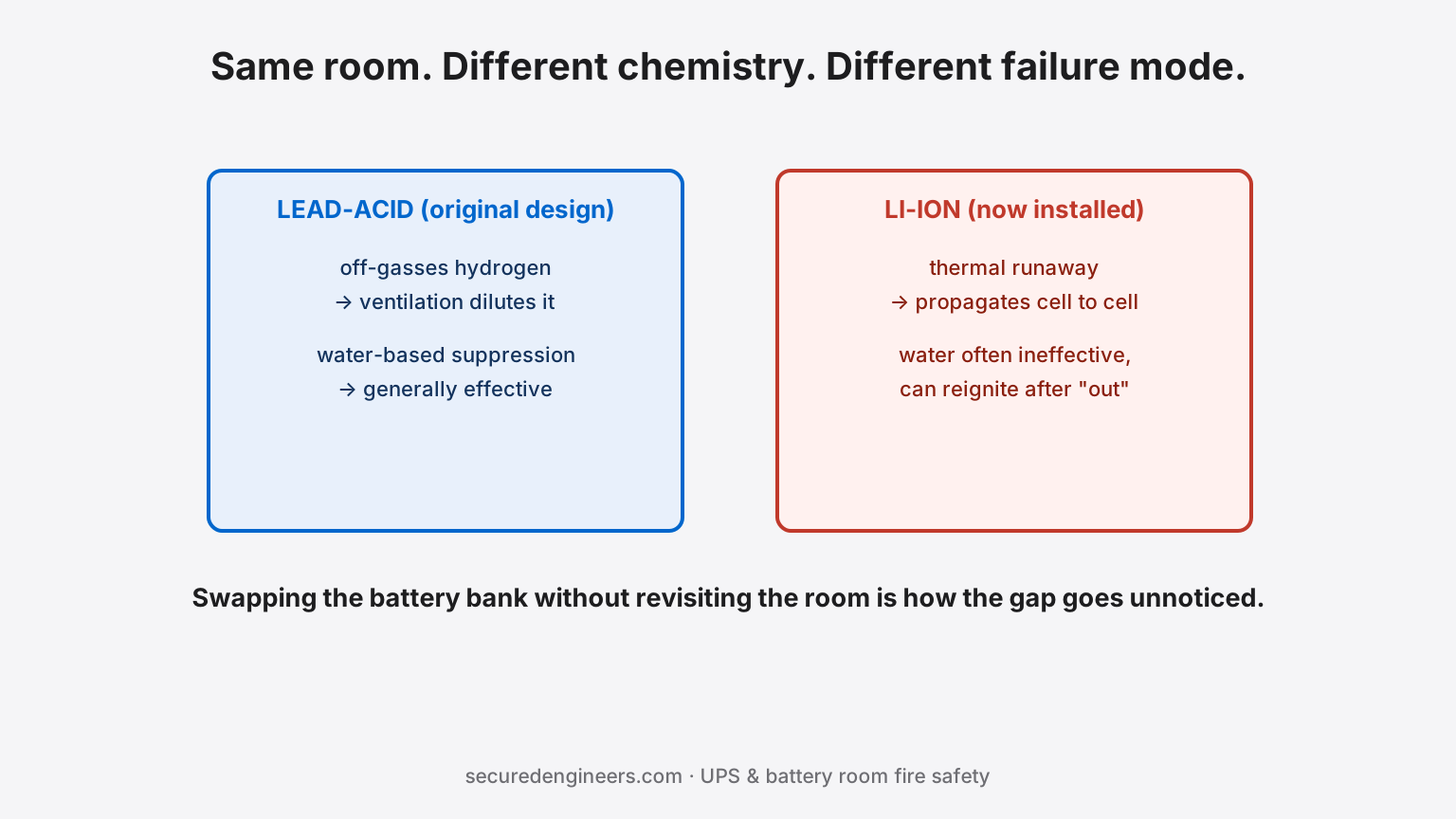
Lithium-ion UPS batteries are winning on every practical metric — smaller footprint, lighter weight, longer cycle life, less maintenance than lead-acid. Facility teams are switching to them, sometimes room by room as old lead-acid banks reach end of life, often without revisiting whether the room itself — its ventilation, its detection, its suppression system, its physical segregation — was ever designed for the failure characteristics of the chemistry now sitting inside it.
This matters because li-ion batteries don't fail the way lead-acid batteries fail. A lead-acid battery under stress off-gasses hydrogen, which is why battery rooms are ventilated for hydrogen dilution. A lithium-ion cell under stress can enter thermal runaway — a self-sustaining, escalating heat reaction that can propagate cell to cell, release toxic and flammable gases, and reignite after apparent extinguishment. A room correctly designed for lead-acid is not automatically correct for li-ion, and swapping the battery bank without revisiting the room is exactly how the gap goes unnoticed.
Where the lead-acid room design assumption breaks down
| Design element | Lead-acid assumption | Li-ion reality |
|---|---|---|
| Ventilation | Sized to dilute hydrogen off-gassing | Needs to address thermal runaway gas venting, a different hazard profile entirely |
| Detection | Standard smoke/heat detection, often at room level only | Early off-gas or thermal detection at the rack level catches runaway before visible smoke or flame |
| Suppression | Water-based systems generally effective | Water can be reapplied and is often ineffective at fully stopping cell-to-cell propagation; suppression strategy needs specific evaluation for the chemistry and rack configuration installed |
| Physical segregation | Single room, general clearances | Rack spacing and compartmentalisation to limit propagation between modules is a specific design input, not an afterthought |
Why this gap forms so easily
- The battery swap is treated as a procurement decision, handled by whoever manages the UPS contract — not routed through a fire-safety design review the way a new battery room installation would be
- Existing rooms get reused without re-evaluation — the room "already has a UPS in it," so a like-for-like battery replacement doesn't trigger the scrutiny a new installation would get
- The building's general fire AMC doesn't cover chemistry-specific requirements — the same documentation gap seen in fire AMC neglect, where a system that looks maintained on paper was never actually evaluated against what it's now protecting
- Li-ion adoption in data centres and server rooms is accelerating fastest exactly where critical-room redundancy and precision cooling already demand careful engineering — adding a battery-chemistry blind spot to an otherwise well-specified room
What a proper li-ion UPS room review covers
- Manufacturer-specific thermal runaway data for the actual battery model installed — chemistry and pack design vary enough between vendors that generic li-ion guidance isn't sufficient on its own
- Detection strategy matched to the failure mode — early off-gas or rack-level thermal sensing, not general area smoke detection alone
- Suppression system evaluated for compatibility with the specific battery installation, rather than assumed adequate because a suppression system of some kind is present
- Rack spacing and compartmentalisation reviewed against the room's actual layout, not the generic clearance the room was originally built to
- Ventilation re-assessed for the gas hazard profile of the installed chemistry, not inherited unchanged from the room's lead-acid design
The suppression-system-as-dedicated-discipline logic that applies to commercial kitchen fire protection applies just as directly here — a battery room's fire protection needs to be specified against the actual hazard installed, not inherited from whatever was in the room before. Our fire protection team reviews UPS and battery rooms specifically against installed battery chemistry, alongside our electrical infrastructure scope for the room's power design.
FAQs
Do lithium-ion UPS batteries need a different room design than lead-acid?
Yes — ventilation, detection and suppression strategy should be evaluated against thermal runaway characteristics specific to li-ion, not inherited unchanged from a lead-acid room design.
Is water-based suppression effective for a lithium-ion battery fire?
It's not automatically reliable against cell-to-cell thermal runaway propagation — suppression strategy needs specific evaluation for the installed battery chemistry and rack configuration rather than assumed adequacy.
Does replacing lead-acid batteries with li-ion in an existing room require a fire safety review?
It should — even though it can look like a like-for-like equipment swap, the room's ventilation, detection and suppression design assumptions may no longer match the installed hazard.
Can you review our UPS or battery room for li-ion fire safety compliance?
Yes — a chemistry-specific review of detection, suppression and ventilation design. Request a review.
More insights
Hydrants, Sprinklers or Both? The Question Is Not Preference.
Building owners often treat fire systems as a budget decision — hydrants are cheaper, sprinklers are thorough. It is not a preference. Occupancy classification and hazard class decide what is required, and guessing wrong is discovered at fire-scheme approval.
Fire SafetyGrease Fires Don't Ask Permission. Does Your Kitchen Hood Have a Suppression System?
Commercial kitchen fires start where general fire codes barely look — the exhaust hood, the grease-laden ductwork, the fryer line. A hotel or restaurant kitchen needs its own dedicated fire suppression system, its own exhaust cleaning schedule and its own inspection regime, distinct from the building's general fire protection. Most hotels discover the gap during an insurance audit, not before.