
STP vs ETP for Industrial Wastewater: What an Expansion Needs
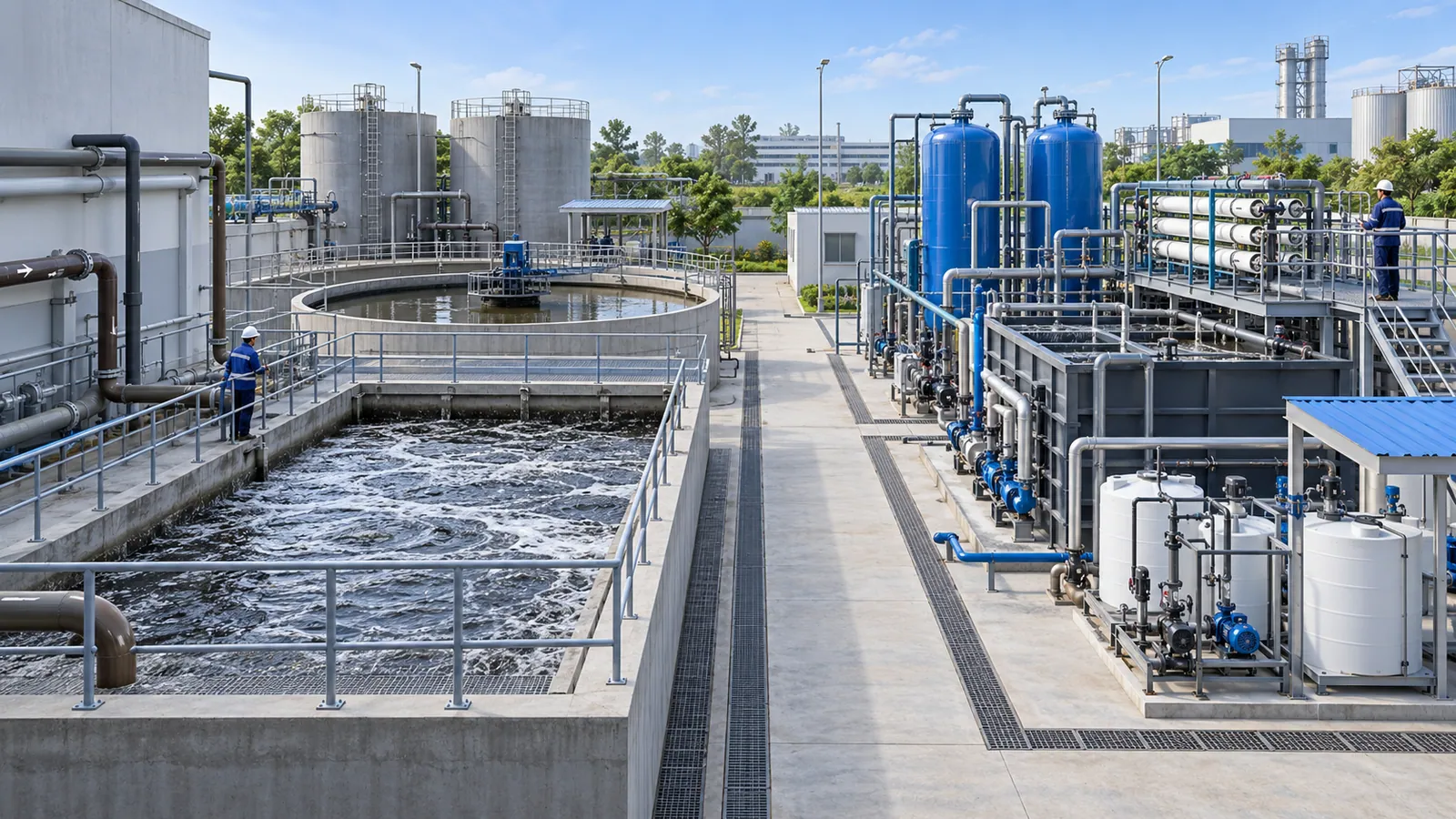
"Do we need an STP or an ETP?" usually means the plant is about to grow and someone has looked at the drains. The short answer is that they treat different things. A sewage treatment plant (STP) treats domestic sewage — from toilets, washrooms and canteens. An effluent treatment plant (ETP) treats process wastewater, whose character is set by your chemistry. A factory with both kinds of wastewater normally needs both kinds of treatment — or an STP plus a route to a common effluent treatment plant (CETP) where one serves the estate.
The law draws the same line. The Water (Prevention and Control of Pollution) Act, 1974 defines trade effluent as any liquid, gaseous or solid substance discharged from premises used for an industry, operation or process, or a treatment and disposal system, "other than domestic sewage". An expansion changes the volume of both streams and, if it adds a process, the character of the effluent — and it is the character that decides the treatment.
Sewage versus process effluent
| Domestic sewage — STP | Process effluent — ETP | |
|---|---|---|
| Where it comes from | Toilets, urinals, washrooms, bathing, canteen and kitchen | Process rinses and baths, batch dumps, floor washing in process areas, cooling-tower and boiler blowdown, treatment rejects, laboratories |
| What drives the volume | Headcount and shifts | Production volume and process design |
| Character | Organic and biodegradable; broadly similar from site to site | Specific to the process — extreme pH, oil and grease, metals, dyes, salts, solvents, heat, non-biodegradable COD |
| How the plant is designed | Biological treatment sized on flow and organic load | A treatment train designed from sampling and treatability tests |
| If the other stream gets in | Toxic or saline process streams can upset or kill the biology | Sewage adds load and pathogens to a plant designed for a chemistry |
The practical rule follows: keep the collection networks separate and treat each stream in the plant designed for it. Keep rainwater out of both — storm water has its own drainage.
Sewage versus process effluent checklist
| Stream | Goes to | Record | Test for |
|---|---|---|---|
| WCs, urinals and washrooms | STP | Headcount per shift, fixtures | Flow and peaks; standard sewage parameters |
| Bathing and lockers | STP | Shift-change pattern | Flow peaks |
| Canteen and kitchen | STP, through a grease trap | Meals per day | Oil and grease |
| Process rinses | ETP | Flow per batch or per hour | pH, suspended solids, BOD, COD, oil and grease, metals or other process-specific substances |
| Process baths and batch dumps | ETP, through equalisation | Volume and frequency of each dump | Full characterisation of each bath type |
| Floor washing in process areas | ETP | Washing frequency | As process effluent |
| Cooling-tower blowdown | As the consent directs (trade effluent) | Flow, cycles of concentration | Dissolved solids, treatment chemicals |
| Boiler blowdown | As the consent directs (trade effluent) | Flow and temperature | Dissolved solids, pH, temperature |
| RO reject and softener regeneration | As the consent directs (trade effluent) | Recovery, regeneration frequency | Dissolved solids, hardness, chlorides |
| Laboratory drains | ETP or segregated handling | Chemicals in use | As those chemicals require |
| Storm water | Neither — separate storm drainage | Roof and paved areas | Keep out of both plants |
Sampling and treatability
An STP can be sized from headcount because sewage is predictable; the STP hydraulic load calculator gives a first hydraulic number from measured flow, or from water demand and a stated return fraction. An ETP cannot. It is designed from your effluent — and for an expansion, from the effluent you will have after the expansion.
- Measure flow before sampling. Flow over a full production cycle, including batch dumps that do not happen every day, gives both the volume and the pattern the plant must absorb.
- Sample to the pattern. Flow-proportional composite samples over a full cycle for the continuous stream, and separate grab samples of each bath or dump that is discharged in batches.
- Test the parameters that matter. Those your consent lists and the general standards cover — pH, suspended solids, BOD, COD, oil and grease, ammoniacal nitrogen, dissolved solids, and the metals or other substances your process uses. Use a laboratory your State Pollution Control Board accepts, and ask the board what accreditation or recognition it requires.
- Test treatability, not just strength. A COD far above the BOD warns that biological treatment alone may not reach the standard; inhibitory or toxic substances can stop the biology altogether; and dissolved salts pass through biological treatment untouched. Bench or jar tests, and a pilot where the effluent is unusual, settle the treatment train before it is built.
- For a new line, use the equipment supplier's or process licensor's data and samples from a similar line, and allow generous equalisation until the line's real effluent can be measured.
The target depends on where the treated effluent goes. Schedule VI of the Environment (Protection) Rules, 1986 sets general discharge standards with different limits for inland surface water, public sewers, land for irrigation and marine coastal areas — the BOD limit, for example, is 30 mg/l for inland surface water and 350 mg/l for a public sewer. The public-sewer limits apply only where the sewer leads to secondary treatment including biological treatment; otherwise the discharge is treated as one to inland surface water. Sector-specific standards and your consent conditions can be stricter, and where they are, they govern.
Segregation and discharge consent
Segregation starts in the drains. Separate networks for sewage, process effluent and storm water — with process streams that need different treatment kept apart at source — cost little at design stage and a great deal to retrofit under a running plant.
The consent follows. Section 25 of the Water Act requires the State Pollution Control Board's previous consent to establish an industry, operation or process, or a treatment and disposal system, "or an extension or addition thereto", that is likely to discharge sewage or trade effluent — and to bring new or altered outlets into use. In practice that means consent to establish before the expansion is built and consent to operate before it runs. The Act was amended in 2024: the amendment applies in Himachal Pradesh, Rajasthan and the union territories and in states that adopt it, and lets the Central Government exempt categories of industrial plants from Section 25 by notification — so confirm the current position with your own board.
Your sector's category also shapes the route. CPCB's directions of 12 February 2025 harmonised the classification of industrial sectors into Red, Orange, Green, White and Blue categories. Under CPCB's online-monitoring directions, the highly polluting "17 categories" of industry, grossly polluting industries in the Ganga basin and common treatment facilities must install online monitoring, and member units of a CETP must meter the effluent they send to it. ETP sludge can be hazardous waste — CPCB, for example, treats sludge from a galvanising unit's ETP as category 35.3 under Schedule I of the Hazardous and Other Wastes (Management and Transboundary Movement) Rules, 2016 — so its storage, disposal and authorisation need planning from the start; see also what a zero liquid discharge direction does to capex.
The National Single Window System has a Know Your Approvals questionnaire that lists the central and state approvals a business needs. Use it to build the list, then confirm each requirement with the issuing authority.
STP, ETP or CETP — decision table
| If the expansion… | Sewage side | Effluent side | Decide with |
|---|---|---|---|
| adds people only — more shifts or offices | Check STP capacity against the new headcount and peaks; extend or add a module | No change unless washing or utilities change | STP designer; consent amendment if capacity or outlet changes |
| adds a process with biodegradable effluent (food, dairy, beverages) | STP for domestic sewage only | ETP with equalisation and biological treatment, designed from sampling | Process designer; SPCB consent |
| adds metals, oils, dyes or solvents | STP for domestic sewage only | ETP with physico-chemical stages before any biological stage; sludge possibly hazardous waste | Process designer; SPCB consent and hazardous-waste authorisation |
| adds high-TDS streams — RO reject, blowdown, regeneration | Not to the STP | Handled as the consent directs; recovery or evaporation where reuse or ZLD is required | Process designer; SPCB |
| is in an estate served by a CETP | On-site STP, or a sewer connection where the consent allows | Pre-treat to the CETP's inlet conditions and meter the flow | CETP operator; SPCB |
| falls in a sector or area under a zero liquid discharge direction | Treated sewage reused on site | ZLD train — treatment, recovery, evaporation; no discharge | SPCB directions; process designer |
| adds only utilities — cooling tower, boiler, water treatment | No change | Blowdown and rejects are trade effluent, routed as the consent requires | SPCB consent |
Specialist process-design brief
Whoever designs the treatment — a process specialist, the plant supplier or an EPC contractor — the brief decides the result. A brief that says "ETP of 100 KLD" invites a box; a brief that carries the following invites a design:
- The stream inventory, with average, peak and batch flows for today and after the expansion.
- The characterisation results, with the sampling method, dates and laboratory.
- The production plan and any later phases the plant must allow for.
- The consent conditions and the destination of the treated water — the discharge point, a CETP, or reuse for cooling, flushing or landscaping — with the quality each requires.
- Monitoring obligations, including online monitoring where your category requires it.
- Sludge quantities, dewatering, and the authorised disposal route.
- Space and levels, and the interface with the building drainage: who owns the line from the last drain to the plant inlet.
- Power availability, operating staff and shifts, and chemical storage.
- Performance terms: outlet parameters guaranteed for a stated range of inlet characteristics, and how commissioning and stabilisation will prove them.
The sewage side has its own sizing traps — see STPs sized for the average that fail on the peak — and the water you add to the site comes back as wastewater, so plan the expansion water balance and the treatment together. Under our plumbing and public health scope, the drainage, the plant interfaces and the treated-water reuse lines are designed together, so the segregation drawn on paper is the segregation built on site. To have the streams reviewed, request a scope review with your water balance, occupancy or shifts and wastewater test data; other guides for projects at this stage are grouped under Plan by project stage.
Sources and how to verify
- The Water (Prevention and Control of Pollution) Act, 1974 — text published by the Pollution Control Board, Assam. Section 2(k) (trade effluent) and Section 25 (consent).
- The Water (Prevention and Control of Pollution) Amendment Act, 2024 (No. 5 of 2024) — Gazette of India, 15 February 2024. Its extent and the new proviso to Section 25(1).
- Schedule VI, Environment (Protection) Rules, 1986 — general standards for discharge of environmental pollutants — Central Pollution Control Board.
- Online monitoring of emissions and effluents — FAQs — CPCB.
- Revised categorisation of industries — Maharashtra Pollution Control Board, listing CPCB's directions of 12 February 2025.
- SOP for utilisation of ETP sludge from a galvanising unit — CPCB, November 2022 (category 35.3, Schedule I, Hazardous and Other Wastes Rules, 2016).
- National Single Window System — Know Your Approvals.
- CPHEEO Manual on Sewerage and Sewage Treatment Systems (2013) — the reference for sewage treatment design practice; this guide takes no design figures from it.
Confirm locally: your sector's category, the consent route, the standards that apply and the laboratories accepted, with your State Pollution Control Board; inlet conditions with the CETP operator where there is one.
Frequently asked
What information do we need before choosing between an STP and an ETP?
An inventory of every wastewater stream — where it comes from, how much and when — with headcount and shifts for the sewage side and production volumes for the process side, characterisation results for each process stream, the current consent conditions, and where the treated water is to go. Without process sampling, an ETP cannot be designed, only guessed.
Which site conditions change the wastewater scope or budget of an expansion?
Batch dumps and high-TDS streams, a sector under online-monitoring or zero liquid discharge directions, no CETP or sewer to receive treated effluent, shared drains that must be separated under a running plant, too little space for equalisation, and sludge that has to be handled as hazardous waste.
What should we send an engineer to review STP and ETP needs for an expansion?
The water balance, occupancy or shift pattern, the production plan, any wastewater test reports with the sampling method, details of the existing treatment plants and the current consent, and drawings of the present drainage. With these, an engineer can say which streams go where before any plant is sized.
Can process effluent go to our existing STP?
No. Keep the streams separate. An STP’s biology is designed for domestic sewage; process effluent with extreme pH, oils, metals, salts or toxic compounds can upset or kill it, and the Act defines trade effluent separately from domestic sewage. Route process effluent to an ETP, or to a CETP on the terms your consent allows.
Related services
More insights
The Rain Was Predictable. The Waterlogging Was a Design Choice.
July 2026's monsoon has brought building collapses in Delhi and Pune, a Pimpri-Chinchwad structure crushed by a garbage mound loosened by rain, and the same waterlogged roads reappearing in the same low-lying pockets they flood every single year. "This happens every year" is usually the sign of a stormwater and site-grading decision made once at design stage, never revisited, and now compounding with every monsoon since.
IndustrialCold Storage Expansion Requirements: Refrigeration, Power and NCCD Checks
A cold store expansion is sized by how much product arrives each day, how warm it arrives and how fast it must be pulled down — not by chamber volume. The checklist for throughput, room conditions, plant and power reserve, and what NCCD’s 2025 guidelines ask of an assisted expansion.
More on Plumbing & Public Health · all insights