
The Rain Was Predictable. The Waterlogging Was a Design Choice.
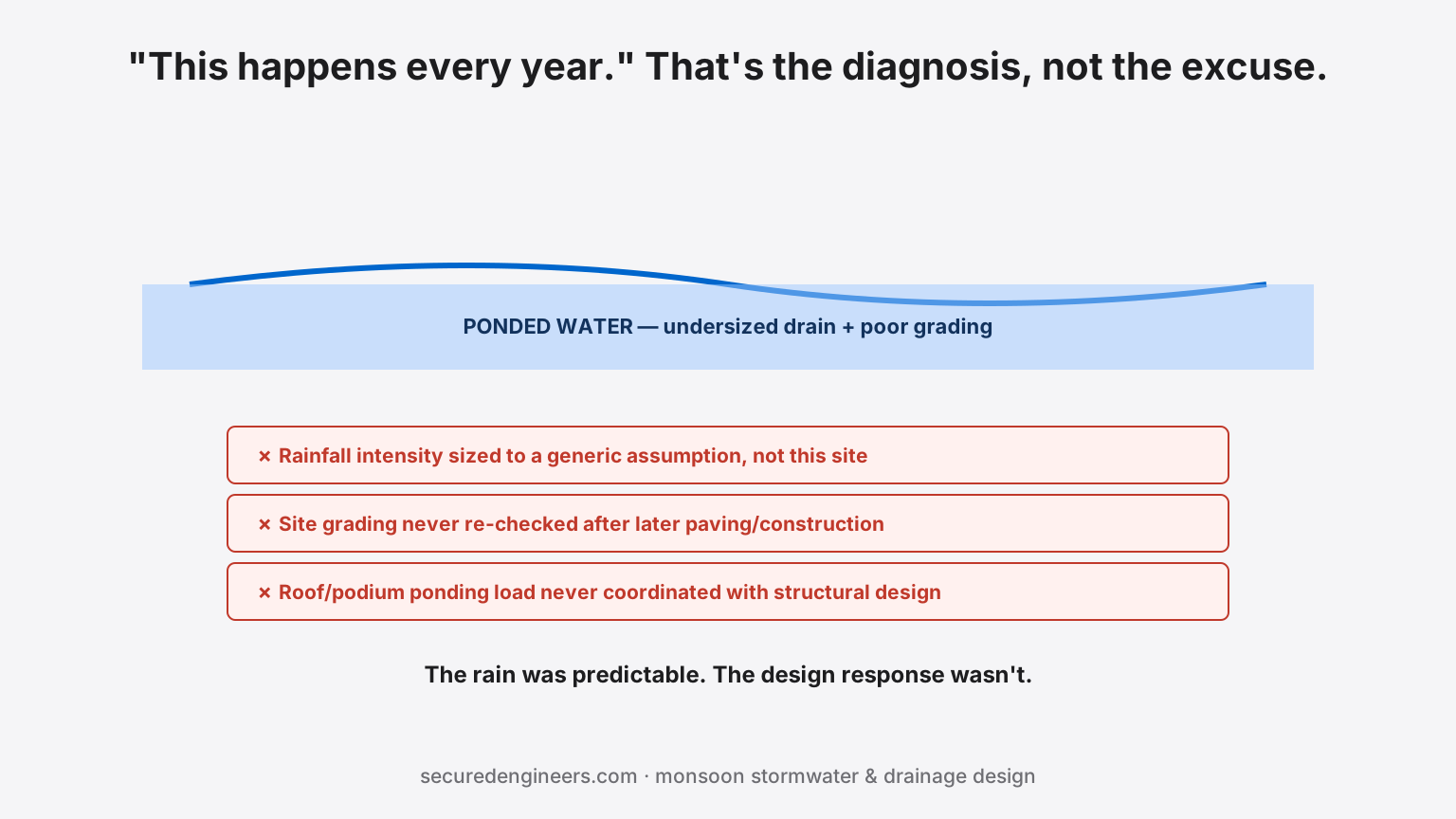
Every July, the same story repeats: waterlogged roads in the same low-lying pockets, a building collapse somewhere attributed to "heavy rain," and residents telling reporters "this happens every year, but the drainage has never been fixed." July 2026 has already delivered building collapses in Delhi and Pune, and in Pimpri-Chinchwad, a three-storey structure built beneath a waste-to-energy site was crushed when monsoon rain loosened a garbage mound onto it. None of this is a surprise weather event. It's the visible result of stormwater and site-grading decisions made at design stage — or not made at all — now compounding year after year.
Why "it rained a lot" isn't the real explanation
- Monsoon rainfall intensity is a known, published design parameter for any given location — stormwater systems are supposed to be sized against historical peak-intensity data for that specific site, not against an average or a hopeful assumption
- Urban site grading determines where water goes before it ever reaches a drain — a site graded without a genuine fall toward collection points, or one that relies on an undersized municipal drain as its only outlet, will pond regardless of how well the drain itself was sized
- "This happens every year" is diagnostic, not just a complaint — a site that floods in the same spot every monsoon has an identified, fixable drainage or grading failure, not a random weather event; the fact that it's never fixed is a maintenance and capital-planning failure layered on top of a design one
Where stormwater design actually fails on real projects
| Failure point | What actually goes wrong |
|---|---|
| Undersized storm drain sizing | Calculated against a generic rainfall assumption instead of the site's actual peak-intensity data, or against outdated intensity data that doesn't reflect worsening rainfall patterns |
| Site grading ignored post-construction | Original grading design assumed clear swales and open ground; later paving, landscaping or adjacent construction changes the actual flow path without anyone re-checking capacity |
| Single point of discharge | A site relying entirely on one municipal drain connection has no fallback when that drain is itself surcharged during a citywide event — exactly when it's needed most |
| Structures sited in identified low-lying or flow-path zones | The Pimpri-Chinchwad pattern — construction on or beneath sites where water and debris are known to concentrate, without engineering the specific risk that creates |
| No maintenance of existing stormwater infrastructure | Drains and catch basins silt up or get blocked between monsoons; a correctly designed system that's never cleaned performs like an undersized one |
The structural risk that gets missed
Ponded water isn't just an inconvenience — it's a load. Flat roofs, basements and podium structures designed without accounting for temporary water accumulation during a drainage-system overload can see loads well beyond what the original structural design assumed, especially where roof drains are undersized or get blocked by debris during the exact storm event that most needs them clear. This is a genuinely different risk category from the waterlogged-road inconvenience most people picture — it's a structural safety question, and it's the kind of load case that's easy to omit if stormwater and structural design aren't coordinated as one problem.
What proper stormwater and site drainage design actually requires
- Rainfall intensity sized to the actual site, using current, location-specific peak-intensity data — not a generic regional assumption carried over from a template
- Site grading verified against as-built conditions, not just the original design drawing — subsequent construction, paving or landscaping changes need to be checked against the drainage design they may have quietly invalidated
- Redundant discharge paths where feasible, so a single surcharged municipal connection doesn't leave the site with nowhere for water to go
- Structural coordination for ponding load, particularly on flat roofs, podiums and below-grade structures, as an explicit design case rather than an assumption that drains will always function
- A standing maintenance schedule for drains, catch basins and roof outlets — treated with the same seriousness as fire system AMC neglect, because an unmaintained drainage system fails exactly when the design was counting on it most
Why this is a design-stage problem, not a monsoon-season one
By the time water is standing in a basement or a road is impassable, the fix is reactive and expensive — pumping, cleanup, liability, and in the worst cases, structural damage or loss of life. The actual decision point was months or years earlier, in a site-grading drawing and a drain-sizing calculation that either accounted for the site's real rainfall exposure or didn't. This is the same lifecycle-economics pattern covered in building services maintenance — getting it right once, at design stage, costs a fraction of what repeated seasonal flooding costs in cleanup, downtime and reputational damage.
Our plumbing & public health team designs stormwater and site drainage as a coordinated system with structural and civil design, not an afterthought sized to a generic template. For sites with a known recurring flooding history, we run a specific drainage diagnostic before the next monsoon arrives.
FAQs
Why does the same area flood every monsoon even after "drainage work" is done?
Usually because the fix addressed a symptom (clearing a specific blocked drain) rather than the underlying capacity or grading problem — or because maintenance lapses again before the next monsoon, silting the system back down.
Can ponded water actually cause structural damage?
Yes — flat roofs, podiums and below-grade structures not designed for temporary ponding loads can be pushed beyond their structural design assumptions during a drainage-system overload, which is a genuine safety risk, not just a nuisance.
How is stormwater drain sizing actually calculated?
Against location-specific historical peak rainfall intensity data, the site's contributing catchment area, and the grading path water will actually follow — not a generic assumption applied regardless of site.
Can you assess our site's flooding risk before next monsoon?
Yes — a stormwater and site-grading diagnostic, including structural ponding-load review where relevant. Request an assessment.
More insights
You Are Treating Water to Drinking Standard and Flushing With It.
Industrial facilities buy or extract water once and use it once. Greywater recycling separates the streams that do not need potable quality — flushing, landscape, cooling make-up — and is increasingly a consent condition rather than a choice.
IndustrialThe Cold Room Held -18°C. The Door Seal Didn't Know That.
Cold storage and refrigerated warehousing fail in ways general industrial MEP design doesn't anticipate — vapour barrier gaps that let moisture migrate into insulation, door and dock seals that leak more cold air than the refrigeration system can replace, defrost cycles that were never coordinated with product load. What makes cold-chain MEP a distinct discipline, not a colder version of standard industrial design.