
Perovskite Cells Promise 30%+ Efficiency. Your Roof Doesn't Have Ten Years to Wait and See.
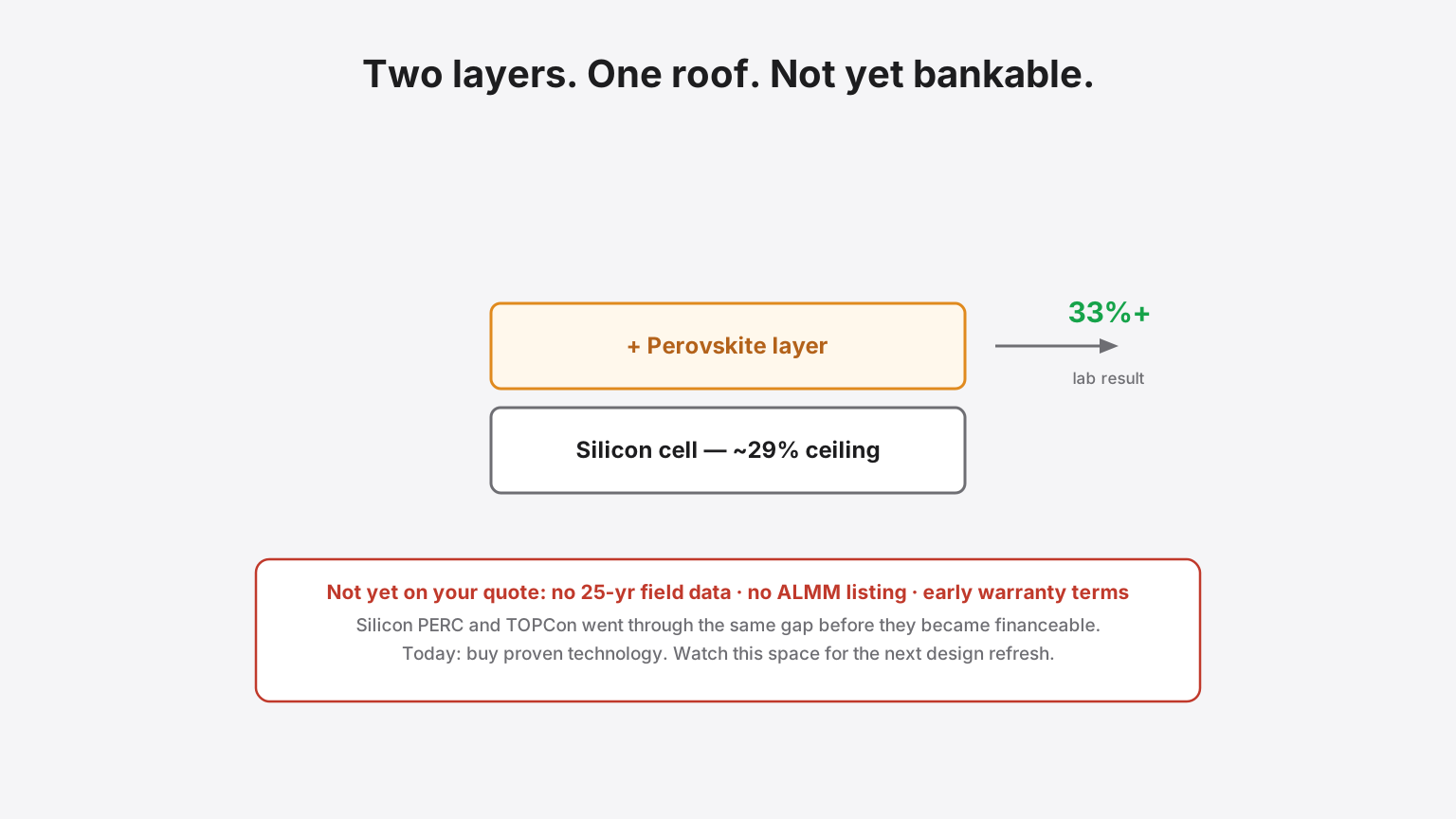
Silicon solar cells have a hard ceiling. A single-junction crystalline silicon cell cannot exceed roughly 29% efficiency no matter how well it is manufactured — the physics of a single semiconductor bandgap caps it there. Perovskite-on-silicon tandem cells stack a second, differently-tuned light-absorbing layer on top of the silicon, catching part of the spectrum silicon wastes. Lab results have pushed past 33% efficiency, and that number is why perovskite is the most-discussed material in solar right now.
It is also, for a factory or hotel roof being quoted today, not yet a real purchasing decision. The gap between "best lab result" and "bankable 25-year module" is where perovskite currently sits.
What perovskite actually solves
More power from the same roof area. A commercial or industrial roof is a fixed asset — its usable, shadow-free area does not grow. Every efficiency point above today's mono-PERC or TOPCon modules (roughly 21-23% at module level) translates directly into more installed capacity on the same footprint, which matters most on sites where roof area, not budget, is the binding constraint.
Why it isn't in an EPC quote yet
| What a 25-year asset needs | Where perovskite currently stands |
|---|---|
| Long-term degradation data | Silicon has multi-decade field data. Perovskite's stability under heat, humidity and UV — India's operating conditions — has improved fast but has nothing like that track record yet. |
| Bankable manufacturer warranty | A 25-year linear performance warranty needs a manufacturer confident enough to stand behind it that long. Tandem-cell warranties are only beginning to approach that. |
| ALMM listing | Government-linked projects and, in a growing number of states, net metering itself require modules on the ALMM list — see our ALMM List-II explainer. Tandem products are not yet established there at volume. |
| Volume manufacturing at Indian scale | Lab and pilot-line output is not the same as the container-load supply chain an EPC contractor needs to commit a project schedule to. |
None of that is a knock on the technology — it is simply where every new cell chemistry sits before it becomes procurable. Silicon PERC went through the same gap before it became the default; TOPCon is going through a faster version of it right now (see our TOPCon explainer).
What we tell buyers who ask about it
If your roof has generous spare area, there is no efficiency emergency — buy proven TOPCon or bifacial technology today and capture the payback that is already available, rather than deferring a project for a module type that isn't financeable yet. If your roof area is the binding constraint on system size, that is exactly the situation worth revisiting in a few years as tandem modules earn field track record and ALMM listings — but it is not a reason to leave your current roof unused in the meantime.
What we do differently
Our Solar EPC team specs modules against what is actually bankable and warrantable today, and keeps design headroom — inverter sizing, string architecture, spare roof area — so that a genuinely better module a design refresh away doesn't mean re-engineering the whole plant.
Are perovskite solar panels available to buy in India today?
Not at commercial-project scale with a bankable long-term warranty. Pilot and early-commercial tandem products exist globally; wide, ALMM-listed availability for Indian industrial EPC projects is not yet here.
Should I delay a solar project to wait for perovskite modules?
Generally no. Today's TOPCon and bifacial modules already deliver a strong payback, and every year of delay is a year of generation and savings not captured. Waiting only makes sense if roof area is your hard constraint and the project can genuinely afford to wait.
More insights
How to choose a solar EPC company in India — the checks that actually matter
Search that phrase and you get 'Top 10' lists written by solar companies about themselves. Here is the evaluation checklist instead — the one we'd want a buyer to run on us.
Solar EnergyBifacial Panels Generate From Both Sides. On the Wrong Roof, the Second Side Generates Almost Nothing.
Bifacial modules capture light reflected off the ground as well as direct sunlight — real, but the gain depends entirely on mounting height, tilt and what's actually underneath the array. Marketing puts the number at up to 20-30%. Most Indian commercial rooftops see a fraction of that, and it's worth knowing why before paying the premium.