
The Data Hall Was Designed for 8 kW Racks. The AI Cluster Wants 60. Air Can't Bridge That Gap.
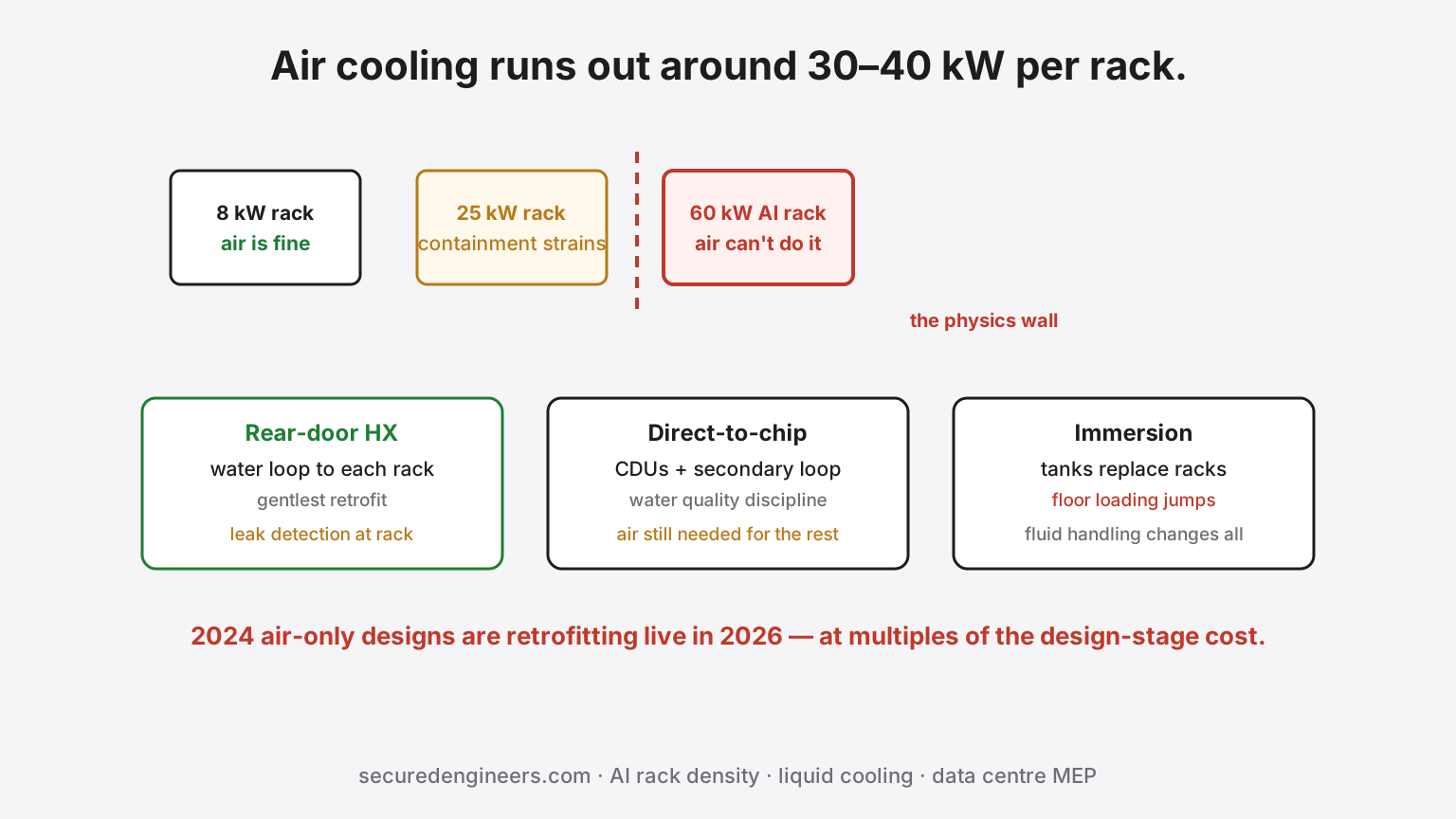
For two decades, data centre cooling design in India could safely assume racks in the low single-digit kilowatts, with the occasional 10–15 kW "high-density" row treated as a special case. AI accelerators ended that assumption abruptly. A single rack of modern GPU servers draws what an entire row drew a few years ago — dense AI configurations routinely land in the 40–100+ kW per rack range — and the uncomfortable physics is that air, as a heat-transfer medium, simply runs out of headroom well before that.
Where air actually stops
Air cooling scales by moving more air, colder. Both levers hit walls: fan power rises steeply with airflow, aisle containment and delta-T management get progressively harder, and beyond roughly 30–40 kW per rack the volume of air required becomes impractical to deliver through a raised floor or overhead system — the airflow needed starts fighting the room itself. Sites push past the limit briefly with spot coolers and heroic containment, and pay for it in stranded capacity, hot spots and fan energy. Past that band, the medium has to change: water carries heat orders of magnitude better than air per unit volume, which is why every serious AI-density roadmap converges on liquid.
The three liquid paths — and what each demands from the building
| Approach | How it works | What the building must provide |
|---|---|---|
| Rear-door heat exchanger (RDHx) | A water-fed coil replaces the rack's rear door, capturing exhaust heat at the rack; servers stay air-cooled internally | Chilled/warm water loop to every equipped rack, manifolds and hose management, leak detection at rack level; gentlest retrofit of the three |
| Direct-to-chip (cold plate) | Coolant circulates through plates on CPUs/GPUs via a coolant distribution unit (CDU); captures most — not all — of the heat, so residual air cooling remains | Primary water loop plus CDU floor space and power, water-quality management for the secondary loop, and a still-functional air system for the remainder |
| Immersion | Servers submerged in dielectric fluid in tanks; near-total liquid capture | The most invasive: tank layouts replace racks entirely, floor loading rises sharply with fluid weight, fluid handling and maintenance practices change everything downstream |
The common thread: every liquid path makes the building a participant in the cooling system. Piping distribution through occupied white space, floor structures checked against concentrated tank or CDU loads, water treatment and quality control as an ongoing discipline, and leak detection with fast isolation — under racks, at manifolds, along headers — because the failure mode liquid introduces is one air never had.
The 2024 design, meeting the 2026 workload
Indian edge and colocation capacity planned around 2024 was overwhelmingly designed air-only — sensible at the time, since the committed tenant load was conventional compute. Then AI inference and fine-tuning demand arrived at the leasing desk, and a hall engineered for 6–10 kW racks was asked to host 40 kW clusters. The result, playing out through 2026, is a wave of live-site retrofits: chilled-water spines being extended into halls that never planned for them, CDUs claiming floor space budgeted for racks, structural checks on slabs that never expected tank loads. All of it is doable; all of it costs multiples of what provisioning at design stage would have — and it lands on exactly the redundancy and change-management discipline our cooling redundancy and uptime-tier guide covers, because you're cutting into a live cooling system.
Water is now an operations discipline, not a commodity
The part air-cooled operators underestimate most is not the piping — it is the ongoing chemistry. A direct-to-chip secondary loop runs treated coolant to tolerances on conductivity, particulates and biological growth that a comfort-cooling chilled-water system never worried about; get it wrong and the failure is corrosion or fouling inside cold plates attached to the most expensive silicon in the building. Immersion fluids need handling procedures, spill containment and periodic quality testing of their own. And every liquid scheme needs a commissioning regime — pressure testing, flow balancing, leak-detection verification — run to a standard closer to process piping than to HVAC, because the consequence of a first-fill leak over a live GPU row is not a comfort complaint. Sites that treat the water loop as a mechanical afterthought, handed to whoever did the chillers, are the ones the retrofit wave is currently teaching in public.
What to decide at design stage now
No one is saying every Indian server room needs immersion tanks — a conventional enterprise room is still well served by the precision-cooling fundamentals in our precision vs comfort cooling guide. The design-stage decision is cheaper than that: route and size a future liquid loop, reserve plant capacity and CDU space, and check floor loading once, on paper. Size the heat-rejection plant against realistic density scenarios — our chiller capacity calculator is a starting point — and treat "liquid-ready" as a line item, not a philosophy. Our HVAC and mechanical team designs data-hall cooling both ways, and the consistent lesson from the current retrofit wave is that the option you preserve at design stage is the cheapest cooling capacity you will ever buy.
More insights
3.5 GW of Data Centres Got Announced. The Substations Did Not.
India's data centre capacity is projected to grow 30% in 2026 alone, with roughly 30 large projects announced between March 2025 and April 2026 adding 3.5 GW of planned capacity — much of it concentrated in Andhra Pradesh and Telangana's AI-centric mega campuses. Announcements move fast. Grid and substation infrastructure doesn't. The gap between the two is where data centre projects actually stall.
Data CentreYou Bought a Tier III Server Room. The Cooling Is Tier I.
Uptime-tier ratings get quoted for power — dual utility feeds, UPS, generator backup — while cooling redundancy quietly gets value-engineered to N, not N+1. A data centre or server room with redundant power and single-string cooling has exactly one Achilles' heel: the day that one CRAC unit fails. What redundancy actually means for cooling, and how to verify you have what you paid for.