
You Bought a Tier III Server Room. The Cooling Is Tier I.
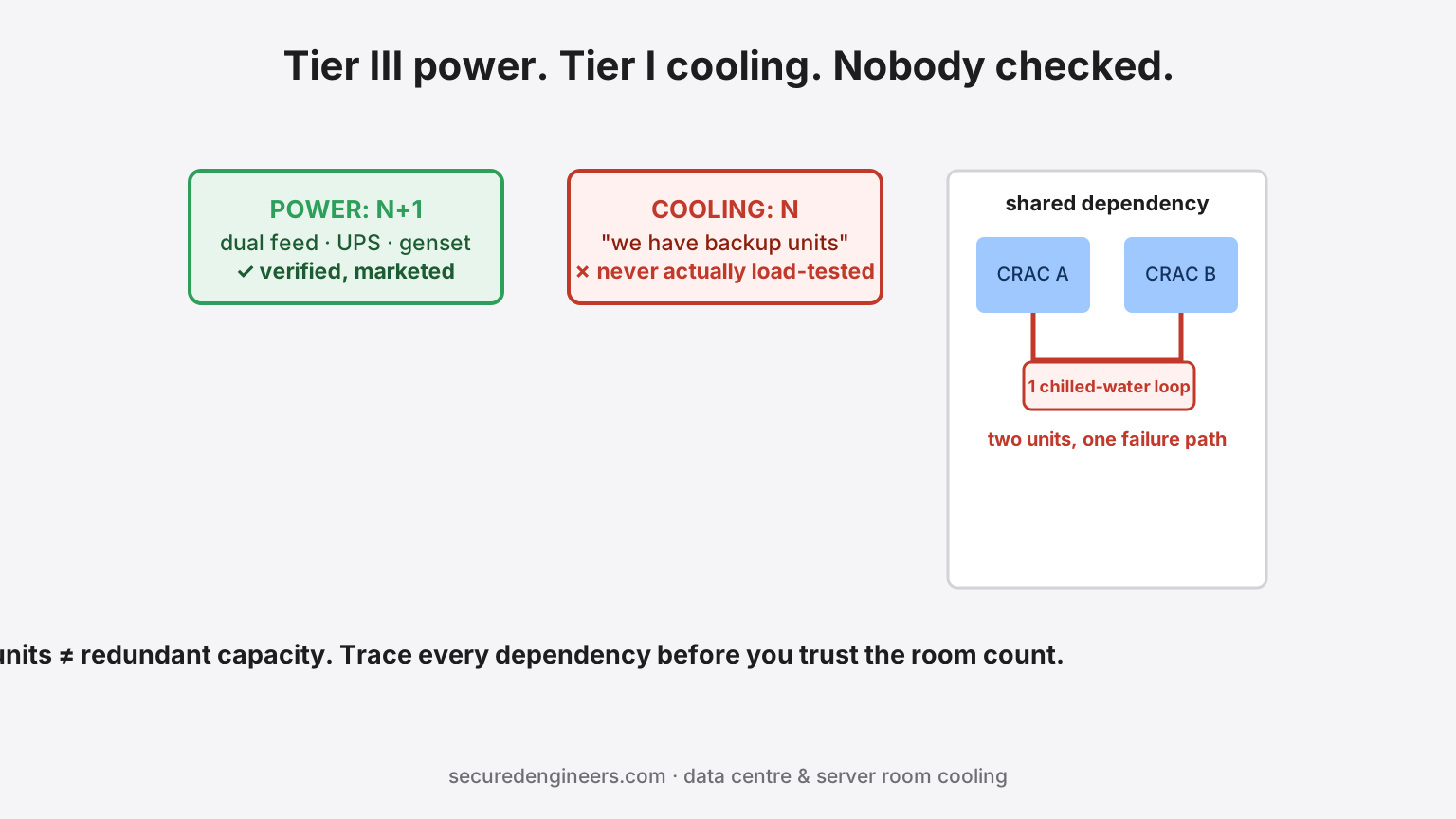
Ask most facility owners about their data centre's uptime tier and they'll talk about power first: dual utility feeds, UPS runtime, generator changeover time. Ask about cooling redundancy and the conversation gets vaguer — "we have backup AC units" is not the same statement as "we have N+1 cooling," and the gap between those two claims is exactly where server rooms fail during the one event redundancy exists to survive.
What N, N+1 and 2N actually mean — for cooling specifically
| Configuration | What it means | What happens on a single unit failure |
|---|---|---|
| N | Exactly enough cooling capacity for the design load, no spare | Room temperature rises immediately — no buffer, no time to respond |
| N+1 | One additional unit beyond what's needed for design load | Remaining units cover the load; the failed unit can be serviced without a room-temperature event |
| 2N | A fully duplicated, independent cooling system | Complete redundant path — the standard for the highest-availability facilities |
| "Backup units" (undefined) | Ambiguous — may mean spare units not actually sized to cover full load, or units that share a single chilled-water loop with no independent failure path | Often fails the same way N does — the "backup" label doesn't guarantee actual redundancy |
The critical distinction: redundant units are not the same as redundant capacity. Two CRAC units each sized for 60% of the room's heat load is not N+1 — it's two units sharing a load that either one alone cannot fully cover. Genuine N+1 means every remaining unit, together, can carry 100% of the design load with any one unit removed.
Why cooling redundancy gets cut and power redundancy doesn't
- Power redundancy is easier to specify and market — "dual feed, N+1 UPS, 2N generators" reads clearly on a data sheet. Cooling redundancy requires understanding actual heat load, airflow paths and shared infrastructure (chilled water loops, condenser water, electrical feeds to the CRAC units themselves) — it's harder to summarise in a sales conversation, so it gets less scrutiny
- Shared dependencies hide behind "redundant" units — two CRAC units both fed from the same electrical panel, or sharing one chiller, are not truly independent even if there are physically two of them. A single point of failure upstream defeats the redundancy the room count implies.
- Cooling capacity is quietly downsized during value engineering, the same pattern covered in L1 procurement backfires — a lower-cost bid wins by trimming the "spare" unit that was never load-tested against the real heat map
- Heat load grows after commissioning — added servers, higher-density racks, and equipment refreshes push real load past what redundancy was designed against, silently eroding N+1 back toward N without anyone re-verifying
How to verify what you actually have
- Get the real heat load, not the original design assumption — measure current IT equipment power draw and compare it against the cooling capacity actually installed
- Trace every "redundant" unit's dependencies — electrical feed, chilled-water source, condenser loop — to confirm no shared single point of failure defeats the redundancy on paper
- Run a real failure test, not a walkthrough — isolate one cooling unit (in a controlled, monitored window) and confirm the room genuinely holds temperature on the remaining capacity
- Check airflow, not just capacity — hot-aisle/cold-aisle containment and rack-level airflow matter as much as total tonnage; a room with adequate total capacity can still have hot spots from poor airflow design
- Re-verify after every capacity change — new racks, higher-density equipment, or an added row of servers all change the load the redundancy calculation was built against
The physics behind why this matters more than it seems
Unlike many building systems, IT equipment failure from heat is fast — server rooms can reach damaging temperatures within minutes of losing cooling, not hours. This is the same category of critical-room engineering covered in precision vs comfort cooling — but redundancy is the layer above system type: even a properly specified precision-cooling installation fails its purpose if there's no genuine spare capacity behind it. A facility with excellent chosen equipment and zero real redundancy is one compressor failure away from an outage; a facility with genuine N+1 buys the time to respond before that failure becomes downtime.
FAQs
What's the difference between N+1 and having two AC units?
N+1 means the remaining capacity — after removing any one unit — can still cover 100% of the design load. Two units that each only cover part of the load, with neither able to carry the full room alone, is not N+1 regardless of unit count.
How do I know if our "backup" cooling units are genuinely redundant?
Trace the dependencies — power feed, water/refrigerant source — of each unit independently. If two units share any single upstream dependency, that dependency's failure takes both down together, defeating the redundancy.
Does data centre uptime tier certification cover cooling specifically?
Formal tier certification frameworks do assess cooling redundancy as part of the overall rating — but many facilities describe themselves informally as "Tier III-like" without actual certification or verified cooling redundancy. Verify independently rather than relying on informal claims.
How often should cooling redundancy be re-verified?
After any material change to IT load (new racks, higher-density equipment) and as a standing item in annual critical-facility reviews — redundancy calculated once at commissioning erodes silently as load grows.
Can you design or upgrade our server room or data centre cooling?
Yes — heat-load calculation, redundancy design and the commissioning tests that prove it, as one scope. Request a proposal.
More insights
The Data Hall Was Designed for 8 kW Racks. The AI Cluster Wants 60. Air Can't Bridge That Gap.
AI-era rack densities have pushed past what air cooling can physically remove — beyond roughly 30–40 kW per rack, liquid stops being optional. What rear-door heat exchangers, direct-to-chip and immersion each demand from the building, and why Indian edge and colo sites built air-only in 2024 are retrofitting in 2026.
Data Centre3.5 GW of Data Centres Got Announced. The Substations Did Not.
India's data centre capacity is projected to grow 30% in 2026 alone, with roughly 30 large projects announced between March 2025 and April 2026 adding 3.5 GW of planned capacity — much of it concentrated in Andhra Pradesh and Telangana's AI-centric mega campuses. Announcements move fast. Grid and substation infrastructure doesn't. The gap between the two is where data centre projects actually stall.