
Your Factory Has a Reservoir, an ETP Pond, or a Cooling Tank. That's Roof Area You Haven't Counted.
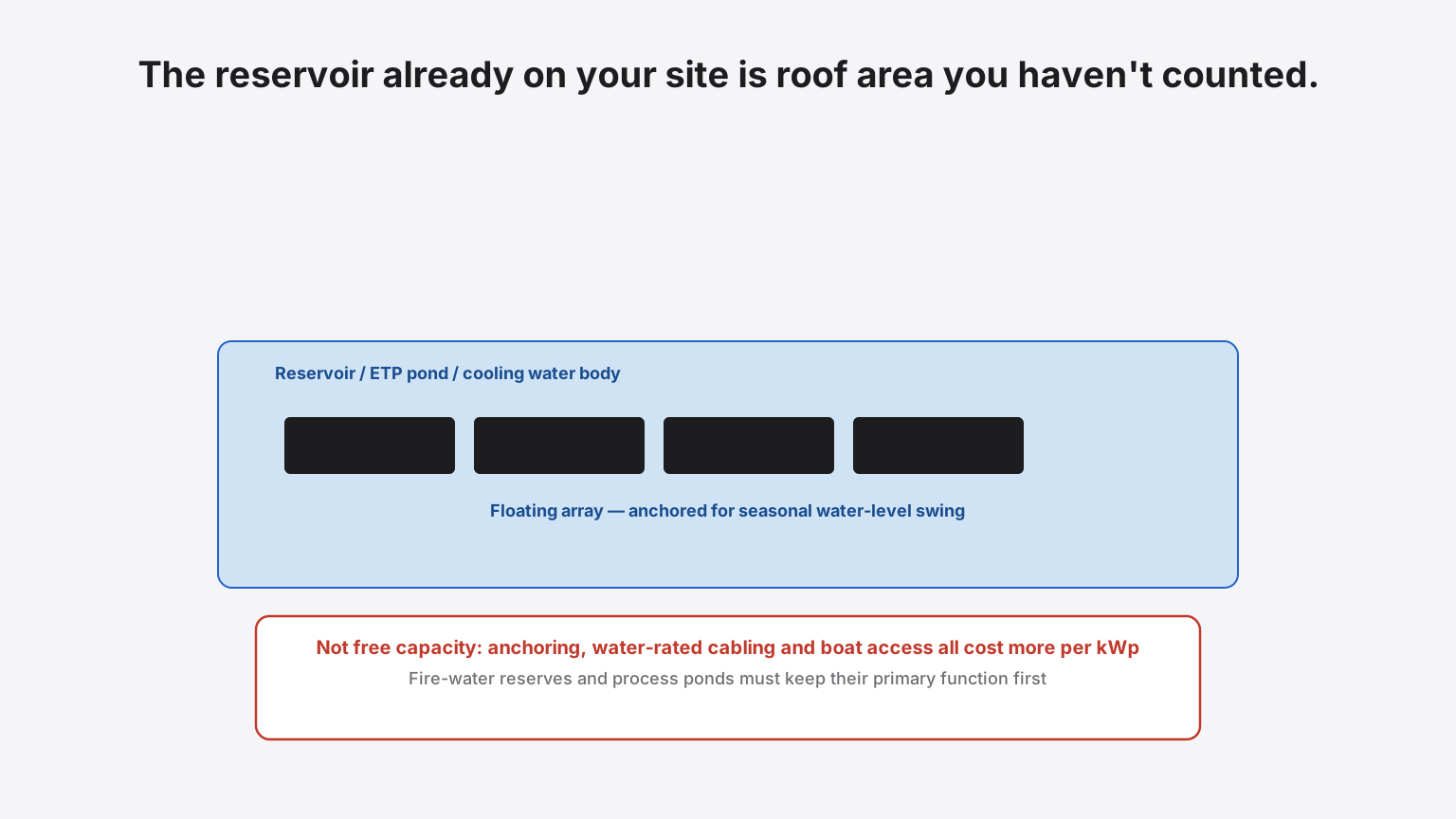
Rooftop solar hits a hard ceiling on many industrial sites — the roof is fully used, or structurally can't take more load, or the plant is single-storey with a roof far smaller than the plot. The usual next step is ground-mount, which needs land the site may not have spare. Floating solar is a third option that only exists if the site already has one thing: a water body. A raw-water reservoir, an effluent treatment pond, a fire-water tank, or a process cooling pond can all, in principle, carry a floating array.
Where it genuinely applies
- Textile and process industries with large ETP or cooling ponds that sit idle as surface area between treatment cycles.
- Large campuses — industrial parks, some hospitals and hospitality sites — with ornamental or storage water bodies of meaningful size.
- Sites where land is genuinely the constraint, and open-access ground-mount (see our open access vs rooftop captive guide) isn't available or isn't attractive.
It does not apply to a small decorative pond, or to a water body the facility cannot take out of full service during installation and periodic maintenance access.
What the pitch usually leaves out
| Claim | What's actually true |
|---|---|
| "Panels run cooler on water, so they generate more" | Real, but modest — a genuine few-percent yield gain from evaporative cooling under the array, not a transformational number. |
| "It reduces evaporation, saving water" | Also real on open reservoirs, and worth quantifying for a water-stressed site — but rarely the primary justification for a facility, more a secondary benefit. |
| "It's cheaper than ground-mount since there's no land cost" | The floats, anchoring system, and water-rated cabling and connectors typically cost more per kWp than a simple ground-mount structure — land you already own isn't free either way, but the structure premium is real. |
| "Maintenance is the same as any solar plant" | Access is by boat or walkway; cleaning, module replacement and cable inspection all take longer and need different safety planning than a roof or ground array. |
The engineering that has to be right
Anchoring has to hold through the water body's actual level variation across the year — a reservoir that draws down seasonally needs an anchoring and mooring design that isn't just "float and tether." Cabling and connectors need water-body-rated ingress protection, not standard rooftop-rated components. And critically: if the water body is a fire-water reservoir or a process water source, the array's presence, maintenance access and any spill risk from the installation itself has to be assessed against that function — a floating array cannot compromise the fire-water reserve it's floating on.
What we do differently
Our Solar EPC team assesses whether a site's water body is structurally, seasonally and functionally suited to a floating array before quoting one — including whether the water body's primary function (fire reserve, process cooling, effluent treatment) constrains what can be installed on it.
Can floating solar go on a fire-water reservoir?
Only if the array and its maintenance access can be designed without compromising the reservoir's fire-water function and required draw-down capacity — this needs sign-off alongside your fire-safety consultant, not a decision made by the solar EPC alone.
More insights
CAPEX vs OPEX Solar for Factories — the 10-Year Total Cost Compared
Own the plant or buy the power? The CAPEX-vs-OPEX solar decision looks financial, but the 10-year total cost turns on clauses most buyers never read.
Solar EnergyYour Solar Plant Sleeps Through Your Evening Peak. A Battery Doesn't Have To.
Battery energy storage paired with rooftop solar lets a factory shave demand peaks, cut demand charges and shrink DG hours — and 2026 is the year the economics started genuinely working. But buyers keep sizing by kWh alone, skipping cycle-life warranty terms, and parking containers where fire codes say they can't sit.