
Everything Switched On at Handover. That Is Not the Same as Commissioned.
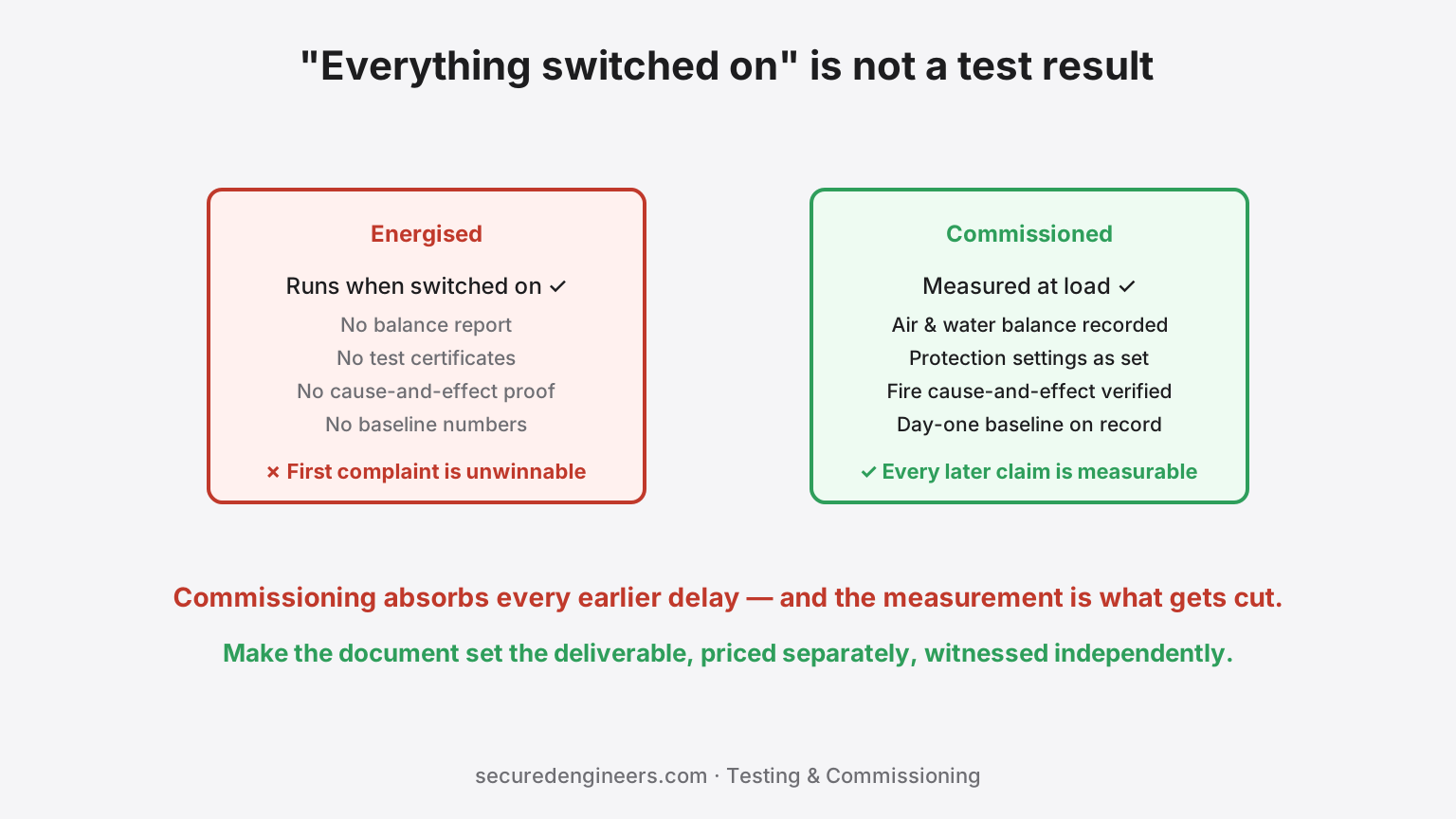
Commissioning is the last activity in a construction programme, which means it absorbs every delay that happened before it. A job that slipped six weeks does not usually get a six-week extension; it gets a compressed commissioning period, and what is compressed out of it is the measurement.
What survives is energisation — everything is switched on, it runs, nothing obviously fails, and the building is handed over. Switching on is a test of connection. It is not a test of performance, and the difference determines who pays when the building underperforms.
What proper commissioning produces that energisation does not
- Measured air and water balance — recorded flow rates at each terminal against design. Without it there is no evidence a space was ever capable of achieving its design condition.
- Electrical test results — insulation resistance, earth resistance, phase sequence, protection settings and relay coordination as actually set, not as designed.
- Fire cause-and-effect verification — proof that each detector actually triggers the intended outputs across every interfaced system, tested as an integrated whole rather than device by device.
- Plant performance at load — chillers, pumps and gensets tested at meaningful load rather than started and observed idling.
- A recorded baseline — the numbers the building achieved on day one, against which every future complaint and energy claim can be measured.
Why the missing baseline costs real money later
| Later dispute | With commissioning data | Without it |
|---|---|---|
| "This floor was never cool enough" | Compare current flow against commissioned flow — establishes whether it degraded or was never right | Unresolvable; usually settled by whoever has more leverage |
| Energy consumption above expectation | Baseline shows what the plant achieved when new | No way to separate design shortfall from operational drift |
| Fire system fails an audit | Cause-and-effect matrix shows what was proven at handover | Full re-testing of an occupied building, at cost |
| Equipment warranty claim | Evidence the plant was commissioned within its operating envelope | Manufacturer can reasonably question installation and commissioning |
The independence problem
There is a structural conflict in the usual arrangement: the contractor who installed the system also commissions it and certifies its performance. That is not necessarily dishonest, but it is an incentive to record a pass rather than to hunt for a shortfall, particularly in the compressed final fortnight when a fail means delaying handover.
This is the argument for commissioning being witnessed or performed independently of the installing contractor — not as an accusation, but because the person measuring should not be the person whose programme suffers from an unfavourable measurement.
How to protect the commissioning period
Three practical measures. Make commissioning a separately-priced line in the contract rather than an assumed inclusion, so that compressing it is a visible commercial decision. Define the deliverable as a document set — balance reports, test certificates, cause-and-effect results, settings schedules — rather than as an event. And make handover conditional on that document set existing, because a system without commissioning data is a system whose performance nobody has ever established.
What we do differently
Our Testing & Commissioning scope is offered independently, including on installations built by other contractors, and produces a measured baseline as the deliverable — because a building handed over without one has no defensible answer to the first performance complaint it receives.
More insights
When should an industrial facility consider an AMC?
An AMC is a decision about who owns the renewals, the logbooks and the breakdowns. A framework for when a maintenance contract is worth it, which kind, and what it must contain to be worth anything.
Project ManagementThe Site Is Insured. The Chiller That Failed on Test Is Probably Not.
Erection all-risk and contractors all-risk policies cover the works during construction. The exclusions are where MEP claims die — testing and commissioning, defective design, and the gap between practical completion and the operational policy starting.