
The Building Code Changed in May 2026. Your Consultant's Drawings Didn't.
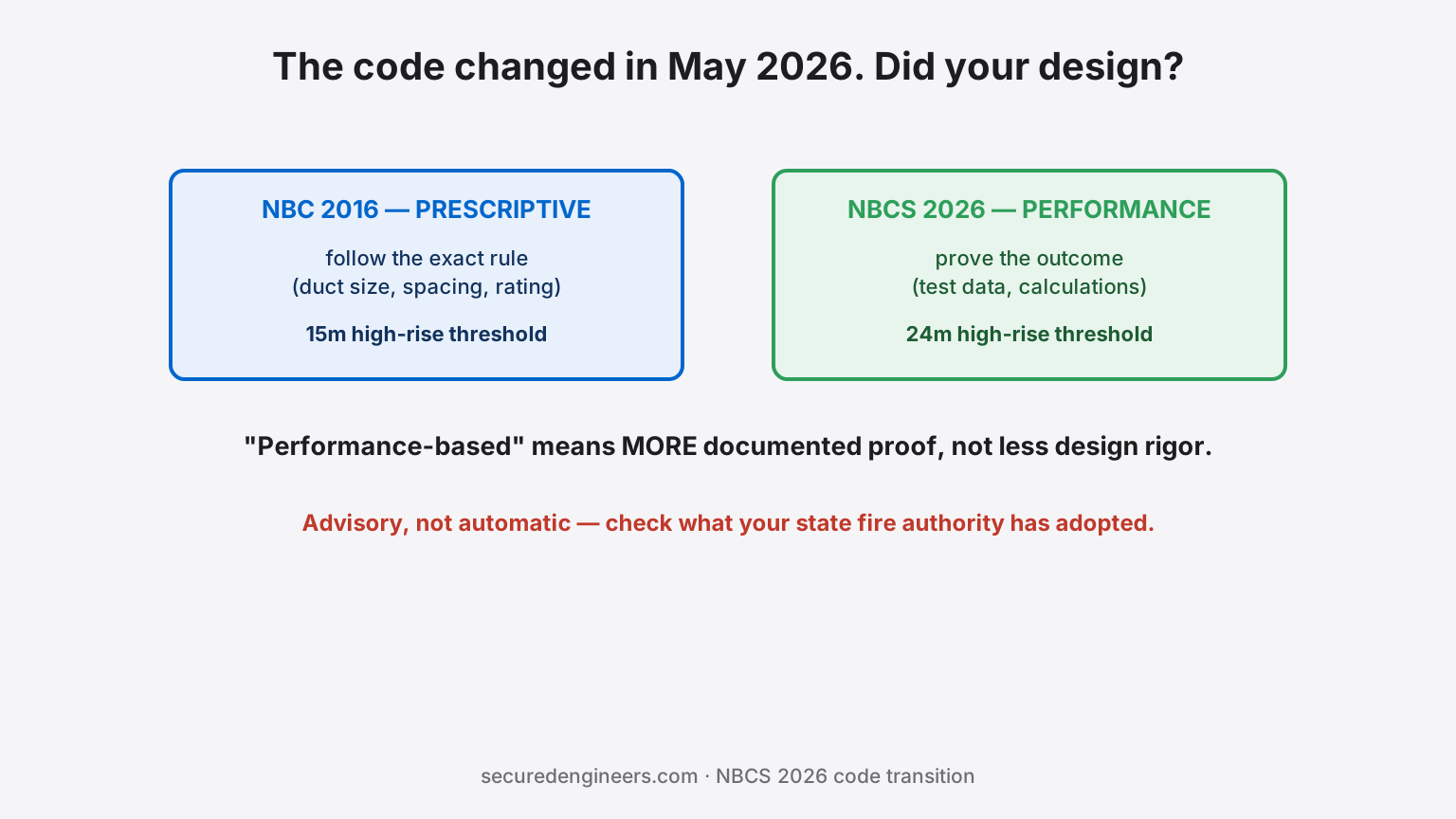
In April–May 2026, the Bureau of Indian Standards replaced the National Building Code of India 2016 with the National Building Construction Standards 2026 — the first ground-up rewrite of the code most Indian MEP and fire-safety design has been built against for a decade. Two changes matter more than any others for anyone currently designing, tendering, or executing a building: the code moved from prescriptive to performance-based, and the residential high-rise fire-safety threshold shifted from 15 metres to 24 metres.
If your consultant is still handing you drawings that read like NBC 2016 without a word about performance demonstration, that's not a shortcut — it's a gap that will surface at approval stage, or worse, after handover.
Prescriptive vs performance-based — the actual difference
| NBC 2016 (prescriptive) | NBCS 2026 (performance-based) | |
|---|---|---|
| How compliance is shown | Follow the specified rule (duct size, sprinkler spacing, material rating) exactly as written | Demonstrate the finished building achieves the required fire-resistance, thermal and life-safety outcome, by whatever tested route achieves it |
| Design flexibility | Low — deviation from the prescribed rule is a violation regardless of actual performance | Higher — alternative materials or layouts are acceptable if performance is proven |
| Burden of proof | On the inspector, to catch a rule violation | On the designer, to produce test data, calculations or certified performance evidence |
| Risk of "performance-based" being misread as "easier" | N/A | High — some project teams are treating it as relaxed, when it actually demands more documented engineering, not less |
The high-rise threshold change, precisely
Under NBC 2016, enhanced fire and life-safety norms kicked in for residential buildings at 15 metres — roughly five storeys. NBCS 2026 raises that threshold to 24 metres, roughly eight storeys. This is a genuine relaxation for buildings between 15m and 24m, which no longer automatically trigger the highest tier of fire-safety requirements. But three things matter more than the headline number:
- NBCS 2026 is advisory, not automatically binding — it's published by BIS as voluntary guidance; individual state building bye-laws and municipal fire NOC authorities decide whether and how to adopt it. A relaxed national standard doesn't override a stricter state or municipal requirement still in force.
- The relaxation applies to the trigger threshold, not to genuine risk — a 20-metre residential building still has the same evacuation-time physics as before; the code change doesn't reduce the actual fire risk, just where the enhanced-requirement line is drawn.
- Recent high-rise fires haven't stopped making the case for stricter practice — the Gaur Green Avenue fire in Indirapuram (April 2026) renewed public and regulatory attention on high-rise fire safety at almost the exact moment the threshold was being relaxed nationally, which is exactly the kind of tension that makes state-level adoption inconsistent and unpredictable project to project.
What this means for a project already in design
- Confirm which code your state fire authority is actually enforcing — don't assume NBCS 2026 applies just because it's the new national standard; check with the specific state fire NOC and municipal building-plan-approval authority before changing any design assumption
- If your consultant is claiming a code-driven cost reduction (e.g., "we don't need the enhanced system anymore, the building is under 24m"), get that in writing against the specific local authority's adopted requirement — not against the national NBCS 2026 text alone
- Treat "performance-based" as a documentation requirement, not a design shortcut — if your MEP consultant proposes an alternative approach under the new performance framework, insist on the test data, calculation basis or certification that actually satisfies the performance demonstration burden; an undocumented deviation is not compliance under either code
- Re-verify fire NOC applications submitted before May 2026 — some may reference the old NBC 2016 clause numbers directly; confirm with the fire department whether resubmission or an addendum is needed
Where this connects to what we've already covered
The prescriptive-vs-performance shift doesn't change the underlying MEP coordination discipline — a services-zone allowance still has to be calculated, not assumed, and a genuine fire-system design still needs the documented specification a tender process depends on. What changes is how compliance gets proven — and a consultant unfamiliar with the new performance-demonstration burden is a real project risk right now, mid-transition.
We're tracking NBCS 2026 adoption state by state as our projects encounter it, and building performance-demonstration documentation into every fire and life-safety design from this point forward. Our fire protection and design & approvals teams can review an in-progress project against both the national standard and your specific state's current enforcement position.
FAQs
Is NBCS 2026 legally mandatory?
NBCS 2026 is published by BIS as voluntary guidance rather than a binding national law — whether it applies to your project depends on adoption by your specific state building bye-laws and municipal or fire-department authority.
Does the 24m threshold mean my 18m residential building no longer needs enhanced fire safety?
Only if your state's fire authority has adopted NBCS 2026's threshold specifically — confirm directly with the local fire NOC authority rather than assuming the national text applies automatically.
What does "performance-based" actually require from a design team?
Documented proof — test data, calculations, or certification — that the specified outcome (fire resistance, life-safety time, thermal performance) is achieved, rather than simply following a prescribed rule. It's a higher documentation bar, not a lower design bar.
Can you review our project's fire and MEP design against the current code position?
Yes — a code-transition review checking both national standard and local enforcement. Request a review.
More insights
The Occupancy Certificate Is a Milestone. It Is Not a Finish Line.
Our occupancy certificate guide covers the chain that has to close before a building can be legally possessed. Compliance doesn't end there — fire systems need periodic testing, water tanks need documented cleaning against legionella risk, and larger energy consumers carry ongoing reporting obligations that start counting from handover, not before.
ComplianceThe Escalator Stopped Mid-Step. The Inquiry Wants to Know Who Last Serviced It.
Lift and escalator incidents in public commercial spaces trigger a different kind of scrutiny than a broken AC — regulatory inquiry, insurance investigation, and personal liability questions for whoever's name is on the maintenance record. Most building owners can't actually answer 'when was this last properly serviced' with evidence. Here's what that record needs to look like.