
Non-DCR solar panels and ALMM List-II: the 2026 commissioning guide
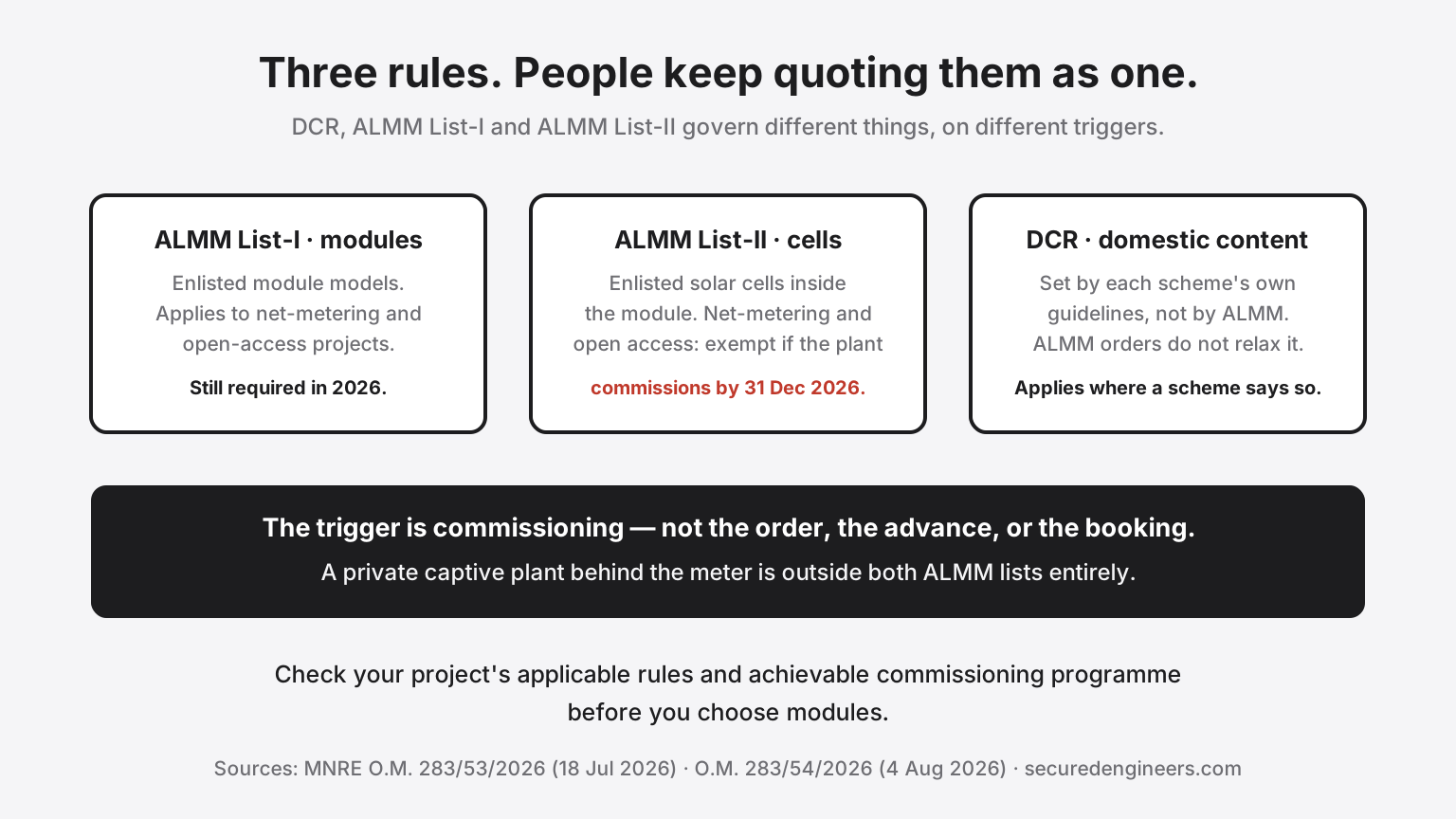
If you have asked three suppliers about solar modules this year you have probably been told three different things about "DCR", "ALMM" and a deadline. Some of what you were told is right for a different kind of project. This page sets out what the two governing MNRE orders actually say, which projects each rule reaches, and the single question that decides most of it: when will the plant commission?
Check your project's applicable rules and achievable commissioning programme before you choose modules.
Three rules, not one
| Rule | What it governs | Who sets it | Who it reaches |
|---|---|---|---|
| ALMM List-I | Which solar PV module models and manufacturers are enlisted | MNRE | Net-metering and open-access projects, government-connected projects — not private captive plants behind the meter |
| ALMM List-II | Which solar PV cells inside the module are enlisted. First issued 31 July 2025 | MNRE | The same projects as List-I — with a commissioning-based exemption through 31 December 2026 for net-metering and open-access projects |
| DCR | Domestic Content Requirement: cells and modules made in India | Each scheme's own guidelines — PM Surya Ghar, PM-KUSUM components, CPSU Phase-II and similar | Only projects under a scheme that imposes it. MNRE's 4 August 2026 clarification, para (f): the ALMM orders have no effect on DCR either way |
"Non-DCR panels" therefore means modules that do not meet a scheme's domestic-content condition. For a commercial plant with no subsidy and no tender, DCR is simply not in play. What is in play is ALMM — and which list, and from when, depends on how the plant connects and when it commissions.
What the two orders say
18 July 2026 — O.M. No. 283/53/2026-GRID SOLAR
MNRE's earlier position was that net-metering and open-access RE projects commissioned on or after 1 June 2026 must use List-I modules and List-II cells, with no blanket extension of List-II. The 18 July order supersedes the May and June 2026 orders on that point. In the ministry's own words, while there will be no blanket extension in applicability of ALMM List-II for solar power projects, however, a limited window is being provided for Net-metering projects and Open Access RE power projects, whereby such projects can now commission with exemption of ALMM List-II (for solar PV cells), till 31st December 2026.
Projects commissioned after that date will be required to comply with the ALMM List-II provisions.
4 August 2026 — O.M. No. 283/54/2026-GRID SOLAR (clarification)
Issued in response to requests for clarification, and it is the document to read if your project is anything other than a straightforward private rooftop. Its operative points:
- Net-metering and open access, para (b). Exempt from List-II
if commissioned by 31.12.2026
, else not. The exemptionis only for ALMM List-II (for solar PV cells), and compliance to ALMM List-I (for solar PV modules) still needs to be followed.
It appliesirrespective of whether the project is initiated pre or post 18.07.2026, and without any need/pre-requisite of any application on the portal.
- What "net-metering" covers. The order construes it to include
Gross Metering, Net Billing, Net Feed In, Virtual Net Metering, Group Net Metering, etc. but excluding Behind-The-Meter connections.
- Behind-the-meter, para (e). List-I and List-II
shall not apply to behind-the-meter solar power plants solely used for captive consumption by a consumer or group of consumers, other than Government entities or Public Sector Enterprises.
Government and PSU behind-the-meter plants must use List-I modules, and List-II cells too if commissioned after 31 December 2026. - Projects awarded through bidding, paras (a) and (c). Governed by the last date of bid submission against cut-offs of 9 December 2024, 28 July 2025 and 31 August 2025, with tender conditions prevailing in the middle band. These tiers are for tendered and government-building projects; they do not transfer to a private factory's plant.
- Residential, para (b). Net-metering consumers who opt to give up the PM Surya Ghar subsidy are exempt from List-II until the scheme period ends on 31 March 2027, subject to applying through the PMSG National Portal; List-I still applies. This is a residential provision and says nothing about commercial plants.
- DCR, para (f).
The Domestic Content Requirement (DCR) provisions in respective Schemes are governed by the Scheme Guidelines … and not by the orders / O.M.s on ALMM
; the ALMM orders do not relax DCR anywhere.
The trigger is commissioning
Everything in the 31 December 2026 window turns on the commissioning date of the plant — the date it is energised and accepted as complete, with the documentary evidence to show it. Not the purchase order. Not the advance. Not a booking confirmation from a supplier. A module shipment sitting in a warehouse on 31 December is not a commissioned plant, and nothing in either order treats it as one.
That is why the realistic programme matters more than the quoted one. A 500 kW rooftop on a working factory in North India runs through structural checks, DISCOM and CEIG filings, procurement lead times and the winter fog window before it is energised. If the honest commissioning date for your project is in the first quarter of 2027, the List-II exemption is not available to it, and the module decision should be made on that basis from the start rather than discovered at inspection.
What is outside both lists
A private business running a solar plant solely for its own consumption, behind its own meter, with no interaction with the grid, is outside ALMM List-I and List-II under para (e). That is a statement about the connection, not about the owner's intentions: a plant that is described as captive but is in fact net-metered, feeding in, or settled through the DISCOM is a net-metering project for this purpose and is reached by both lists on the dates above.
We will not suggest reconfiguring a connection to move a plant from one column to the other. Whether to export surplus, how it is settled, what the DISCOM requires and what the plant is worth to you are engineering and commercial questions with consequences of their own. Choose the connection for the right reasons; then apply the rules that follow from it.
What we check before advising on a 2026 project
- Connection arrangement, as it will actually be built — net-metering family, open access, or genuinely behind the meter — from the application, not the description.
- Scheme, subsidy or tender involvement, and the DCR terms of that scheme, read from its own guidelines.
- The realistic commissioning date against 31 December 2026, built from the actual programme including approvals and the season.
- The exact module model quoted, its List-I status at the time of supply, and — where List-II will apply — the cell eligibility, from the current lists rather than a supplier's assurance. List-I was last updated on 16 September 2026 and List-II is on its tenth revision as of 28 September 2026; both move.
- Utility acceptance — whether your DISCOM's own process asks for anything beyond MNRE's position.
- A check for any superseding MNRE order issued after the ones cited here.
Module pricing follows from those answers. Enlisted-cell modules and other modules are different products at different prices; the difference on any given day is a matter of scope-matched supplier quotations, not a figure to publish, and a price difference today is not a forecast of one tomorrow.
After the window
This page will not be taken down on 1 January 2027. The status block at the top switches to historical wording automatically on that date in Indian Standard Time, and the body will be revised against MNRE's position at the time. The URL stays stable so that anything linking here keeps working.
Frequently asked
Are non-DCR solar panels banned in India from 2026?
No. DCR — Domestic Content Requirement — is a condition of specific government schemes such as PM Surya Ghar and PM-KUSUM components, set by each scheme's own guidelines. It is not a general rule for all solar projects, and MNRE's 4 August 2026 clarification states expressly that the ALMM orders neither impose nor relax DCR. A commercial rooftop plant with no subsidy and no scheme involvement is not subject to DCR at all.
What is the difference between ALMM List-I and ALMM List-II?
List-I is MNRE's approved list of solar PV module models and manufacturers; List-II, first issued on 31 July 2025, is the equivalent list for the solar cells inside those modules. For net-metering and open-access projects, List-I (modules) applies throughout 2026. List-II (cells) is exempt for those projects if they are commissioned on or before 31 December 2026, and applies to any such project commissioned after that date.
Does the 31 December 2026 date apply to the order date, the advance, or commissioning?
Commissioning. MNRE's O.M. of 18 July 2026 ties the List-II exemption to projects that commission by 31 December 2026, and the 4 August 2026 clarification adds that this applies whether the project was initiated before or after 18 July 2026 and that no application on the NISE DCR portal is needed. An order placed or an advance paid before the date does not by itself secure the exemption if the plant commissions after it.
Does ALMM apply to a captive solar plant behind the meter?
For a private consumer, no. Para (e) of the 4 August 2026 clarification states that ALMM List-I and List-II do not apply to behind-the-meter solar plants used solely for captive consumption by a consumer or group of consumers, other than government entities or public-sector enterprises. Government and PSU behind-the-meter plants must use List-I modules and, if commissioned after 31 December 2026, List-II cells as well. Whether a plant is genuinely behind the meter is a question of how it is connected and metered, not of what it is called.
Should I switch to a behind-the-meter connection to avoid ALMM?
That is not a decision to make for compliance reasons. Connection type determines whether you can export, how surplus is settled, what the DISCOM requires and what the plant is worth to you — it is an engineering and commercial choice with its own consequences. We will not recommend changing it to escape a module rule, and a plant described as behind-the-meter that is in fact interacting with the grid is exposed on both counts.
What should a factory do before choosing modules for a 2026 plant?
Establish four things in writing: how the plant will connect (net-metering family, open access, or genuinely behind the meter); whether any subsidy, scheme or tender is involved and what its DCR terms are; the realistic commissioning date against the 31 December 2026 window, not the hoped-for one; and the exact module model and its List-I status at the time of supply, with the cell eligibility recorded where List-II will apply. Then check for any superseding MNRE order. Price the modules against that, not before it.
Related services
More insights
Rooftop solar without roof leaks — penetrations, ballast and the monsoon test
The plant works and the roof does not. Leak complaints arrive with the first monsoon, months after the installer demobilised. Here is how the detail is done properly.
Solar EnergyA Plant Down 8% Looks Exactly Like a Plant Working Fine.
Solar underperformance is invisible from the ground and rarely obvious in the monitoring portal. Aerial thermography inspects every module in a fraction of the time a manual survey takes — and finds the specific failures that inverter data cannot localise.