
How to select an industrial electrical contractor — licence, substation experience, CEIG record
An electrical contractor's work is checked by the Chief Electrical Inspector before a single machine runs, and the inspector checks the contractor's licence before the installation. Select on the licence, the substation record and the protection engineering; the panels and cable follow.
Last reviewed · Reviewed for checklist content, linked standards Authority names, portals, fees and timelines change with state notifications; confirm the live position with the authority before relying on it.
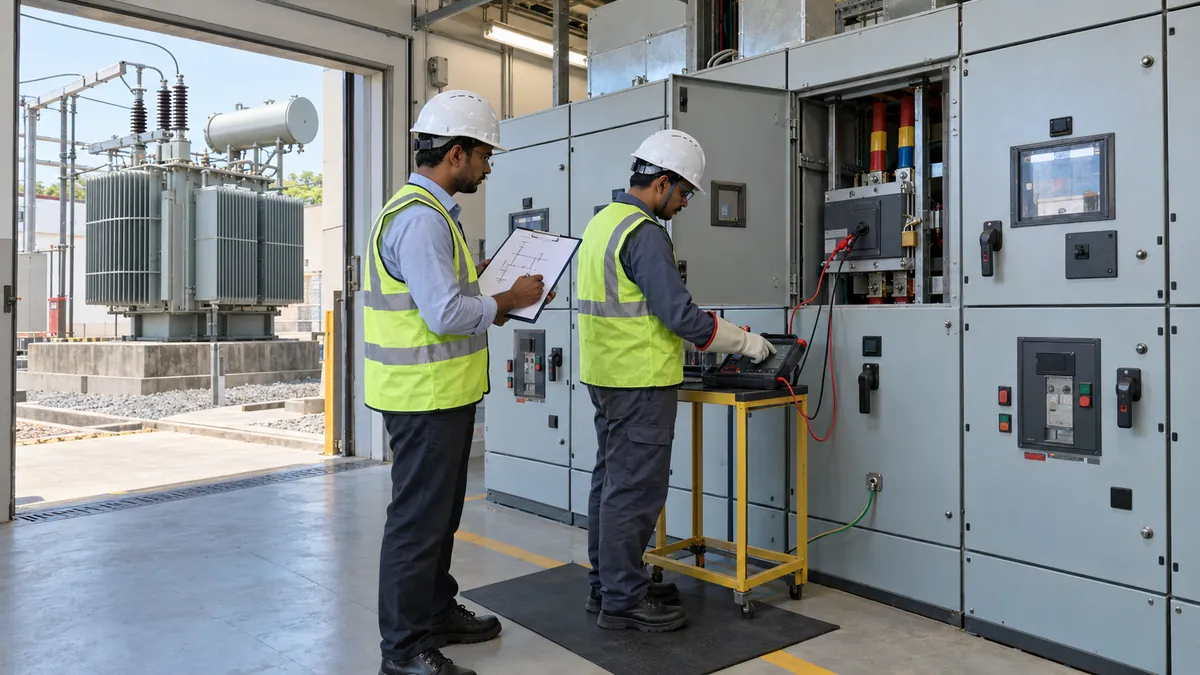
What to check
- The state electrical contractor licence and supervisor certificates — current, for the voltage class of your installation
- CEIG submissions the contractor has filed and had inspected as the licensed contractor, in your state
- Substations of your voltage and capacity delivered, with the energisation clearance
- Protection coordination capability — relay settings and a discrimination study on a past project
- Earthing design from measured soil resistivity, with recorded values
- DG and synchronising experience where backup power is in scope
Documents to request
- Electrical contractor licence and supervisor certificates
- A CEIG-approved drawing and the energisation clearance from a comparable project
- A protection coordination study sample
- Earthing test register from a recent handover
- Make list for switchgear, transformers, panels and cable, with type-test certificates for panels (IEC 61439)
Technical questions to ask
- How will you build the load list and maximum demand, and what sanctioned load will you apply for?
- What is the protection scheme from the DISCOM feeder to the last breaker, and who does the coordination study?
- How will earthing be designed — soil resistivity measured where, target values, electrode count?
- Cable sizing basis — derating for installation method and grouping, voltage drop, short-circuit withstand?
- Form of separation and fault level for the LT panels?
- When will the CEIG drawing be submitted relative to substation civil work?
Commercial questions to ask
- Are DISCOM sanction, CEIG filing and inspection attendance included?
- Are statutory fees excluded and stated?
- Is cable measured from routes on drawings, or from a metres-per-square-foot figure?
- Copper versus aluminium — and is the choice fixed in the contract?
- Is an escalation clause proposed for copper and steel, and on what index?
Hidden scope gaps to look for
- Earthing as a note on the drawing rather than a designed and priced system
- Protection relay settings and secondary injection testing not priced
- Fire-stopping at cable penetrations left to others
- DG acoustic enclosure and pollution-board consent excluded
- Substation civil work, cable trenches and DG foundations assumed to be the client's
- Thermography at first load not included
Commissioning documentation to insist on
- Insulation-resistance and high-voltage test reports for cables and switchgear
- Earth-resistance values by pit and at the main terminal
- Relay secondary-injection test records and the settings as applied
- Transformer test reports — ratio, insulation, oil breakdown voltage
- DG load-test and AMF/synchronisation sequence record
- CEIG energisation clearance and DISCOM connection agreement; as-built single-line diagram and cable schedule
Warranty and AMC terms to review
- Switchgear, transformer and DG warranties assigned to the client
- AMC with thermography, relay testing, earthing measurement before monsoon, transformer oil testing, DG servicing and APFC checks
- Periodic CEIG inspection compliance carried by the AMC provider or explicitly assigned
Safety and compliance issues that matter
- CEA (Measures relating to Safety and Electric Supply) Regulations; Electricity Act 2003; IS 732; IS 3043
- A licensed contractor — the inspectorate will not accept test reports otherwise
- Arc-flash and lockout procedures on live sites
- CPCB noise and emission norms for DG sets
How Secured Engineers can help
Secured Engineers Pvt. Ltd. holds the electrical contractor licence, files CEIG submissions as the licensed contractor, designs protection and earthing from measured values, and delivers the test records the inspectorate asks for. The CEIG guides set out the process by state; the transformer and DG calculators give a first check on ratings.
Related
Other buyer's guides
- How to select an MEP contractor
- How to select a fire protection contractor
- How to select an industrial HVAC contractor
- How to select a solar EPC contractor
- How to compare MEPF quotations
- How to evaluate solar EPC proposals
- How to evaluate fire protection quotes
All 8 guides are on the buyer's guides hub; the short answers are on the questions page and the terms in the engineering glossary.