
72.5 Million Square Feet Leased This Year. How Many Passed a Real Fire Audit?
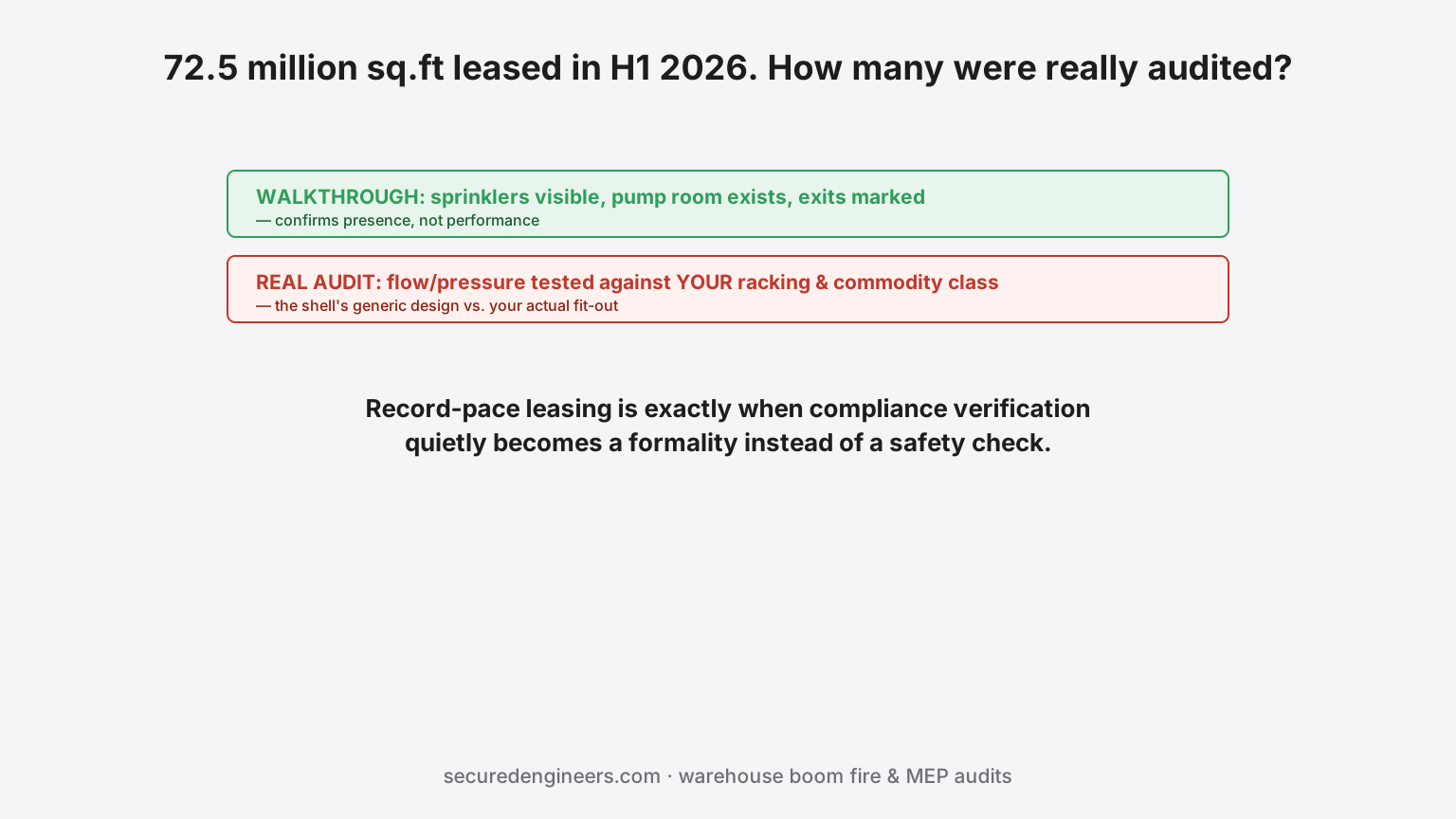
India's industrial and logistics real estate sector isn't just growing — it's accelerating. Net warehouse absorption hit 34.8 million square feet in H1 2026, total transacted volume jumped 29% year-on-year to 72.5 million square feet, and Grade A vacancy is tightening fast enough that operators are moving in on compressed timelines just to secure space before it's gone. That pace is good news for the sector and genuinely bad news for fire and MEP compliance quality — because speed is exactly the condition under which "it passed" quietly becomes "it looked fine at a walkthrough," not "it was properly audited."
Why boom-pace construction produces compliance gaps
- Developers building to lease, not to a specific tenant's operational profile — a generic Grade A shell can satisfy building-code minimums while still being poorly matched to what a specific tenant's actual racking, goods and operations demand, the exact gap covered in warehouse racking fire compliance
- Compressed handover-to-occupancy timelines leave little room for the kind of independent verification that catches gaps before a tenant is operating — commissioning gets treated as a milestone to clear, not a genuine performance check
- Fire and MEP contractors under the same schedule pressure as everyone else, the same compression covered in realistic project timelines — corners get cut on testing and documentation first, because they're the least visible to a walkthrough
- Tenant due diligence often focused on commercial terms and location, with fire and MEP compliance assumed rather than independently verified — reasonable when leasing an established facility, risky when leasing something built in the last eighteen months at record pace
What "passed a walkthrough" doesn't actually verify
| Looks fine at a walkthrough | What a genuine audit actually checks |
|---|---|
| Sprinkler heads visibly present | Water flow and pressure tested at the hydraulically farthest point, sized against the ACTUAL commodity class and storage height the tenant will use — not the generic design assumption |
| Fire pump room exists | Pump capacity, jockey pump function and changeover tested under real load, not just visually confirmed present |
| Electrical panels installed and labelled | Load capacity verified against actual operational equipment — racking automation, cold-chain equipment, charging infrastructure — not just the base-building design load |
| Fire exits and signage in place | Egress capacity calculated against actual occupancy and storage configuration, which can change significantly once a tenant's specific racking and goods are in place |
Where this specifically bites in a boom market
- Racking height and commodity class changes after handover — a shell designed for a generic storage assumption gets fitted out by the tenant for a very different actual use, and nobody re-verifies the fire system design against the new reality
- Multiple tenants in a multi-let facility each fitting out independently, with no single party responsible for verifying the building's fire and MEP systems still work as a coordinated whole once everyone's specific use is accounted for
- 3PL and e-commerce operators — the sector's fastest-growing tenant categories — often have automation, charging infrastructure and throughput demands well beyond what a standard Grade A shell's base electrical design assumed
- Tier-2/3 city facilities, where the boom's next growth wave is concentrated, sometimes have less mature local fire-department and approval-authority capacity to catch gaps that a metro-market audit process would flag
What tenants and developers should actually verify before occupancy
A real audit, not a walkthrough, tests systems under actual or simulated load, verifies design assumptions against the specific intended use (not the generic shell design), and produces documented evidence — the same documentation discipline that prevents disputes at handover generally. For any facility taken on in the current leasing pace, treat the compliance verification as a distinct, non-negotiable step separate from the commercial lease signing — not a formality bundled into the move-in schedule.
Our fire protection and testing & commissioning teams run independent verification audits for warehousing and logistics tenants and developers, testing systems against actual intended use rather than assuming the generic shell design already covers it.
FAQs
Is a "Grade A" classification a guarantee of proper fire and MEP compliance?
No — Grade A generally refers to construction quality, specifications and location standards, not independently verified fire and MEP system performance against your specific intended use.
Do we need a new fire safety audit if we're fitting out a shell with our own racking and equipment?
Yes — the base-building fire system design is typically sized against a generic assumption; your actual commodity class, storage height and equipment load need to be verified against that design, not assumed compatible.
Who's responsible for compliance in a multi-tenant warehouse facility?
This should be explicitly defined in the lease and facility management agreement — but regardless of contractual allocation, no single tenant's fit-out should be assumed compatible with shared fire systems without verification.
Can you design the fire and MEP scope a warehouse fit-out needs?
Yes — fire detection, suppression and MEP designed for your specific intended use and storage class, with the Fire NOC and occupancy approvals taken alongside. Request a proposal.
More insights
Moving the Machines Is the Easy Half of Moving a Factory
Riggers can shift a press in a weekend. What stretches into months is everything around it: power sanction and CEIG at the new premises, fire NOC from scratch, compressed air and utilities re-laid, and approvals that do not transfer with the trucks. A relocation is an MEP project wearing a logistics costume.
IndustrialLand Got Expensive, So the Factory Went Vertical. The MEP Design Didn't Follow.
Multi-storey industrial buildings are becoming common as land prices push factories vertical instead of horizontal — but MEP design habits built for single-storey sheds don't automatically transfer. Fire compartmentation, vertical risers and floor-by-floor load all need rethinking.