
Every MEP Contractor Says They Have Done It Before. Here Is How to Check.
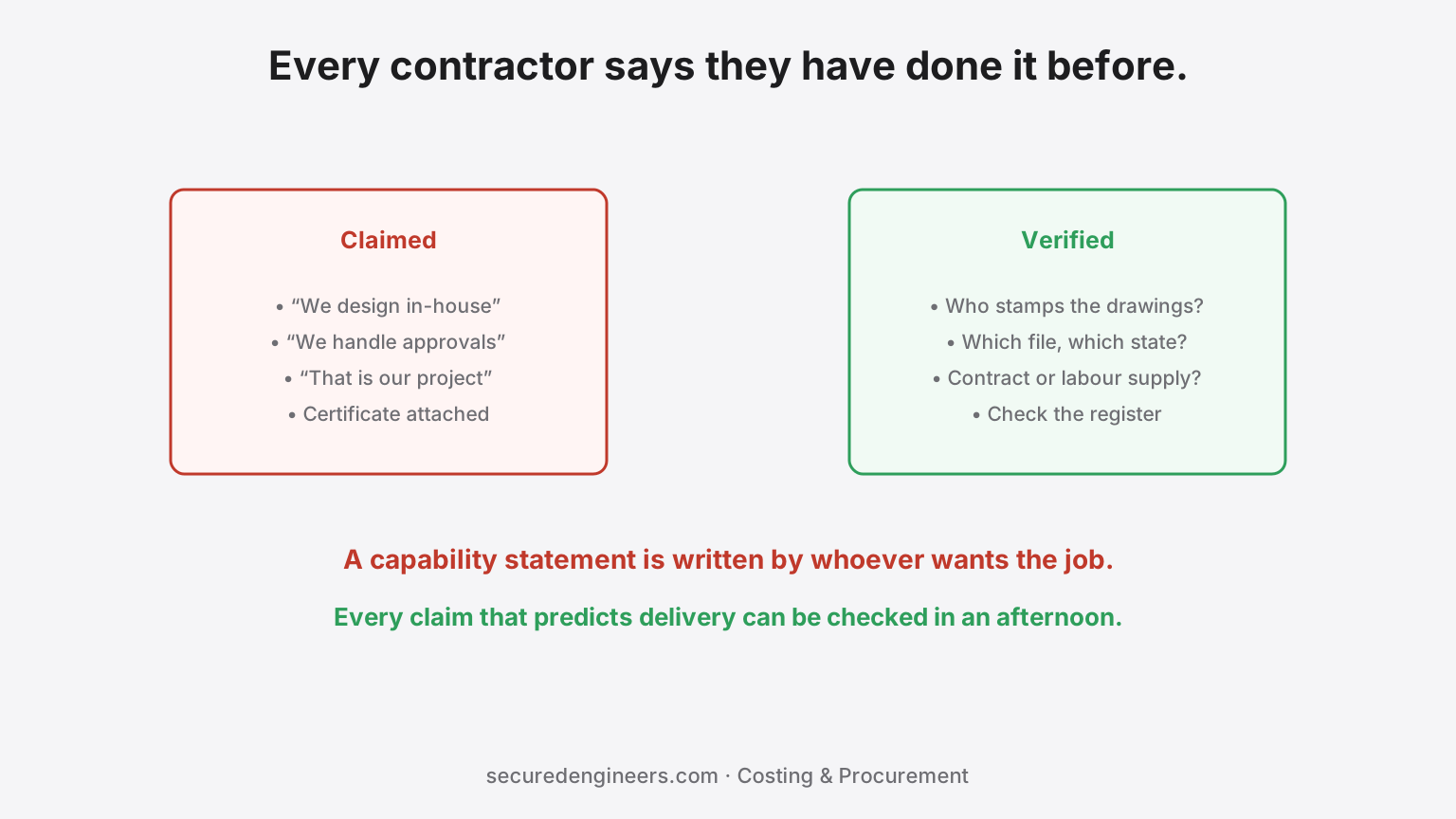
Every MEP tender produces a stack of near-identical capability statements: decades of experience, marquee clients, a project list, an ISO certificate. They are written by the party that wants the work, and almost none of it is checked before the award.
That is odd, because the claims that actually predict whether a project runs well are specific, factual, and verifiable in about an afternoon.
The four claims worth verifying
- "We do the design in-house." Ask who stamps the drawings and ask to speak to them. A contractor who outsources design to a freelancer has no one accountable when the design is wrong at 2am on site — and design errors are where MEP projects actually fail.
- "We handle the approvals." This is the one most often overstated. Ask which specific approvals they have personally filed in your state — Fire NOC, CEIG, pollution board — and ask for the file reference of a recent one. Handling approvals and knowing someone who does are very different capabilities.
- "We have done projects like yours." Ask for one where something went wrong and what it cost them to fix. A contractor with real delivery history has a war story; one reciting a portfolio usually does not.
- "That is our project." Establish whether they held the MEP contract or supplied labour to whoever did. Both appear on a project list identically, and they are entirely different businesses.
What separates an EPC contractor from a labour supplier
| Question | EPC contractor | Labour supplier |
|---|---|---|
| Who produces the shop drawings? | In-house engineering team | "Your consultant will give us drawings" |
| Who owns the statutory approvals? | Named person, files them directly | "We will support your consultant" |
| Who is liable if the system underperforms? | Contractually, them | Diffused across parties |
| What happens at commissioning? | Measured, documented, handed over | Everything is switched on |
| Who answers a defect in year two? | Same organisation | Usually gone |
The checks that cost nothing
Three that consistently reveal more than a capability statement:
Visit a live site, unannounced if you can. Not a finished showcase — a job in progress. Look at cable dressing, pipe supports, how material is stored, whether anyone is wearing the PPE the safety policy promises. Workmanship habits are visible in an hour and do not change between projects.
Call a client from two or three years ago, not last month. Recent clients are still inside the relationship. The useful question is not "were you happy" but "what did they do when something went wrong, and did they come back for the snags."
Check the registration, not just the certificate. An ISO certificate is a scan; the certifying body's register is the fact. Same for GST and company registration.
Why the cheapest bid usually fails this test
A materially lower bid is not generosity — it is a different scope, thinner materials, or a plan to recover margin through variations later. The verification above tends to expose which, because a bidder who has cut design and approvals out of their price cannot answer the first two questions convincingly. That dynamic is worth understanding before you compare numbers at all — we covered it in why the cheapest MEP contractor backfires, and the BOQ side in writing a BOQ that cannot be gamed.
What we do differently
We answer all four questions in writing before anyone signs: the engineers who stamp the drawings are ours, the approvals are filed by our own team, and the scope we quote is the scope we self-execute. See how that works under turnkey MEPF EPC, or ask for a budgetary proposal and check us against this list.
More insights
The AC Failed in Month 11 of a 12-Month DLP. Is That a Defect, or Just... Life?
The defect liability period sounds simple: the contractor fixes anything that goes wrong for 12 months after handover. In practice, 'goes wrong' is exactly where owner and contractor start disagreeing — is a filter clog a defect or routine maintenance the owner skipped? Is a compressor failure a manufacturing fault or normal wear? The DLP works only when 'defect' is defined before it's argued about.
Costing & ProcurementYour MEP Contractor Is an MSME. Your Payment Terms Say 90 Days.
Construction payment terms are negotiated as though they are free to agree. Where the supplier is a registered MSME, the statutory 45-day clock does not care what the contract says — and the consequences of ignoring it are financial, not merely contractual.