
EV charger testing, commissioning and AMC: what owners should verify
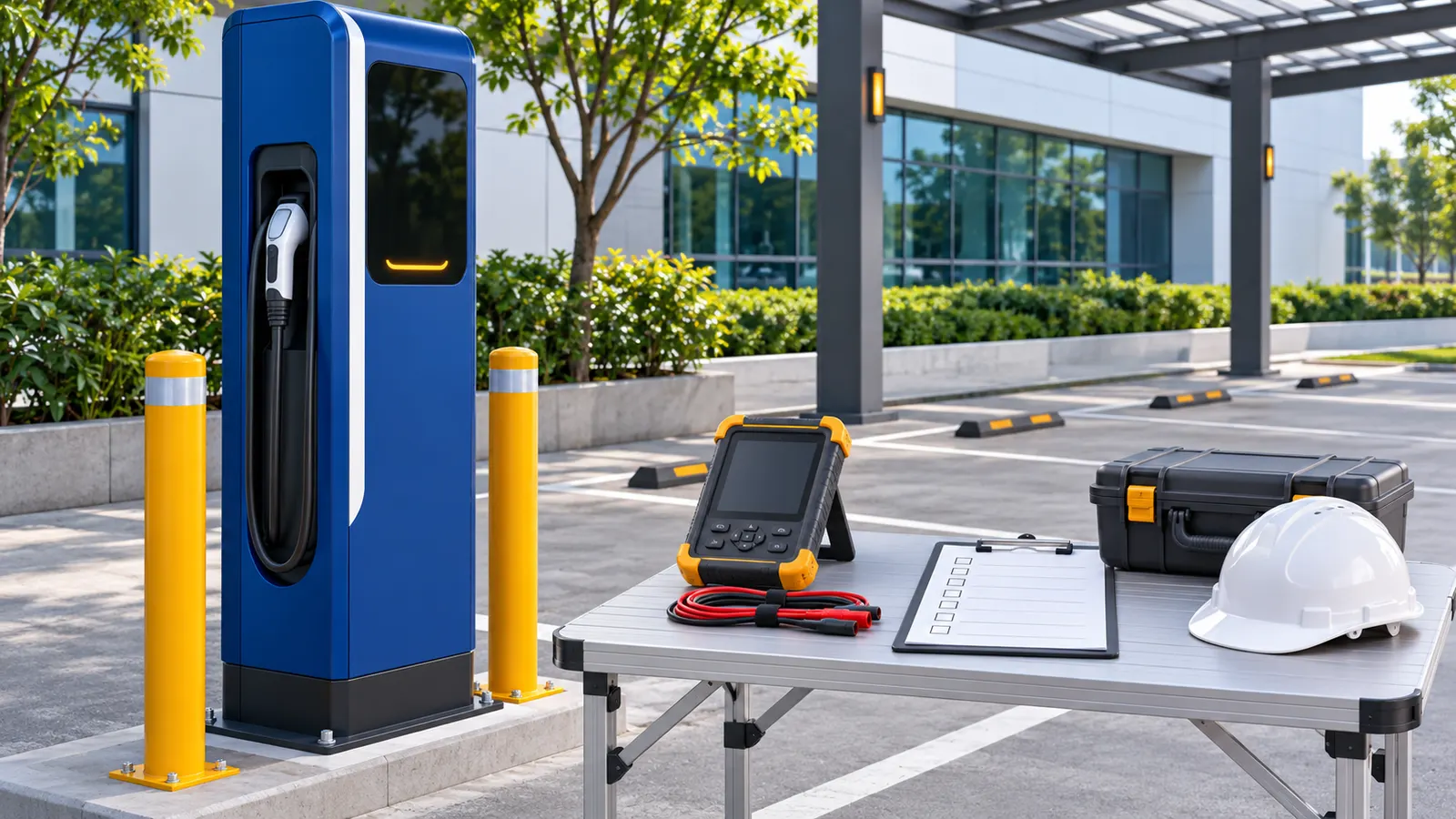
Commissioning should demonstrate a safe, documented installation and the agreed charging journey, not just an illuminated display. The owner needs evidence from the electrical contractor, charger OEM and software/operator team. An AMC then defines how that accepted installation will be maintained and restored when something fails.
Agree the acceptance plan before procurement, including pass criteria, test responsibilities, instruments, representative vehicles and document deliverables. Testing electrical protection is work for competent authorised personnel using approved procedures. This buyer checklist does not provide live-work instructions or generic protective settings.
Accept the installation in distinct stages
| Stage | What the owner should receive or witness | Typical responsible party to name |
|---|---|---|
| Document readiness | Approved drawings, equipment identity, applicable certificates and authority conditions | Designer, contractor, OEM and applicant |
| Installation inspection | Cable routes, enclosure condition, labels, barriers, drainage and access checked against design | Electrical/civil contractor and supervising engineer |
| Electrical verification | Signed tests for the designed circuits, earthing/bonding and protective functions, with instrument details | Competent testing personnel; inspector where required |
| Charger operation | Representative compatible-vehicle sessions, connector operation, configured output and alarms | OEM/authorised commissioning party and installer |
| Controls and billing | Authorisation, power allocation, session records, price display, payment and receipt where provided | CMS/operator team with OEM support |
| Handover | As-builts, settings, access rights, training, open-item list and warranty/support contacts | Contracting parties and owner's representative |
The CEA notified regulations register includes the 2023 safety regulations and 2026 amendment. Check applicable testing, inspection and record obligations against the installation and current provisions. Manufacturer instructions remain essential for model-specific checks. A conformity certificate for a charger does not certify the whole installed site.
Use evidence that can be traced later
Every test record should identify the site, circuit or asset, test date, method, result, acceptance criterion, instrument and responsible person. A generic signed “all OK” page is difficult to use after a fault. Keep charger serial numbers, firmware, protection settings, meter identifiers and the final SLD aligned.
For charging tests, record the vehicle, arrival state of charge, session duration, delivered energy, observed power and any shared-output conditions. A vehicle refusing high power is not automatically a charger failure; its charging limits and battery condition must be considered. Test the contractual requirement under the agreed conditions, rather than comparing an uncontrolled session with a peak brochure number.
Separate four kinds of support
| Issue | Responsibility to agree | Evidence needed for escalation |
|---|---|---|
| Installation defect | Contractor's defect-liability scope and exclusions | Affected circuit, installation record and inspection finding |
| Charger internal fault | OEM warranty, parts, labour, travel and replacement process | Serial number, fault code, logs and approved diagnostics |
| Platform or payment failure | CMS/operator/payment provider with one customer-facing owner | Session identifier, timestamps and reconciliation status |
| Routine maintenance or external damage | AMC scope, site team duties, exclusions and insurance route | Maintenance history, inspection record and incident report |
Ask whether preventive visits include cleaning, connector/cable inspection, enclosure condition, filters/cooling where fitted, electrical checks, firmware review and reports. Frequency should follow the equipment, environment, usage and applicable requirements. Specify consumables and spares separately. Do not assume an electrical AMC includes the OEM's proprietary charger repairs or a 24-hour customer helpdesk.
Define availability before agreeing a percentage
An availability figure needs a measurement unit and denominator. Is it per outlet, cabinet or site? Are only opening hours counted? Does a charger that is online but cannot start a session count as available? How are planned maintenance, utility outages, blocked parking, derated output and communications failure handled?
Illustration: for one outlet scheduled to operate 720 hours in a month, 12 unavailable hours produce (720 − 12) ÷ 720 × 100 = 98.33% availability, if all 12 hours are included under the agreed rule. Excluding six utility-outage hours changes the calculation and must be disclosed. This is arithmetic, not an SEPL SLA or performance result. Report successful-session rate and energy delivered alongside availability.
Make the handover pack usable by the site team
Provide operating instructions, emergency arrangements, isolation locations, approved user guidance, a support contact tree, warranty terms, maintenance schedule and owner access to data. Train the people who actually receive complaints. Record open defects with a responsible party and closure date; do not silently reclassify them as maintenance after acceptance.
For networked equipment, retain the verified OCPP certificate where one is specified and the actual integration-test record. A later firmware change should have an approval, backup and re-test plan appropriate to its effect.
Share your commissioning or support requirement Share the site location and your requirement with Secured Engineers. Electrical infrastructure, charger supply, software and ongoing support responsibilities are agreed in the project scope.
Continue planning your installation
- Agree acceptance evidence in the tender
- Test software and data portability
- Connect charger availability with fleet dispatch
Sources checked 7 November 2026. Confirm the applicable order, equipment revision and site conditions before procurement.
Related services
Guides that reference this page
- OCPP, OCPI and charging management software: a buyer’s checklist
- EV charging EPC tender checklist: BOQ, OEM scope and handover
- Own your EV chargers or host a CPO? Compare cost, control and responsibilities
- Fleet depot EV charging design: meet dispatch windows within available power
- EV Charging for a Factory Fleet and Employee Parking: Load, Chargers and Approvals
- Three Vendors, One Roof, Three Different Generation Figures.
Related on this site
- termModule Mounting Structure
- termPPA (Power Purchase Agreement)
- termEPC
- serviceO&M & Performance (Solar EPC)
- serviceCabling, Cable Trays & Bus Ducts (Electrical)
- calculatorUPS Runtime Calculator
- calculatorSolar Calculator
- buyer's guideHow to Select an MEP Contractor
- guideFire NOC for factories
- guideCEIG approval for factories
More on EV Charging · all insights