
Fleet depot EV charging design: meet dispatch windows within available power
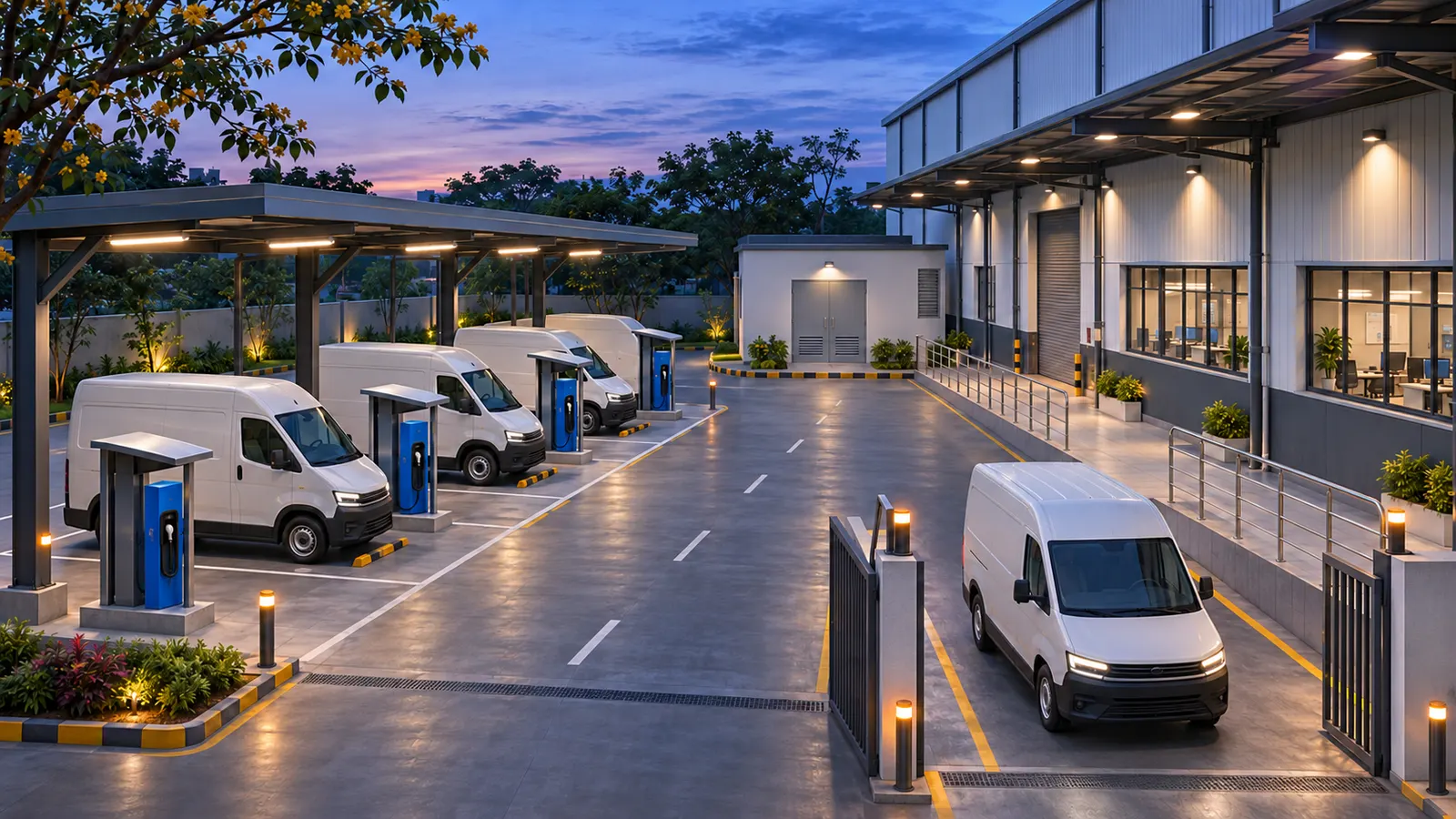
A depot charging plan succeeds when the required vehicles leave with enough energy, including on a difficult operating day. Daily kWh is the starting point; a time-based schedule reveals whether chargers, supply and parking operations can deliver it. A large connected charger capacity cannot recover hours when vehicles are still on the road.
This guide focuses on dispatch scheduling and resilience for depot managers. For a broader introduction covering employee cars and factory electrical readiness, use the existing factory fleet and employee charging guide. The example below is a planning exercise, not a design or a vehicle performance claim.
Create a vehicle-by-vehicle energy worksheet
| Input | What to record | Why an average is insufficient |
|---|---|---|
| Return and departure | Actual timestamps, cleaning/loading periods and earliest required dispatch | Not all parked time is available for charging. |
| Energy requirement | Route energy plus agreed reserve, less usable energy on arrival | Weather, payload and route changes affect the requirement. |
| Vehicle charging limits | Compatible connector, voltage/current range and usable charging curve | A peak rating does not describe the complete session. |
| Site constraints | Interval building demand, supply limits and charging allocation | The building may need more power during the same window. |
| Operational constraints | Bay access, reversing rules, cable reach and who moves vehicles | A theoretically free connector can be blocked by another vehicle. |
Worked overnight schedule: twelve delivery vans
Assume 12 compatible vans each require 30 kWh added to the battery: 360 kWh per night. Assume 90% overall efficiency from the EV supply meter to the battery, so input energy is 400 kWh. There are eight usable hours, 22:00–06:00. The energy-average input is 400 ÷ 8 = 50 kW, but that alone does not prove the schedule works.
Assume four charging outlets can each deliver 15 kW DC when all four operate together, with no shared-cabinet restriction beyond that total. Each van requires two hours at a constant 15 kW delivered power. Three consecutive groups of four therefore take six hours. At 90% efficiency, the four active outlets need about 66.7 kW input. The illustrative site's verified EV allocation is 70 kW throughout the period. The schedule fits arithmetically, leaving two hours for delays; actual charging curves, auxiliaries and changeovers must then be checked.
| Scenario | Arithmetic consequence | Decision |
|---|---|---|
| All vans available at 22:00 | Three two-hour groups finish by 04:00 | Confirm staff can move vehicles between groups. |
| Usable window falls to five hours | 400 kWh ÷ 5 h = 80 kW average input, exceeding the 70 kW allocation | Change operations, energy need or supply; more outlets alone do not solve it. |
| One of four independent outlets fails | Three outlets need four two-hour groups: the full eight hours | No recovery margin remains; plan backup or prioritised dispatch. |
| Fleet expands to sixteen vans | 480 kWh battery energy / 0.90 = 533.3 kWh input; four groups consume eight hours | Expansion fits only under ideal assumptions; test margin before ordering vehicles. |
If the outlets share one cabinet, or a single controller failure disables several chargers, the outage scenario changes. Record common failure points rather than assuming every gun is an independent spare.
Give load management a measurable job
Specify the maximum EV input at the site boundary, the priority rule for early departures, minimum useful allocations and the response when communications or metering fail. Ask the supplier to demonstrate that the limit is respected while the building load changes. Remote scheduling in a dashboard is not proof of dependable local power control.
Document which sessions may be deferred and how dispatch staff override priorities. Log missed energy targets and their causes: late vehicle, charger fault, utility outage, blocked bay or configuration. The distinction tells you whether to buy capacity, repair equipment or change the operating plan.
Reserve expansion routes without buying idle capacity blindly
Phase one can reserve space for an additional panel, cable routes, foundations or a future transformer while limiting initial equipment to the supported schedule. Re-run the model when vehicle types, routes or shifts change. Solar may offset daytime input, but overnight dispatch cannot depend on sunshine without a separately designed storage or energy arrangement. See the solar carport guide.
Check model-specific shared-output behaviour with the OEM; Exicom's compatible-charger power sharing illustrates why architecture matters. National charging guidance also treats e-bus depots separately; bus or heavy-truck procurement must be assessed against the relevant EVCI guideline provisions and vehicle requirements, not extrapolated from this van example.
Discuss a fleet or CPO rollout Share the site location and your requirement with Secured Engineers. Electrical infrastructure, charger supply, software and ongoing support responsibilities are agreed in the project scope.
Continue planning your installation
Sources checked 7 November 2026. Confirm the applicable order, equipment revision and site conditions before procurement.
Related services
Guides that reference this page
- EV charger testing, commissioning and AMC: what owners should verify
- EV charging electricity tariffs in Punjab, Delhi and UP: budget the full bill
- AC vs DC EV charging for commercial sites: choose by vehicle and dwell time
- EV Charging for a Factory Fleet and Employee Parking: Load, Chargers and Approvals
- Your Shopfloor Is Probably Lit Wrong in Both Directions at Once
- You Sized the DG. Nobody Sized the Safety Distance Its Diesel Tank Needs.
Related on this site
- termEarthing / Grounding (IS 3043)
- termPower Factor Correction
- termContract Demand
- serviceTransformers & DG Sets (Electrical)
- calculatorFactory Electrical Capacity Calculator
- calculatorSolar Water Pump Calculator
- buyer's guideHow to Compare MEPF Quotations
- guideEnvironmental clearance (EIA 2006)
- guideNBC 2016 fire and life safety for factories
More on EV Charging · all insights