
OCPP, OCPI and charging management software: a buyer’s checklist
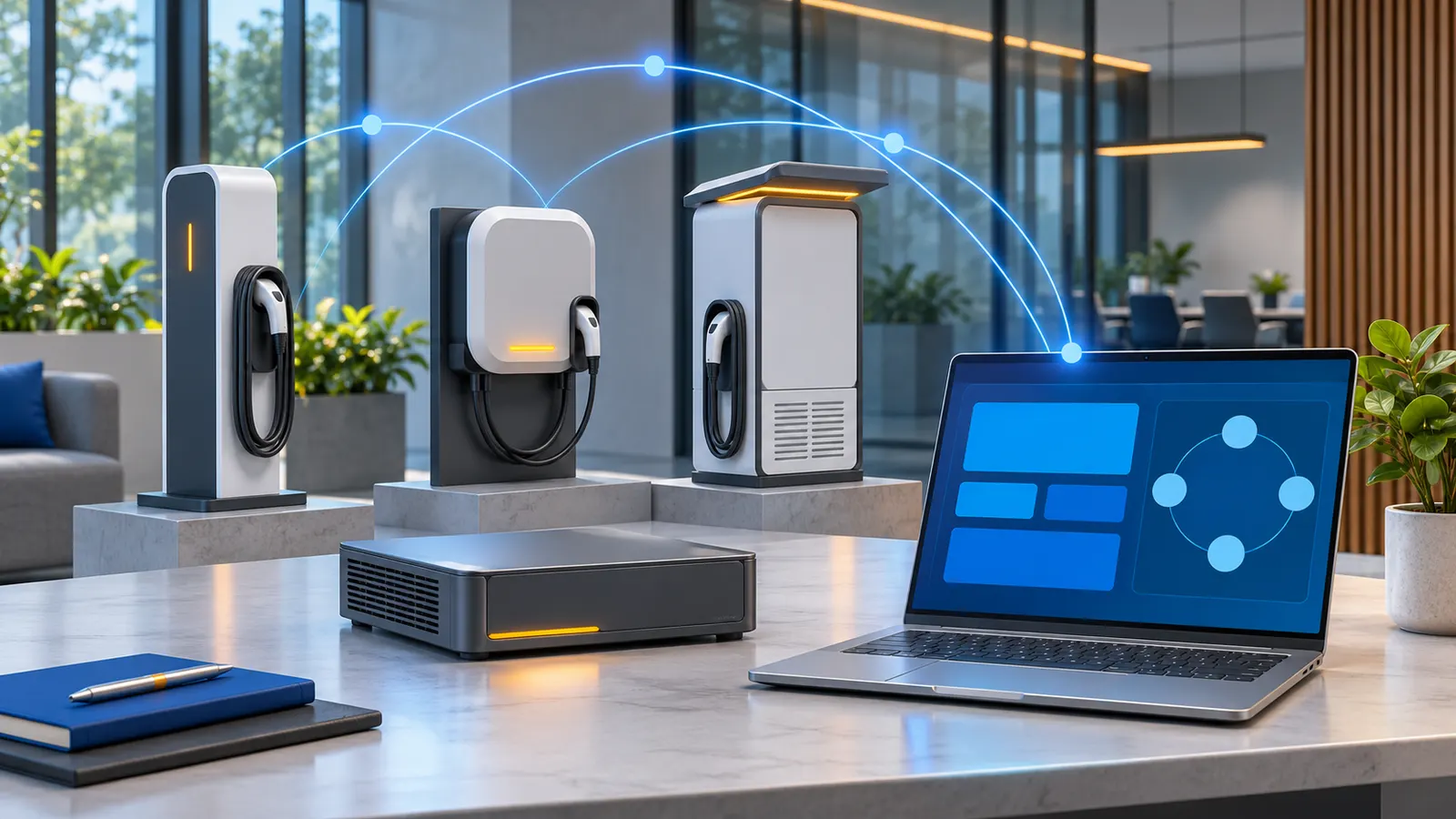
OCPP connects charging equipment with its management system; OCPI supports exchanges between charging operators and mobility-service platforms. They solve different interfaces. Neither abbreviation by itself proves that your charger, payment journey, roaming agreements and load controller will work together.
The Open Charge Alliance maintains OCPP. The EVRoaming Foundation maintains OCPI and describes connections between CPOs and eMobility Service Providers, directly or through roaming hubs. As checked on 7 November 2026, its page identifies OCPI 2.3.0 as current and 3.0 as a draft. Do not specify a draft as a released requirement without an explicit project reason.
Use an interface map with named owners
| Interface | Typical role | Procurement question |
|---|---|---|
| Vehicle ↔ EVSE | Physical connector and vehicle-charging communication | Does the exact vehicle charge correctly within the equipment's voltage/current limits? |
| EVSE ↔ CSMS | OCPP: charge-station status, sessions and supported management functions | Which version, security profile and functional profiles are implemented on both ends? |
| CPO platform ↔ mobility service / roaming hub | OCPI: supported exchanges such as locations, tariffs, sessions and charge detail records | Which modules and versions are enabled, and which commercial roaming agreements exist? |
| Site meter/controller ↔ chargers | Local energy allocation and site power limiting | Who controls the limit when the internet or remote platform is unavailable? |
| Customer ↔ payment / support provider | Authentication, payment, receipt, refund and assistance | Which contracted party owns each failed-session and billing issue? |
This is a roles diagram expressed as an accessible table. The actual architecture may combine several roles in one supplier, but combining them does not remove the need to test the boundaries.
“Supports OCPP” and “OCPP certified” are different statements
Ask for the official certificate number and verify it in the OCA certificate verification process. Match the manufacturer/product identity, charging-station or CSMS role, protocol version, relevant software/firmware and included profiles. Request clarification if a reseller's certificate names a different product. OCA membership, a lab logo or an unsupported statement in a brochure is insufficient evidence of an official certificate.
OCA's certification programme lists supported certification routes. A certificate is evidence of the specified conformance scope; it is not a promise that every optional feature works with every platform. Require an integration test of the exact combination you are purchasing.
Test everyday operation and failure recovery
- Register the charger and map physical outlets to the correct asset identifiers.
- Authorise, start and stop a session using every promised access method.
- Compare session energy, timestamps, tariff and receipt with the agreed meter boundary.
- Simulate a lost network connection using the supplier's controlled procedure; verify local behaviour and later record reconciliation.
- Demonstrate load allocation with several vehicles and changing building demand.
- Check remote resets, firmware-update approval, alarms and rollback responsibilities.
- Where roaming is contracted, run a session through the actual partner and reconcile its charge detail record.
Do not simulate electrical faults by bypassing protection. Software and network tests should be planned with the OEM and site team so operations remain controlled.
Put data and migration rights in the contract
Specify who owns site and session data, which exports are available, their format, retention period and delivery frequency. Keep customer information access proportional to the site's role. Define administrator permissions, credential handover, security updates, incident notification and access removal when staff or suppliers change.
For migration, require a documented process for changing the management endpoint, certificates and authorisation data. Ask whether the owner can export assets, tariffs, sessions and fault history without a new development project. Test one representative charger on the intended replacement platform before assuming a whole estate can move. Account for warranty conditions, licence fees and any proprietary functions that will be lost.
Price the complete service
List per-charger/per-connector charges, minimum subscription, connectivity, payment fees, roaming fees, branded apps, support hours and integration work separately. Specify what happens if the subscription ends. For a small captive installation, a simpler authorised-access and reporting arrangement may be enough; public or multi-site operations may need more. The requirement should follow the operating model.
Discuss software and OEM boundaries for your EV installation Share the site location and your requirement with Secured Engineers. Electrical infrastructure, charger supply, software and ongoing support responsibilities are agreed in the project scope.
Continue planning your installation
- Add software acceptance to the EPC tender
- Define the user and billing journey
- Verify handover and ongoing support
Sources checked 7 November 2026. Confirm the applicable order, equipment revision and site conditions before procurement.
Related services
Guides that reference this page
- EV charger testing, commissioning and AMC: what owners should verify
- EV charging EPC tender checklist: BOQ, OEM scope and handover
- Workplace and hotel EV charging: access, billing and parking policies
- Addressable Lighting Control Pays in Some Buildings and Not in Others.
- Your Shopfloor Is Probably Lit Wrong in Both Directions at Once
- EV Charging for a Factory Fleet and Employee Parking: Load, Chargers and Approvals
Related on this site
- termAPFC Panel
- termDG Set Sizing
- termContract Demand
- serviceLighting & Small Power (Electrical)
- serviceCCTV & IP Video Surveillance (Low Voltage / ELV)
- calculatorCctv Storage Calculator
- calculatorSolar Open Access Savings Calculator
- buyer's guideHow to Compare MEPF Quotations
- guideFire NOC for factories
- guideCEIG approval for factories
More on EV Charging · all insights