
The Cable Run Passed Its Current Rating. It Still Failed. Nobody Checked Voltage Drop.
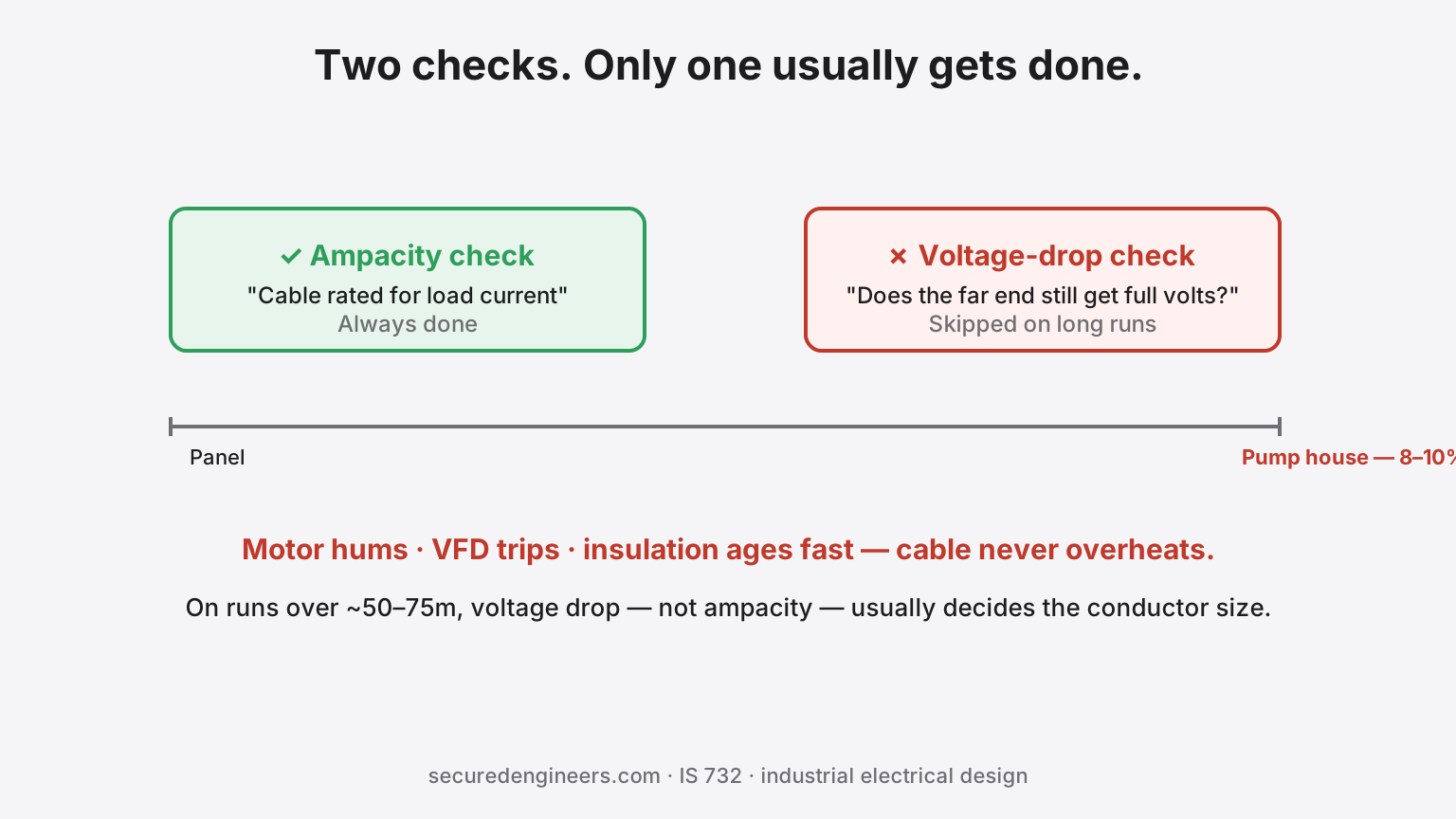
Ask most site electricians how a cable gets sized and you'll hear one number: current-carrying capacity. Look up the ampacity table, pick the conductor that's rated for the load current, done. On a 15-metre run to a panel next door, that's usually fine. On a 180-metre run to a pump house at the back of a plot, it's how you get a motor that hums, trips on start, and burns out its winding insulation years early — while the cable itself never once exceeds its rated temperature.
The missing check is voltage drop, and on long industrial runs it — not ampacity — is usually what decides the conductor size.
Why a "correctly rated" cable still fails
Every conductor has resistance. Push current through resistance over distance and you lose voltage along the way — proportionally to length, inversely to cross-sectional area. A cable that comfortably carries 100A without overheating can still drop the voltage at the far end by 8–10% on a long run, and Indian codes (aligned with IS 732) generally call for keeping total drop within about 3–5% for power circuits, tighter for lighting.
What an undervolted motor actually does:
- Draws more current to deliver the same torque — which heats the winding faster than the nameplate current implies, quietly shortening insulation life.
- Struggles on starting — starting current is already 5–7× running current; a voltage-depressed start pulls it out for longer, stressing contactors and the motor itself.
- Trips VFDs on undervoltage fault — modern drives protect themselves by tripping rather than running undervolted, which reads on-site as "the drive is faulty" when the actual fault is 200 metres of undersized copper.
Where this actually bites in Indian industrial layouts
| Situation | Why voltage drop dominates |
|---|---|
| Pump houses / effluent treatment at the plot boundary | Often 100–250m from the main LT panel — ampacity-only sizing routinely undersizes these runs |
| Solar inverter-to-panel DC/AC cabling | String and array cabling is long by design; drop here is lost generation, not just a code check |
| Phase 2/3 expansion sheds fed from an existing substation | The new shed is far from the original transformer; nobody re-runs the drop calculation for the new distance |
| DG-to-panel feeders on large plots | Genset yards sit away from the load centre for noise/exhaust reasons — a long feeder undersized on ampacity alone |
The fix costs nothing extra to specify
Voltage-drop checking is a calculation, not a material upgrade you pay a premium for — it just occasionally means one size up on the specific runs that need it, decided at design stage instead of discovered at commissioning. The inputs are simple: run length, load current, power factor, and the conductor's resistance/reactance per metre. Our cable size calculator runs both checks — current-carrying capacity and voltage drop — and flags which one actually governs your conductor size for a given run.
The pattern to watch for on any new layout: if a feeder run is longer than roughly 50–75 metres, don't assume ampacity sizing is enough — check drop explicitly, especially for motor and VFD loads where undervoltage isn't a code violation on paper, it's a real operating problem in month three.
What we do differently
Electrical design under our Electrical Infrastructure scope sizes every feeder for both ampacity and voltage drop as standard, not as an add-on check — because on an industrial plot, the runs that fail are rarely the short ones next to the panel.
More insights
Your UPS Is Not for Power Cuts. It Is for the 200 Milliseconds Before the DG Wakes Up.
Factories buy UPS capacity the way they buy stabilizers — by habit and by kVA. Then a half-second voltage dip scraps a batch anyway. What a UPS is actually for, which topology earns its cost, and how to size the battery honestly.
ElectricalYou Bought a Second DG for Redundancy. It Can't Actually Run in Parallel With the First.
Adding a second DG set for N+1 redundancy only works if the two sets can synchronize and share load — a control and switchgear problem, not just a second engine. Buy the second DG without planning synchronization, and you have two single points of failure, not real redundancy.