
The Plant Met Spec in 2020. The Spec Assumed Summers North India No Longer Has.
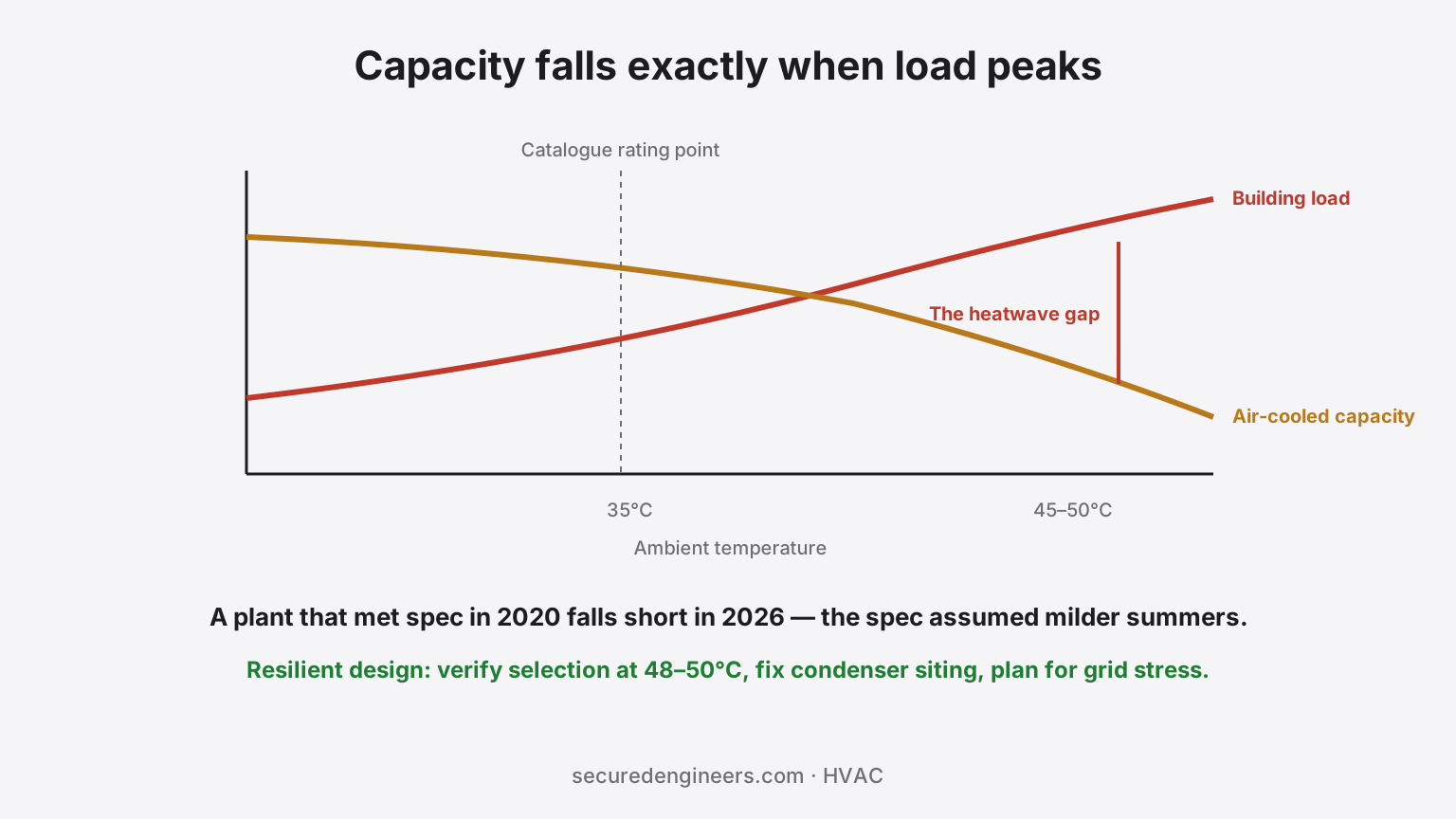
HVAC design in North India has quietly relied on an assumption that stopped being true: that the design summer peaks somewhere around the mid-40s for a few hours, and that a machine catalogued at 35°C ambient with "some margin" covers it. The last few summers have delivered sustained 45°C-plus spells across NCR, Punjab, Haryana and Rajasthan, with individual events pushing toward 50°C — and this is no longer treated as freak weather but as the recurring pattern buildings should be designed around. A plant that genuinely met its specification in 2020 can now fall short every May and June, not because anything broke, but because the specification described a climate the site no longer has.
The cruel physics: capacity falls exactly when load rises
An air-cooled chiller or VRF condenser rejects heat to the outside air. The hotter that air, the harder rejection gets: capacity drops, power draw rises, and efficiency falls — steeply, once ambient climbs well past the catalogue rating point. Meanwhile the building's cooling load is doing the opposite, peaking with the same heat. The gap between what the plant can deliver and what the building needs is at its widest at the exact hour that matters most. Add the second-order effects — condensers sitting on a roof that is itself far hotter than air temperature, discharge air recirculating between tightly packed units, high-pressure trips taking machines offline in sequence — and "the AC can't cope in a heatwave" is not a mystery. It's arithmetic that was done at the wrong ambient.
What climate-resilient design actually changes
| Design decision | Legacy practice | Resilient practice |
|---|---|---|
| Ambient design temperature | Standard published design condition, often effectively mid-40s or below | Selection verified at realistic site extremes — with capacity and power checked at 48–50°C, not just the catalogue point |
| Condenser sizing & siting | Tightest footprint, roof placement by leftover space | Oversized/derated selection, generous spacing against recirculation, shading where feasible, away from hot façades |
| Air-cooled vs water-cooled | Air-cooled by default for simplicity | Water-cooled or evaporative-assisted seriously evaluated for larger plants — wet-bulb, which cooling towers work against, rises far less than dry-bulb in an extreme |
| Roof & plant-room heat | Ignored | Cool-roof treatment, ventilated plant rooms, and equipment kept out of solar-baked enclosures |
| Heatwave power strategy | Generic DG backup | Backup sized and prioritised for cooling-critical loads, because grid stress peaks with the same heatwave |
The grid fails on the same afternoon
The last row deserves its own paragraph. Heatwaves stress the grid precisely when they stress your plant — record demand, sagging voltage, load shedding — so the probability of losing utility power is highest at the moment your building most needs full cooling capacity. Climate-resilient design treats this as one combined scenario: which cooling loads are critical (server rooms, healthcare areas, process cooling), whether the DG and changeover scheme can actually carry them through a 47°C afternoon, and whether voltage-sensitive drives ride through the switchover. A backup plan proven only on a mild day has not been proven.
What existing buildings can do
You rarely need to scrap the plant. The retrofit sequence that works: first, recover hidden capacity — condenser coil cleaning, correcting recirculation with ducting or barriers, shading, and cool-roof coating are cheap and directly improve high-ambient performance. Second, add controllability — variable-speed drives let the plant shed gracefully instead of tripping, and the same retrofit carries the year-round energy savings covered in our chiller VFD retrofit guide. Third, when any machine comes up for replacement, re-run the selection at today's design ambient rather than copying the old nameplate — the load side may have crept too, especially in heavily glazed buildings, where our glass façade load analysis shows how much of the problem comes in through the envelope.
Design for the summer you'll actually get
For new projects the rule is simpler: pick the ambient basis deliberately, as a risk decision made with the owner — not inherited silently from a catalogue. The capacity cost of designing for 48°C instead of 43°C is real but modest at design stage, and it buys the difference between a building that shrugs through a heatwave and one that makes the news. Start with an honest load number from our chiller capacity calculator, then let our HVAC & Mechanical team select and site the plant for the summers North India actually has now — with 15+ years of watching what happens to the plants that weren't.
More insights
The New Chiller Runs on a Mildly Flammable Refrigerant. Your Plant Room Was Never Designed for That.
R-32 and R-454B — mildly flammable A2L refrigerants — are now the default in new chillers, VRF and splits sold in India as R-410A phases down. Most building owners haven't noticed that this changes plant-room ventilation, leak detection, technician requirements and the AMC contract itself.
HVACVRF vs Chiller Plant: Which HVAC System Should You Choose in India?
A direct, India-specific comparison of VRF and chilled-water plants — by capacity, running cost, plant room, payback and the building types each one suits best.