
3.5 GW of Data Centres Got Announced. The Substations Did Not.
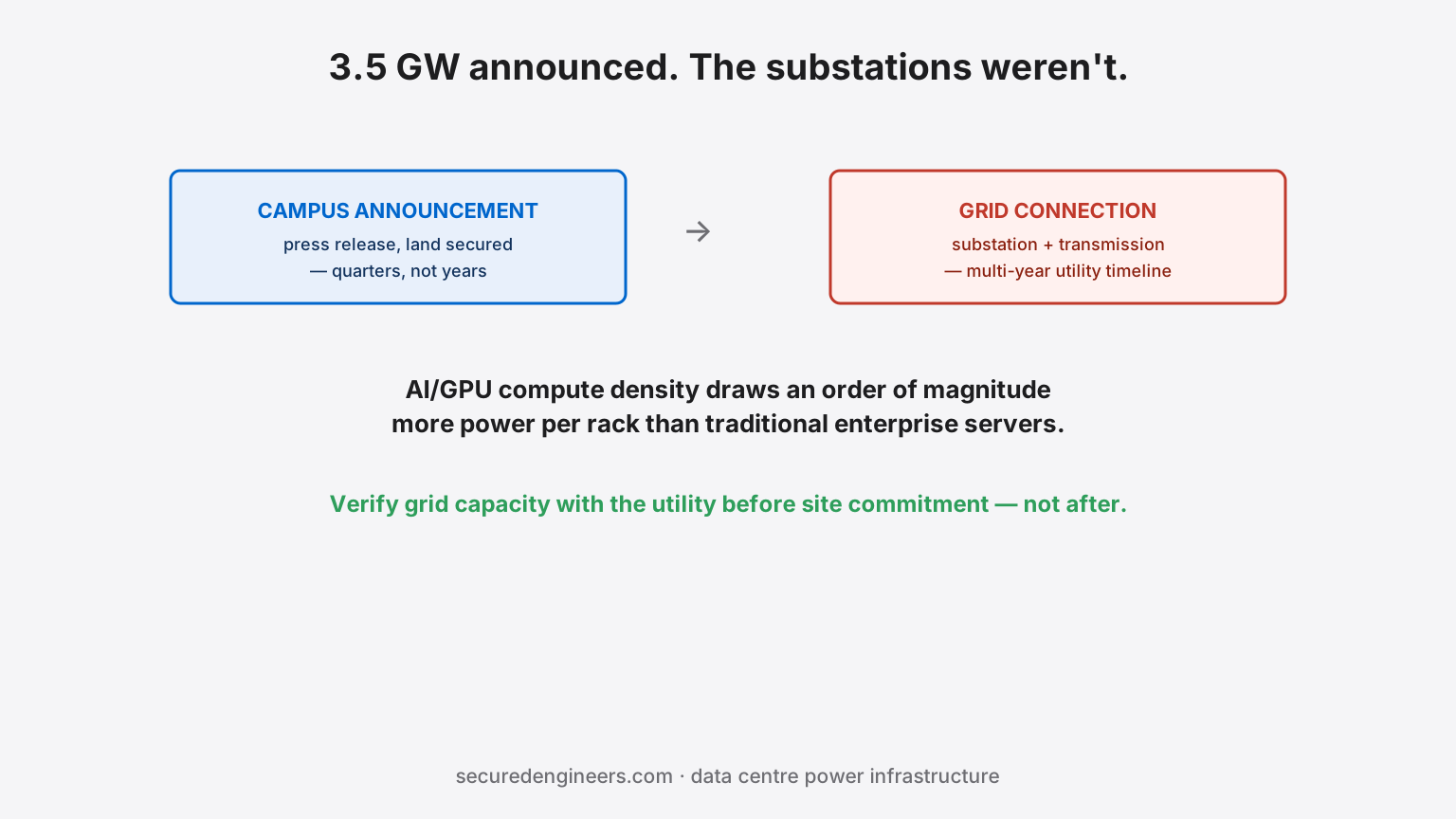
India's data centre industry is forecast to grow 66% by 2026, with capacity projected to expand another 30% year-on-year and around 500 MW of fresh supply expected online this year alone. Between March 2025 and April 2026, operators announced roughly 30 large projects collectively adding 3.5 GW of planned capacity, with Andhra Pradesh and Telangana alone accounting for over 2 GW of AI-centric mega campuses. What gets far less coverage than the announcements: a hyperscale AI data centre's power demand is an entirely different order of magnitude from a traditional enterprise facility, and grid infrastructure — substations, transmission capacity, HT connections — moves on a timeline measured in years, not the quarters an announcement press release implies.
Why AI data centres break the old power-planning assumptions
- AI/GPU compute density draws dramatically more power per rack than traditional enterprise server infrastructure — a data centre sized for "servers" in the old sense can be an order of magnitude under-provisioned for an AI-workload campus of the same floor area
- Announced capacity figures describe the campus plan, not the grid connection already secured — a 40MW facility announcement doesn't mean a 40MW substation connection exists or is even approved yet
- Redundancy requirements multiply the real demand — the N+1 or 2N redundancy a serious data centre needs applies to power infrastructure just as much as cooling, meaning the grid connection required is meaningfully larger than the facility's nameplate IT load alone
Where the power bottleneck actually bites, project by project
| Stage | What typically goes wrong |
|---|---|
| Site selection | Land and connectivity (fibre) get prioritised in site selection; grid capacity at that specific location is checked too late, or assumed available without confirming with the DISCOM/transmission utility |
| HT connection application | The same HT connection delays that affect any large industrial load apply here, at a scale where the delay cost is proportionally much larger given the capital already committed to construction |
| Substation upgrade dependency | A data centre campus's full planned capacity often requires a dedicated or upgraded substation — a multi-year utility infrastructure project that construction timelines don't naturally wait for |
| Phased campus buildout | The same shared-infrastructure undersizing risk covered in campus master planning — Phase 1's power infrastructure sized for Phase 1 alone, leaving no path to the announced full capacity without a second, disruptive utility project |
Why the tax incentives don't solve the physical bottleneck
The Union Budget 2026-27's 20-year tax holiday for eligible foreign cloud providers and 25-35% capital incentives for green technology adoption make the financial case for building in India stronger than ever — but tax policy doesn't build a substation. The capital incentives and the physical grid infrastructure timeline are two entirely separate constraints, and an operator that's solved the financing case still has to solve the power-delivery case, often on a longer critical path than the building itself.
What a realistic data centre power strategy actually requires
- Grid capacity confirmed with the actual utility before site commitment, not assumed from a general regional power-surplus narrative — the specific substation and feeder serving that exact site is what matters
- HT connection and substation upgrade applications filed in parallel with, not after, construction planning — given multi-year utility timelines, this is very often the true critical path for a large campus, not the building itself
- Full-campus power demand modelled from day one, even for phased construction — the same full-build-out logic that applies to shared campus infrastructure generally, so Phase 2 and 3 aren't stranded behind an undersized initial grid connection
- On-site generation and storage evaluated as a genuine part of the power strategy, not just a backup — captive generation, solar and battery storage can bridge gaps while grid infrastructure catches up, particularly relevant given the DG-vs-grid-vs-solar economics at this scale
- Redundant power paths designed against the facility's actual uptime tier requirement, not a generic assumption, mirroring the same discipline needed for cooling redundancy
Our electrical infrastructure team works through grid-capacity verification and HT connection strategy at the site-selection stage — before capital is committed to a location the grid can't actually support at the announced scale.
FAQs
Why does a data centre's announced capacity not match its actual available power?
Announced capacity typically describes the campus's planned build-out, not a confirmed grid connection — substation and transmission capacity at that specific site needs separate verification with the utility, and often takes longer to secure than construction itself.
How much more power does an AI data centre need compared to a traditional one?
Meaningfully more per rack, given GPU/AI compute density — a facility sized using traditional enterprise server assumptions can be significantly under-provisioned for an AI-workload campus of the same floor area.
Can on-site generation solve a data centre's grid capacity gap?
It can bridge a gap while grid infrastructure catches up, but captive generation, solar and storage need to be sized and integrated as a genuine part of the power strategy, not treated purely as backup for an otherwise-adequate grid connection.
Can you assess grid capacity and power strategy for a data centre site before we commit to it?
Yes — site-specific grid verification and HT connection strategy as part of site selection. Request an assessment.
More insights
The Data Hall Was Designed for 8 kW Racks. The AI Cluster Wants 60. Air Can't Bridge That Gap.
AI-era rack densities have pushed past what air cooling can physically remove — beyond roughly 30–40 kW per rack, liquid stops being optional. What rear-door heat exchangers, direct-to-chip and immersion each demand from the building, and why Indian edge and colo sites built air-only in 2024 are retrofitting in 2026.
Data CentreYou Bought a Tier III Server Room. The Cooling Is Tier I.
Uptime-tier ratings get quoted for power — dual utility feeds, UPS, generator backup — while cooling redundancy quietly gets value-engineered to N, not N+1. A data centre or server room with redundant power and single-string cooling has exactly one Achilles' heel: the day that one CRAC unit fails. What redundancy actually means for cooling, and how to verify you have what you paid for.