
AC vs DC EV charging for commercial sites: choose by vehicle and dwell time
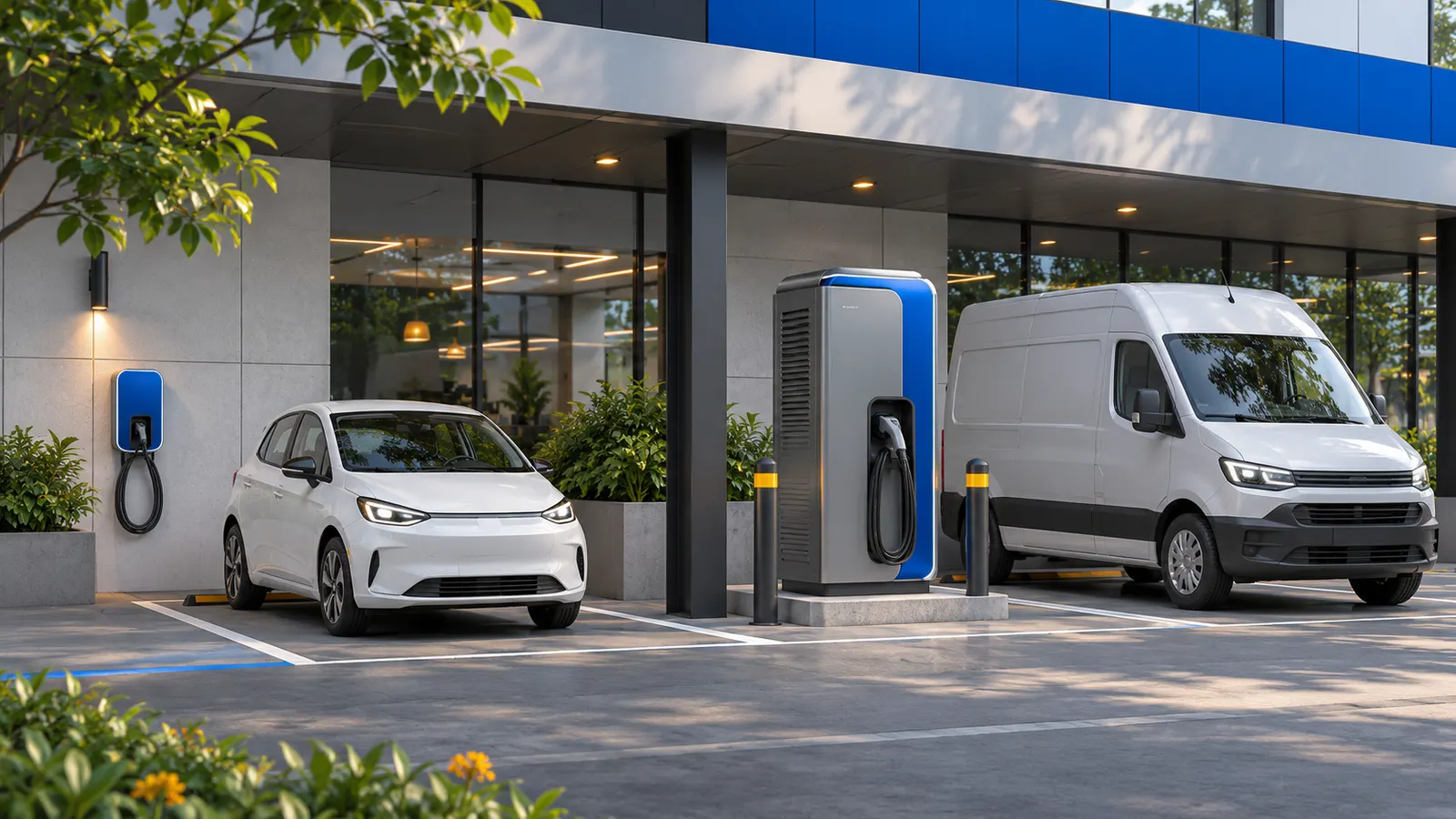
Choose AC when compatible vehicles have enough parking time to receive the required energy; consider DC when the charging window or vehicle duty requires it. Higher charger power is useful only if the vehicle, connector and available supply can use it. A 22 kW AC point does not make a car with a 7 kW on-board charging limit take 22 kW.
AC charging supplies the vehicle's on-board charger; DC equipment performs the conversion outside the vehicle. This distinction is explained in the NITI Aayog EV charging infrastructure handbook. Use that principle with the current vehicle manual and exact EVSE datasheet, rather than treating a generic connector label as proof of compatibility.
Start with the parking task
| Use case | First option to examine | Question that can change it |
|---|---|---|
| Employee cars parked for a full shift | AC points with managed allocation | Can each vehicle receive its daily top-up within the actual plugged-in hours? |
| Hotel guests staying overnight | AC charging plus a clear access policy | Are short-stay visitors or high-energy vehicles a material part of demand? |
| Delivery vans returning between routes | Compatible DC charging for the turnaround window | What power can the van sustain over the required state-of-charge range? |
| Mixed fleet depot | A schedule-led mix of charging powers | Can slower overnight charging and a priority recovery point meet dispatch? |
| Public short-stay parking | Compare dwell time, expected usage and operating costs | Will enough customers use the installed power to support the chosen model? |
Use charging-time examples correctly
Suppose a car needs 21 kWh added to its battery before departure. If the charger and car together permit 7 kW AC input and the assumed overall AC-to-battery efficiency is 90%, the arithmetic is 21 ÷ (7 × 0.90) = 3.33 hours. On a 22 kW AC point, the same 7 kW-limited car still needs approximately that time. The 90% figure is an illustrative assumption, not a specification or guaranteed session time.
For DC, suppose the required battery energy is 30 kWh and the vehicle sustains an average 40 kW at the battery over the selected window. The energy-only estimate is 30 ÷ 40 = 0.75 hours, or 45 minutes. Do not divide by a peak 60 kW nameplate if the vehicle's charging curve averages less. Arrival state of charge, temperature, preconditioning, battery limits and session overhead can change the result.
Separate DC output from building input
A hypothetical charger delivering 60 kW DC at 95% conversion efficiency draws about 63.2 kW before any separately specified auxiliary loads. At an assumed input power factor of 0.99, that is approximately 63.8 kVA. Actual design uses the manufacturer's maximum input data, including its operating conditions. kW is real power; kVA is apparent power; kWh is energy delivered or consumed over time.
Check the cabinet's total output as well as each outlet's limit. Power may be shared between vehicles, and some products can share capacity across compatible cabinets. Exicom's power-sharing explanation is one manufacturer example, not a claim that every charger has that capability. Ask the bidder to show the simultaneous-output table for the exact configuration.
Ask for a compatibility schedule before ordering
- Vehicle model and model year, AC phase/current limit, DC voltage/current envelope and inlet.
- EVSE model, connector, output range, cable reach and permitted installation environment.
- Number of vehicles charging together and the allocated power when all outlets are occupied.
- Load-management behaviour during network failure and recovery after a power interruption.
- Demonstrated charging with representative vehicles at site acceptance.
The EV charging load calculator is a screening tool. Final selection needs the electrical study, operating schedule and supplier's data. Do not buy DC purely because it appears more future-proof: reserve expansion routes and capacity on evidence, then install the useful first phase.
Request an EV site assessment Share the site location and your requirement with Secured Engineers. Electrical infrastructure, charger supply, software and ongoing support responsibilities are agreed in the project scope.
Continue planning your installation
Sources checked 7 November 2026. Confirm the applicable order, equipment revision and site conditions before procurement.
Related services
Guides that reference this page
- Workplace and hotel EV charging: access, billing and parking policies
- Fleet depot EV charging design: meet dispatch windows within available power
- EV charging station installation cost in India: what a complete BOQ includes
- You Were Going to Build a Parking Shed Anyway. Put Solar on It Before the EV Chargers Go In.
- Your Shopfloor Is Probably Lit Wrong in Both Directions at Once
- Busbar or Cable? The Rising-Mains Decision You Only Get to Make Once
Related on this site
- termEarthing / Grounding (IS 3043)
- termPower Factor Correction
- termContract Demand
- serviceLT Panels — PCC / MCC / APFC (Electrical)
- serviceEPABX & Intercom (Low Voltage / ELV)
- calculatorFactory Electrical Capacity Calculator
- calculatorEV Charging Load Calculator
- buyer's guideHow to Compare MEPF Quotations
- guideEnvironmental clearance (EIA 2006)
- guideNBC 2016 fire and life safety for factories
More on EV Charging · all insights