
Workplace and hotel EV charging: access, billing and parking policies
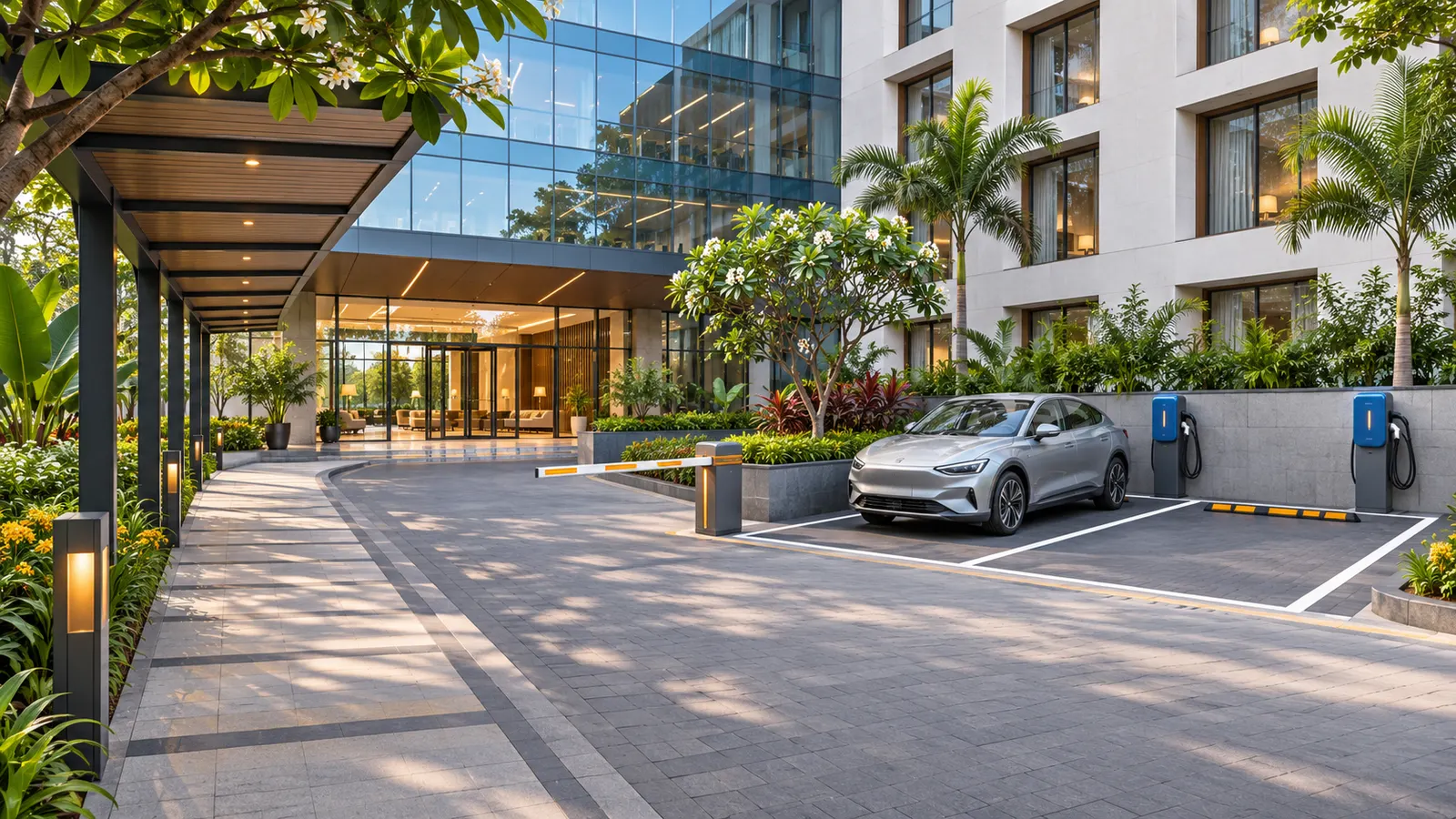
Workplace and hotel charging needs an operating policy as well as electrical infrastructure. Decide who can use it, how a session starts, who pays and what happens when a vehicle stays after charging. These decisions determine the software, metering and support you need.
Long dwell times can make managed AC charging suitable for many employee and overnight guest vehicles. A hotel with short-stay restaurant traffic, airport transfers or taxis may need a different mix. Use vehicle requirements and actual parking time, rather than assuming all hotel users can charge overnight. Electrical headroom and cable routes belong in the separate retrofit assessment.
Write a one-page operating policy before procurement
| Decision | Workplace example to evaluate | Hotel example to evaluate |
|---|---|---|
| Eligible users | Employees, tenants, visitors and authorised fleet vehicles | Resident guests, event visitors, restaurant customers and public users |
| Access method | Employee authorisation with a process for joining/leaving | Reception-assisted access or self-service with clear arrival instructions |
| Allocation | Fair daily energy allocation or rotating reservations | Guest booking linked to expected arrival and departure, with no unsupported energy guarantee |
| Payment | Employer benefit, direct user payment or approved internal allocation | Separate charging payment or agreed room-bill integration |
| Bay turnover | Moving vehicles during breaks without disrupting work | A policy that does not require overnight vehicle movement without agreed assistance |
| Fault response | Facilities team triage plus OEM/CMS escalation | A named reception process and technical escalation contact |
These are policy choices, not automatic legal entitlements or offers from SEPL. Confirm tariff, taxation, invoicing and employment/tenant arrangements with the responsible advisers and utility. Publish applicable prices and conditions before the session starts.
Separate a parking reservation from an energy promise
A reserved bay does not guarantee a full battery by a particular time. Ask for the vehicle model, desired energy and departure time, then explain any limits from shared power or the vehicle. If staff can move cars, agree permission, keys, access and responsibility under the site's normal procedures. Do not leave that arrangement to an electrician or charger app by default.
For an illustrative office, eight users each requesting 12 kWh need 96 kWh at the battery. At assumed 90% overall efficiency over seven usable hours, average grid input is about 15.2 kW. If eight 7 kW AC points are available, their 56 kW nameplate sum is a different quantity. A controlled allocation could fit the energy task within lower site power, but only after checking vehicle limits, arrival patterns and the controller's behaviour. This is an example, not a recommended design limit.
Design the customer journey through a failure
Test how a first-time visitor finds the bay, sees the price, authenticates, connects, starts, stops and receives a receipt. Then test a rejected payment, poor mobile signal, a charger marked available when the bay is blocked, and a vehicle that does not start charging. Reception or security staff need a short script that routes the problem without asking them to open electrical equipment.
Record which organisation owns the customer relationship and refunds. A CMS subscription does not necessarily include payment acquiring, roaming, a helpdesk or on-site maintenance. The EVRoaming Foundation's OCPI explanation describes a network-to-service-provider interface; buying an OCPI-capable platform alone does not provide a signed roaming or support agreement.
Keep parking and accessibility usable
Arrange bays and cable reach around real vehicle inlet positions, pedestrian routes and accessible use. Review collision protection, lighting, weather exposure and drainage in the site design. Keep emergency access and escape routes clear. Where chargers are in a basement, resolve the building/fire conditions before promising guests the facility.
Measure the first phase before expanding
Track requested versus delivered energy, completed and failed sessions, waiting users, occupied-but-not-charging time, complaints and cost allocation. Use anonymised operational reporting where possible. Expand when repeated unmet demand is demonstrated, and distinguish shortage of electrical capacity from blocked bays or a confusing app.
Request an EV site assessment for your workplace or hotel Share the site location and your requirement with Secured Engineers. Electrical infrastructure, charger supply, software and ongoing support responsibilities are agreed in the project scope.
Continue planning your installation
- Choose equipment around dwell time
- Compare ownership with hosting
- Specify the software and data responsibilities
Sources checked 7 November 2026. Confirm the applicable order, equipment revision and site conditions before procurement.
Related services
Guides that reference this page
- OCPP, OCPI and charging management software: a buyer’s checklist
- AC vs DC EV charging for commercial sites: choose by vehicle and dwell time
- Addressable Lighting Control Pays in Some Buildings and Not in Others.
- Your Shopfloor Is Probably Lit Wrong in Both Directions at Once
- Factory CCTV Expansion Planning: Cameras, Access Control and the Fire Alarm
- Your DG Is a ₹30/kWh Habit. Here Is What Every Unit Actually Costs.
Related on this site
- termCEIG Approval
- termLT vs HT Distribution
- termContract Demand
- serviceIntrusion, X-ray & Entrance Automation (Low Voltage / ELV)
- serviceSolar PV Modules (Solar EPC)
- calculatorUPS Runtime Calculator
- calculatorDG vs Solar Calculator
- buyer's guideHow to Compare MEPF Quotations
- guideCEIG approval for factories
- guideFactory approvals roadmap, India
More on EV Charging · all insights