
Your Panel Passed Inspection. Its Breakers Are Rated Below Your Actual Fault Current.
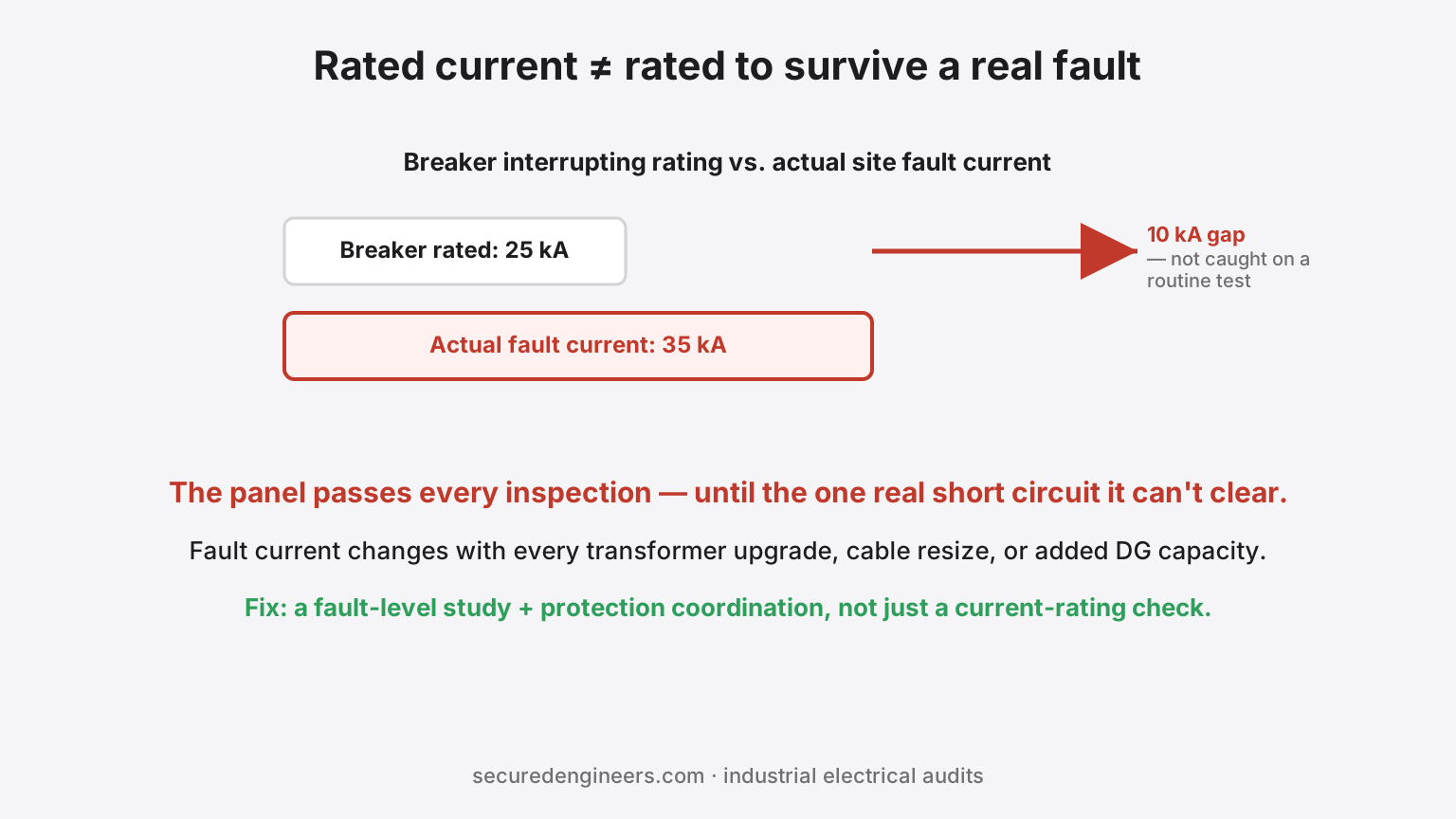
Every breaker has two ratings that get confused with each other: the current rating it switches routinely, and the interrupting (breaking) rating — the maximum fault current it can safely clear without exploding, welding shut, or throwing arc past its enclosure. The first one is on every nameplate and gets checked constantly. The second is a calculated property of the whole electrical system upstream, and on a large share of Indian factory panels, nobody ever calculated it.
A breaker with the right current rating and the wrong interrupting rating passes every routine test. It only fails once — on the one real short circuit it was never rated to clear.
Why interrupting rating isn't obvious from the panel
Fault current at any point in a system depends on the transformer's impedance, the length and size of every upstream cable, and how many sources (grid + DG, especially in parallel) can feed the fault simultaneously. It is not a fixed number stamped on the switchboard — it changes every time you add a transformer, upsize a cable, or add DG capacity, and it is highest closest to the transformer, tapering as you move downstream.
Two situations create the gap most often:
- Panels bought to a generic spec ("industry-standard 25kA breakers") without anyone calculating what the site's actual prospective fault current is at that panel's location.
- Load growth after commissioning — a transformer upgrade or a second transformer added years later raises fault current sitewide, but the breakers installed for the original, smaller system are never re-rated.
What actually happens when it's wrong
An underrated breaker facing a fault beyond its interrupting capacity doesn't just fail to clear the fault — it can fail destructively: contacts weld together, the arc isn't extinguished within the breaker, and the enclosure itself becomes the point of failure, which is a fundamentally different (and far more dangerous) event than "the breaker didn't trip." This is precisely the scenario protection coordination and interrupting-rating studies exist to prevent, and it is why serious industrial buyers increasingly ask for a fault-level study as a condition of handover, not an optional extra.
The coordination problem compounds it
Even where interrupting ratings are individually adequate, relay/breaker coordination — making sure the breaker closest to a fault trips first, not an upstream breaker that blacks out half the plant — is a separate study most panels also skip. Relays left on factory-default settings, copied from a different project with a different fault level, are one of the most common defects found on CEIG inspection, and the same gap shows up whether the trigger is a factory audit, an insurance survey, or an incident investigation.
What a proper study covers
| Study | What it establishes |
|---|---|
| Short-circuit / fault-level study | Prospective fault current (kA) at every panel and distribution board in the system |
| Breaker rating verification | Confirms every installed breaker's interrupting rating exceeds the fault current it could actually see |
| Protection coordination (selectivity) | Relay/breaker settings tuned so the nearest device trips first, minimising the blackout radius of any single fault |
This is exactly the kind of gap a fault-level study is built to surface — most factories that have never had one are surprised by what it finds, especially after any DG or transformer capacity has been added since original commissioning.
More insights
Grid Down. DG Running at 70% Capacity. 40 Tenants. Who Gets Power First?
Your building's DG covers 70% of connected load — an entirely normal design ratio. The day the grid actually fails, that 30% gap becomes a very personal argument between 40 tenants, none of whom knew where they stood in the queue. Backup power allocation is a policy decision, not an electrical one — and most buildings never make it.
ElectricalYour Electrician Opens That Panel Live Every Week. Nobody Has Calculated What It Could Do to Him.
Arc-flash — an explosive release of energy from a fault inside a live panel — is a well-documented, quantifiable risk in electrical safety practice worldwide. Indian factories routinely skip the study that quantifies it, leaving maintenance staff working on panels with no idea what the actual incident-energy exposure is.