
The Borewell You Drilled in 2009 Now Needs a Licence. And a Meter. And a Fee.
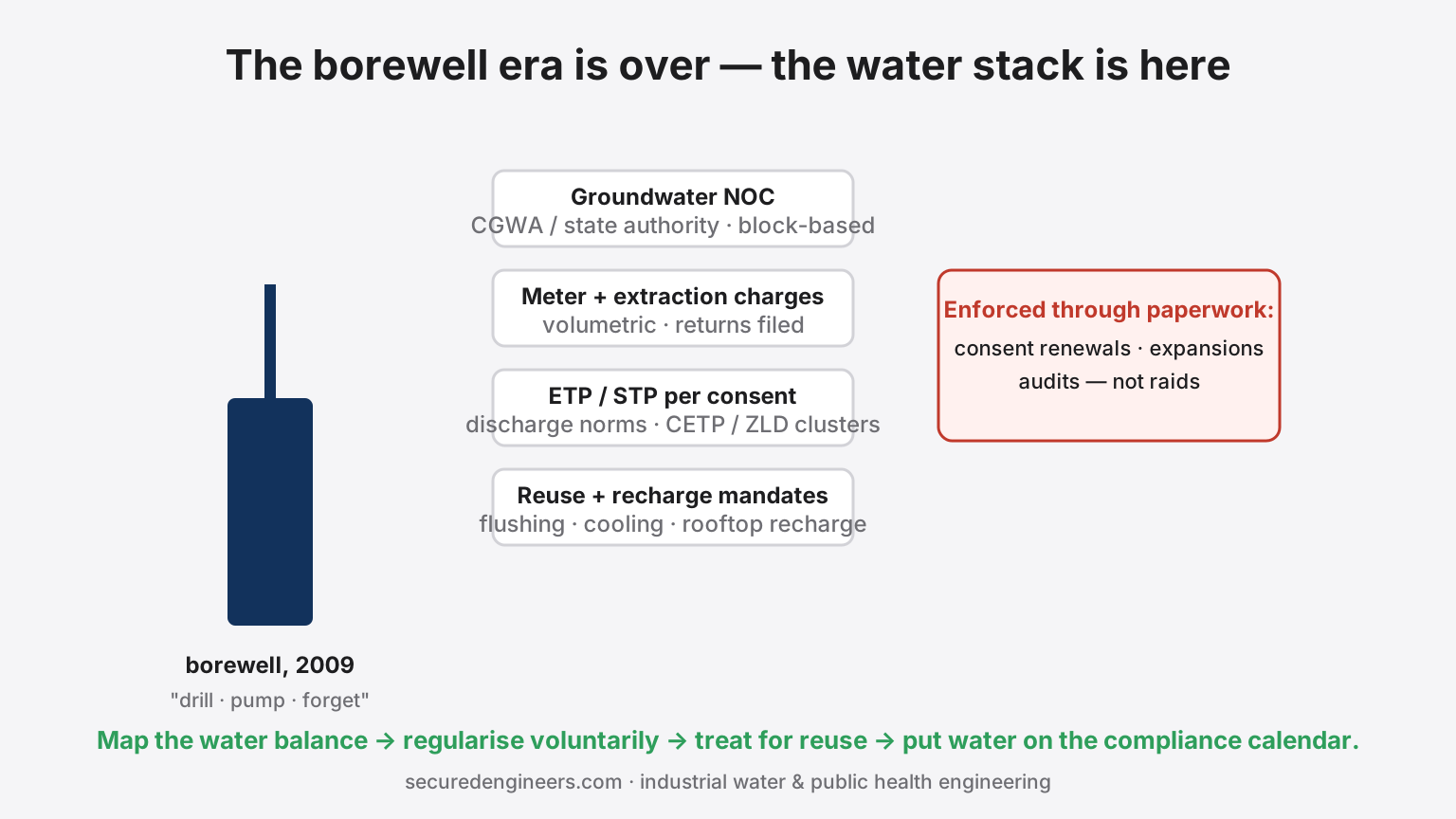
There is a generation of North Indian factories built on a simple water plan: drill a borewell, connect a pump, and never think about it again. That plan quietly expired. Groundwater in Punjab, Haryana and western UP is among the most stressed in the country, and the regulatory response has been assembling for years — NOCs, extraction charges, meters, recharge obligations and reuse mandates — enforced not by raids, but through the paperwork you cannot avoid: consent renewals, expansions and audits.
Most units discover the stack the way they discover every compliance layer — at expansion time, all at once.
The four layers of the water stack
| Layer | Who administers it | What it demands |
|---|---|---|
| Extraction permission | CGWA and/or the state groundwater authority (Punjab and Haryana run their own regimes; UP under state rules with CGWA overlay) | NOC to abstract groundwater, category- and block-dependent (safe vs over-exploited blocks), with validity and renewal |
| Extraction charges & metering | State authority schedules | Volumetric charges on abstraction, tamper-evident flow meters, periodic returns — the "free" borewell now has a bill |
| Effluent & sewage treatment | State pollution board via your CTE/CTO | ETP/STP sized and functioning per consent; discharge norms; in many clusters, CETP membership or zero-liquid-discharge |
| Reuse & recharge | Consents + building approvals | Treated-water reuse (flushing, cooling, horticulture) and rooftop rainwater recharge structures as approval conditions |
The block classification matters enormously: a unit over an over-exploited block faces a categorically harder regime than one over a safe block — and much of industrial Punjab and Haryana sits in the hard category. Verify your block status and the current authority rules before assuming anything; the schedules and thresholds revise frequently.
Where it actually bites
- Consent renewal cross-checks. The pollution board's renewal file increasingly asks for the groundwater NOC and meter returns. No NOC → a condition on your CTO → a clock you did not choose.
- Expansion applications. More production means more water on the application — which invites the question of where today's water lawfully comes from.
- The arithmetic of charges. Volumetric charges turn water efficiency from virtue into finance: a unit pulling 200 KLD pays real money annually, and every KLD recycled through the ETP/STP back into cooling towers and flushing comes straight off that bill.
- Water-intensive sectors first. Dyeing, electroplating, food processing, paper — the sectors with the biggest draw are the enforcement front line, and largely the same sectors already under Red-category consent scrutiny.
The audit-first sequence (same logic as every compliance trap)
- Map the water balance: what comes in (borewell, tanker, municipal), what each process consumes, what leaves as effluent — metered where possible, estimated honestly where not (water demand calculator for the design-side numbers)
- Verify your block status and NOC position with the current CGWA/state-authority rules — voluntary regularisation consistently beats discovered non-compliance
- Size treatment for reuse, not just discharge: an STP/ETP that produces reusable water converts a compliance cost into a supply line — flushing, cooling make-up and horticulture can absorb 30–60% of treated volumes in a typical plant
- Build the recharge structures properly: rainwater recharge sized to roof area and soil, not a symbolic pit for the inspection photo
- Put water on the same compliance calendar as fire and electrical — meter readings, returns, NOC renewals — because that is exactly where the enforcement now lives
FAQs
Does every factory borewell need an NOC?
Industrial groundwater abstraction broadly requires permission under the CGWA/state-authority regimes, with the stringency set by your block's classification and your draw. Exemption thresholds exist but are narrow — verify against the current rules rather than assuming legacy status protects you.
What do groundwater extraction charges cost?
They are volumetric, schedule-based and state-specific, rising with block stress and draw volume. For a mid-size water-using unit they are a real annual line item — and the strongest financial case for recycling you will find.
Can treated STP/ETP water really be reused?
Yes — flushing, cooling-tower make-up, floor wash and horticulture are standard reuse routes, and consents increasingly expect them. The design decision is making treatment quality match the reuse point, which is cheaper done at design than retrofitted.
Can you handle the whole water stack?
Yes — water balance, NOC applications, treatment and plumbing design, recharge structures and the consent-side paperwork run as one scope. Start with a water-compliance audit.
More insights
The Plant Room Meets Code. The Resident Next Door Still Can't Sleep.
A DG set, chiller plant or cooling tower can be fully compliant with equipment noise ratings and still generate a valid neighbour complaint, a Pollution Control Board notice, or an insurance and reputational headache — because ambient noise limits, not just equipment specification sheets, are what actually gets enforced. Acoustic enclosures and vibration isolation are plant room design decisions, not optional add-ons priced out under budget pressure.
ComplianceYou Have a Valid Fire NOC. It Does Not Cover What the Building Is Now.
A Fire NOC is issued against a specific building, occupancy and fire scheme. Add a mezzanine, raise the racking, change what you store or convert a shed — and the NOC you hold may no longer describe the building you have.