
Your Electrician Opens That Panel Live Every Week. Nobody Has Calculated What It Could Do to Him.
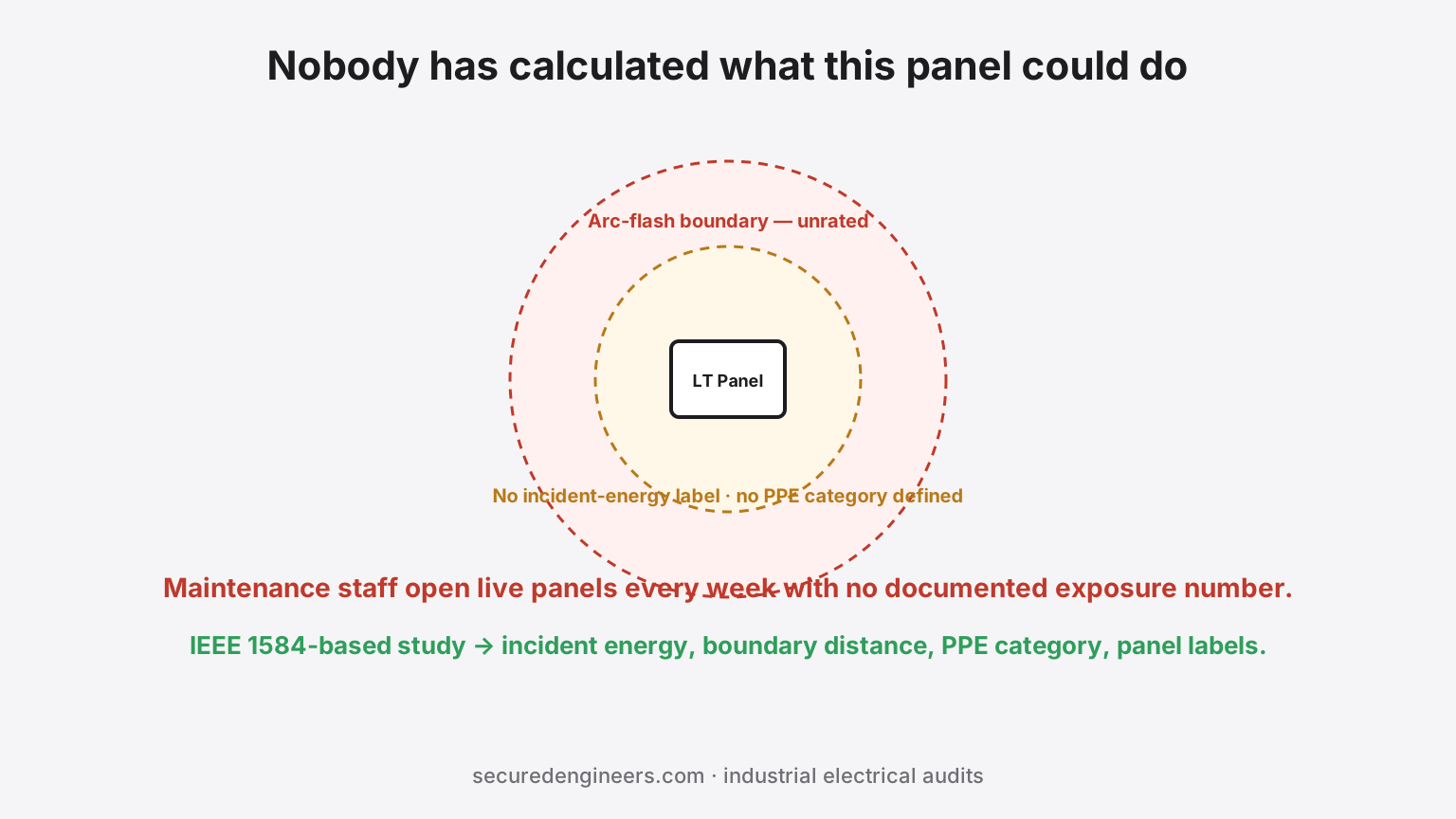
An arc flash is what happens when a fault occurs inside an energised electrical panel and the fault current arcs through air instead of through the intended conductive path — releasing an intense, explosive burst of heat, light and pressure in a fraction of a second. It is one of the most severe risks in electrical maintenance work, well studied and standardised internationally (IEEE 1584 is the reference calculation method used worldwide), and it is a risk that scales directly with the same fault-current levels covered in our fault-level coordination article — a panel with unrated breakers is very often also a panel nobody has arc-flash-assessed.
Why this gets skipped in Indian industrial practice
Arc-flash studies are standard practice in mature safety cultures internationally, but they remain uncommon on Indian factory floors relative to how routinely maintenance staff work on or near live panels — racking breakers, checking connections, troubleshooting — often without any documented incident-energy rating telling them what protective equipment the task actually requires, or whether the task should be done live at all. The gap isn't awareness that arc flash is dangerous in general; it's the absence of a site-specific calculation translating "dangerous" into a number that drives real PPE and procedure decisions.
What a study actually produces
| Output | What it's used for |
|---|---|
| Incident energy (cal/cm²) at each panel/bus | Determines the PPE category required for any work on that specific panel |
| Arc-flash boundary distance | Defines the safe approach distance for anyone not wearing rated PPE |
| Panel labelling | Physical labels on each panel stating its hazard category — so the information is at the point of work, not in a filed report |
| Recommendations to reduce risk | Often the study itself identifies protection-setting changes that lower incident energy, not just document it |
The liability dimension
Beyond the direct safety case, arc-flash exposure is increasingly a factor in industrial insurance underwriting and in due-diligence reviews ahead of acquisitions or major expansions — an undocumented, unquantified electrical safety risk is exactly the kind of gap that surfaces in the pre-transaction reviews covered in our MEP due-diligence guide. Having the study on file, with current panel labels matching the calculated hazard levels, converts an open question into a documented, managed risk — which matters as much for insurance and transaction purposes as it does for the person opening the panel.
An arc-flash assessment is only meaningful when it is calculated against your actual system's fault levels and protection settings, not a generic industry estimate.
More insights
Where Wires Go to Die: Why Indian Electrical Layouts Fail Every Single Time
Your switches end up at shoulder height, your lights cast shadows on your desk, and your bathroom has no ELCB. None of it was on the drawing — and all of it was preventable.
ElectricalEvery Meter Reads Normal. Your Neutral Is Still Overheating. That's What Harmonics Do.
VFDs, LED drivers, UPS units and solar inverters have quietly filled modern plants with non-linear loads — and the harmonic distortion they inject overheats neutrals and transformers, trips sensitive equipment and kills capacitor banks. A standard electrical audit won't see any of it; a power-quality audit is built to.