
You Bought a Second DG for Redundancy. It Can't Actually Run in Parallel With the First.
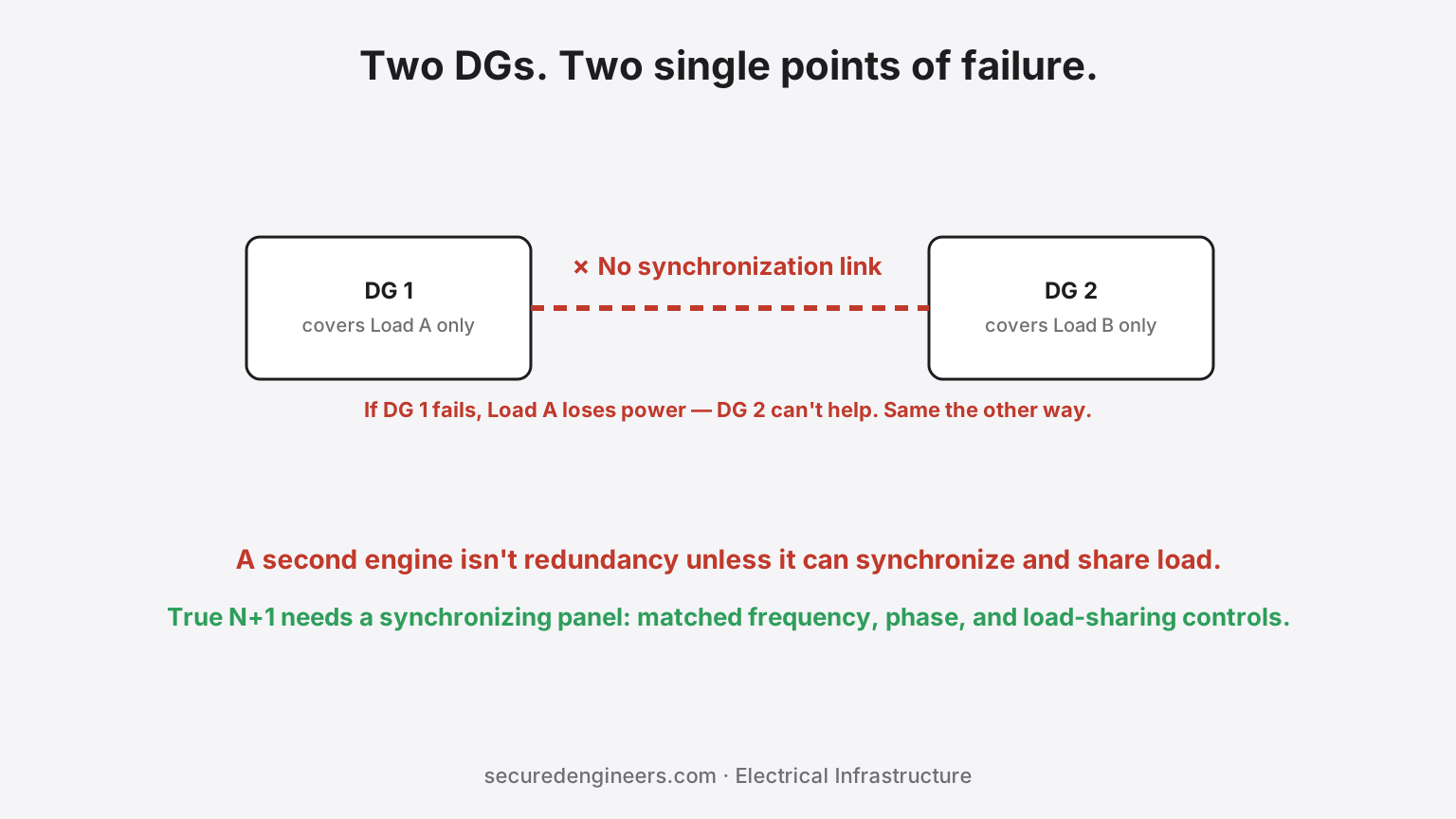
The logic behind adding a second DG set is simple: if one fails, the other covers the load, and critical operations never lose power. That logic only holds if the two sets can actually synchronize — start, match frequency and voltage phase, and share load together on a common bus — which is a control and switchgear design problem, not something that happens automatically because two gensets are wired into the same building.
What "N+1" actually requires
True N+1 DG redundancy (enough capacity that any one set can fail without a supply interruption) needs, at minimum:
- Synchronizing controls — matching frequency, voltage and phase angle before closing the paralleling breaker, done automatically and fast enough that the transition doesn't itself cause a disturbance.
- Load-sharing logic — once paralleled, the sets need to share the connected load proportionally (typically by kW and kVAR droop control), not have one set carry everything while the other idles or, worse, fight over the load.
- Protection coordination between sets — a fault on one set's output must isolate that set without tripping the whole bus, which circles back to the same coordination discipline covered in our fault-level coordination article.
- A genset-rated synchronizing panel — purpose-built switchgear for this, not a manual changeover panel repurposed for two sources.
Where this breaks in practice
The common failure pattern: a facility starts with one DG, sized correctly for the load at the time. Load grows, and rather than replacing the DG with a larger single unit, a second DG of similar size is added — often years later, sometimes from a different manufacturer or a different control platform than the first. Without synchronizing controls designed for that specific pairing, the two sets can run independently (each covering a segregated part of the load, switched manually) but cannot run together sharing one load — which means neither set alone can cover the full load if the other fails. The facility has two DGs and, functionally, zero true redundancy.
Getting it right
| Approach | What it buys you |
|---|---|
| Segregated (manual changeover) DGs | Simple, cheap — but each DG is a single point of failure for its own segment |
| Synchronized, load-sharing DGs | Genuine N+1 — any one set can fail with automatic, uninterrupted coverage by the rest |
| Mixed-brand/mixed-age synchronization | Possible, but needs the synchronizing panel specifically engineered for the pairing — not assumed to work by default |
If genuine redundancy is the goal — not just "a spare engine somewhere on site" — synchronization needs to be part of the DG specification from the start, sized and controlled as one system rather than bolted together as two separate purchases. Size your load correctly first with our DG sizing calculator, then talk to our Electrical Infrastructure team about whether your redundancy plan actually delivers redundancy.
More insights
Every Meter Reads Normal. Your Neutral Is Still Overheating. That's What Harmonics Do.
VFDs, LED drivers, UPS units and solar inverters have quietly filled modern plants with non-linear loads — and the harmonic distortion they inject overheats neutrals and transformers, trips sensitive equipment and kills capacitor banks. A standard electrical audit won't see any of it; a power-quality audit is built to.
ElectricalThe Transformer Fit Day-One Load Perfectly. Then You Grew.
A transformer and substation sized precisely to opening-day load looks efficient on the cost sheet — until the first expansion, the first new production line, the first added shift, all discover there's no headroom left. Substation undersizing is one of the most expensive false economies in industrial electrical design, because the fix isn't a component swap, it's often a new substation.