
Fire NOC process for factories — documents, inspection and timelines
A Fire NOC is issued by the State Fire Service against a fire-protection scheme designed to NBC 2016 Part 4. This page sets out the whole process for factories, warehouses, commercial buildings, hospitals and hotels — and draws the line between what a consultant or contractor does and what only the statutory authority can do. For the state-by-state route, start with Fire NOC for factories in Punjab, Haryana and UP.
Last reviewed · Reviewed for Fire NOC process, NBC 2016 Part 4 basis, state guide links Authority names, portals, fees and timelines change with state notifications; confirm the live position with the authority before relying on it.
Get a Fire NOC Readiness Review
Send us your drawings and occupancy details. We'll tell you what the authority will ask for, what is missing, and what it takes to be submission-ready.
Thank you. Our engineering team will review your requirement and contact you shortly.
If it's urgent, call +91 70099 85817 or message us on WhatsApp.
Where Secured Engineers Pvt. Ltd. fits in the process
This page explains the process. If you already know you need it done — scheme, drawings, filing, liaison, inspection and renewal — the Fire NOC consultancy service page is where the scope, the deliverables and the enquiry form are.
Secured Engineers Pvt. Ltd. is an MEPF and solar EPC contractor, in business since 2011, with its registered office in Ludhiana, Punjab and corporate office in Noida (Delhi NCR). For Fire NOC, it provides the consultancy, engineering and liaison — applicability review, the fire-protection scheme and drawings to NBC 2016 Part 4, the documentation, filing and follow-up with the State Fire Service, installation and testing of the fire systems where the scope includes them, attendance at inspection, shortfall closure and renewal management — for factories, warehouses, commercial buildings, hospitals, hotels and institutions across India. The NOC itself is issued only by the state's fire authority. Enquiries: +91 70099 85817 · sales@securedengineers.com.
What is a Fire NOC?
A Fire NOC — No Objection Certificate — is the State Fire Service's confirmation that a building's fire-protection arrangements meet the requirements that apply to it. Those requirements come from two places: the National Building Code of India 2016, Part 4 (Fire and Life Safety), which sets out, by occupancy type, height and area, which systems a building must carry; and the state's own Fire Services Act and rules, which decide the process, the fees, the inspection and the renewal. The NOC is granted in two stages. The provisional NOC, sometimes called scheme approval, is granted on the drawings before construction. The final NOC is granted after the systems are installed, tested and inspected on site. Occupancy needs the final one.
Who needs it?
Any building that NBC 2016 Part 4 places in an occupancy and height class that requires fixed fire-protection systems — and, in practice, any building the state's rules bring within the fire authority's purview. That covers most industrial buildings above the state's threshold area or height, warehouses and storage occupancies, commercial buildings and offices above the height threshold, assembly buildings, institutional buildings, hospitals, hotels and high-rise residential buildings. Thresholds are set by the state, not by the code alone, and they differ: the state guides below give each state's position. An existing NOC does not cover an expansion, a change of use or an increase in height; each of those is a fresh application.
Fire NOC for a factory — what is different
An industrial building is assessed on what it makes and stores, not on its floor area alone. The hazard classification — light, ordinary or high hazard, and for storage the commodity class and the rack height — is what sets the sprinkler design density and the area of operation under IS 15105, and through them the fire-water tank capacity and the pump duty. Two sheds of identical area, one assembling components and one storing solvent drums, do not carry the same scheme. A factory that describes its process loosely is asking the fire officer to classify it conservatively, and paying for that classification in tank capacity.
- Suppression is selected area by area, not building-wide. Hydrant and sprinkler cover across the shop floor and storage; clean-agent suppression in server, UPS and electrical rooms where water is the wrong medium; and extinguishers matched to the fire class in each area under IS 2190 — ABC generally, CO₂ for electrical rooms, foam for flammable liquids, K-class for kitchens and canteens.
- Three authorities read overlapping drawings. The factory plan approval from DISH or the Chief Inspector of Factories checks the machine layout, the aisles and the exits, and the fire scheme has to show the same exits and the same layout. Where flammable liquids or gases are stored above licensing thresholds, the PESO licence and the fire scheme must agree. The pump room's electrical installation needs electrical-inspector clearance above the state's threshold. Files that describe three different premises are the usual reason a factory's approvals move at the pace of the slowest one.
- The process description is a fire document. The materials, the process flow and the machinery layout prepared for the factory inspectorate are what the hazard class is argued from, and what the inspector tests it against on site. A scheme designed before anyone wrote down what the plant will store is a scheme that will be revised.
- Racking and expansion change the scheme, not just the drawing. Raising rack height, adding a shed or introducing a new process changes the commodity class and the design density. Each is a fresh application, not a variation of the existing NOC.
The sequence and the documentation below apply to a factory as written, and the state guides give the state's process. What changes for an industrial building is that the hazard has to be settled early — it decides the tank, the pump room and the sprinkler design that the civil work is then built around. The factory approvals roadmap sets the Fire NOC alongside the other clearances in the order they are needed.
Which authorities may be involved?
- The State Fire and Emergency Services — the issuing authority for both the provisional and the final NOC. In some states the application is filed through an online portal; in others through the local fire station or the directorate.
- The local body or building-plan sanctioning authority — the fire scheme is usually a condition of the building-plan sanction and of the completion or occupancy certificate.
- The industrial estate authority (PSIEC, HSIIDC, NOIDA, GNIDA, RIICO and their equivalents) — for plots in industrial estates, the estate's sanction and the fire scheme are coordinated.
- The Chief Electrical Inspector — for the pump room's electrical installation where the state's threshold applies; a separate approval, described on the CEIG page.
- PESO — where flammable liquids or gases are stored above licensing thresholds, the fire scheme and the PESO licence must agree; see the PESO guide.
- The insurer — not an authority, but a policy may specify a standard (often the sprinkler design) that goes beyond the NOC minimum.
Typical documentation
For the provisional NOC: the application in the state's form; proof of ownership or lease; the building-plan sanction or its application; architectural drawings — site plan with access roads and setbacks, floor plans, sections and elevations; the fire-protection scheme drawings; a statement of occupancy, use, height and area; the hazard basis for storage or process; undertakings the state requires; and the fee. For the final NOC: the completion certificate from the fire-fighting contractor, test reports for the installed systems, equipment test certificates and listings, the as-built drawings where the installation differs from the approved scheme, and the inspection request. The exact list is the state's; the state guides link to it.
Fire safety drawings
The scheme drawings are what the provisional NOC is granted against, and what the inspection is checked against. They show the hydrant network with the ring main, risers, landing valves and hose reels; the sprinkler layout by hazard class with the design density and the area of operation; the pump room with the main, standby and jockey pumps and their duties; the fire-water tank and its capacity; the detection and alarm zones with the panel and the cause-and-effect; the exits, travel distances, refuge areas and staircase pressurisation; the fire-brigade inlet and the access for fire tenders; and the compartmentation with the fire dampers at every duct crossing. A scheme that shows all of this, sized from the occupancy under NBC 2016 Part 4, clears the first stage; a scheme that shows "fire fighting as per norms" does not.
Fire protection systems
What a building must carry follows from its NBC occupancy class and height. The systems, each of which has its own page describing design, installation and testing: hydrant and wet or dry riser systems, automatic sprinklers, fire pumps and the pump room with the static tank, fire detection and alarm, public address and voice evacuation where the occupancy requires it, clean-agent and special-hazard suppression for server, UPS and electrical rooms, and portable extinguishers. The Fire NOC document readiness checklist tracks the documents an application usually needs; which systems a building must carry is settled by the approved fire scheme and the authority.
Inspection
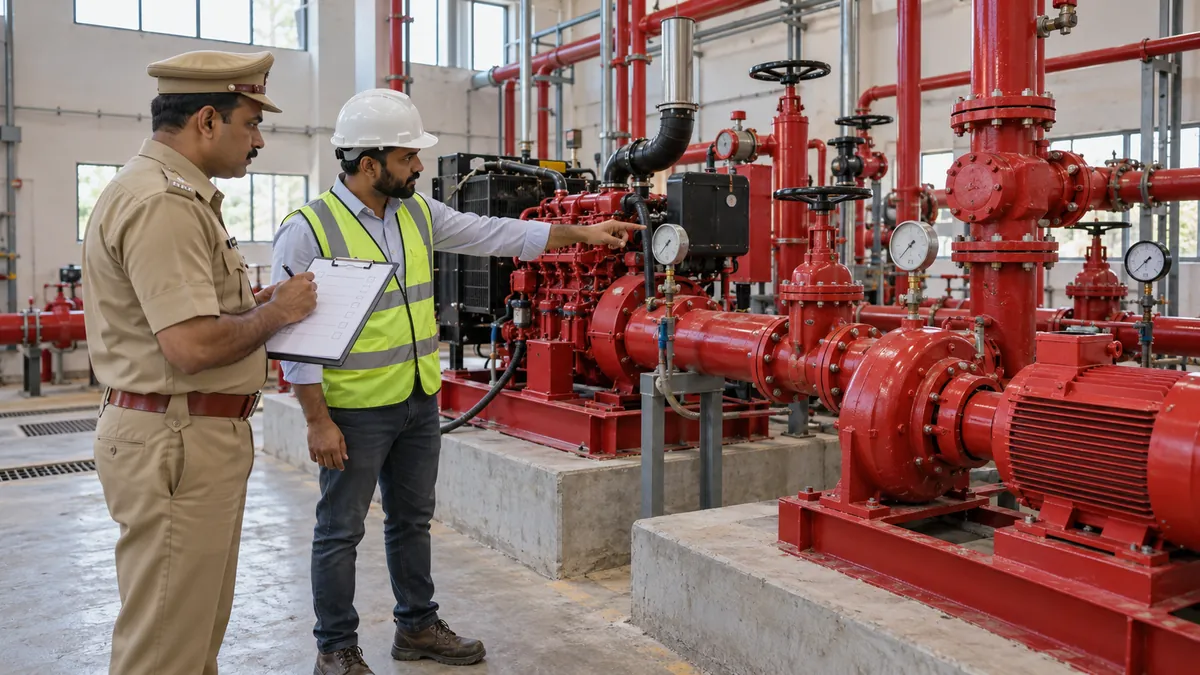
The fire officer inspects the installation against the approved drawings, not against a general standard — which is why a site that has drifted from its drawings fails. What is checked: that the hydrants, risers and landing valves are where the drawings put them and the pumps hold the design pressure at the most remote outlet; that the pump sets auto-start on pressure drop, the diesel standby runs, and the jockey holds the system pressurised; that the tank holds the approved capacity and is connected as drawn; that detectors, manual call points and sounders work, and the panel shows the right zone; that sprinkler heads are not obstructed by ducts, cable trays or racking; that exits, signage, emergency lighting and refuge areas match the drawings; that fire dampers exist at the compartment crossings; that extinguishers are placed and tagged; and that the pump room is accessible, ventilated and drained. Test records — hydrostatic tests, flow tests, detector tests — are asked for, and the absence of a record is treated as the absence of the test.
Common reasons for delay
- Applying after construction. The scheme should be approved before the tank is cast and the pump room built; retrofitting to satisfy the authority is the expensive route.
- Drawings that do not match the site. Storage racking added after the sprinkler design, a pump room moved, a tank reduced — each is a variance the inspector will find.
- Tank and pump room fixed by the architect before the fire scheme existed. Undersized for the hazard, or inaccessible.
- Hazard understated. A warehouse classified as ordinary hazard to save on sprinkler density, then failing on the commodity class and rack height the inspector sees.
- Incomplete documentation. Missing test reports, equipment certificates, ownership proof or the building-plan sanction reference.
- Change of use or expansion treated as covered by the existing NOC.
- Nobody owning the file. Queries from the authority unanswered for weeks because they were addressed to the owner and forwarded to no one.
Renewal
A Fire NOC is not permanent. Renewal is at the interval the state sets — commonly between one and three years by state and occupancy, with hospitals and hotels often on the shorter cycle — and it depends on the systems having been tested and the tests logged in the meantime: pump auto-start tests, hydrant flow tests, detector tests, extinguisher servicing. A renewal application without a logbook is a fresh inspection with a shortfall list. Renewal is best carried by whoever maintains the systems; the AMC scope is written to include it.
What a consultant or contractor can assist with
- Applicability review — whether the building needs a NOC and which systems apply under NBC 2016 Part 4 and the state's rules.
- Scheme design and drawings — the fire-protection scheme sized from the occupancy and hazard, drawn in the form the authority accepts.
- Documentation, filing and follow-up — the application set, the fee, the portal or directorate submission, and the queries that follow.
- Installation and testing — where the contractor also executes the systems, with the test records the final inspection asks for.
- Attendance at inspection and shortfall closure — the person who drew the scheme answering the inspector's questions, and the shortfall list closed in one cycle rather than three.
- Renewal management — the logbook, the periodic tests and the renewal filing before expiry.
Limitations — what no consultant can do
Only the State Fire Service issues a Fire NOC. Secured Engineers Pvt. Ltd. does not issue, grant or certify approvals of any kind; it prepares, files, installs, tests and liaises. The authority decides whether the scheme and the installation are acceptable, and when. Timelines are the authority's and vary by state, by portal and by how complete the submission is — no consultant can guarantee a date. Requirements are the authority's: where the fire officer asks for more than the code minimum, the scheme changes, not the officer. Fees are statutory and paid to the authority. Anyone who promises an NOC, a date or a fee "arrangement" is describing something other than consultancy.
State and location considerations
The code basis is national; the process is the state's. Each state guide below covers that state's fire act, the issuing department, how the application is filed, what the authority is known to ask for, and where files stall — verified against the department's own published position on the date shown.
- Delhi: DFS Process Guide — How Fire NOC works for factories in Delhi under the Delhi Fire Service Act, 2007 — issuing authority, DSIIDC estate coordination, and no inspection fee.Reviewed 2026-10-10
- Fire NOC Himachal Pradesh (HP) for Factories: Baddi & BBN — The Directorate of Fire Services, Shimla issues the Fire NOC in Himachal Pradesh, under the HP Fire Fighting Services Act, 1984 — BBN and Kala Amb alike.Reviewed 2026-10-10
- Fire NOC Punjab for Factories: 2024 Act, Process & Validity — Punjab Fire and Emergency Services, under the Local Government Department, issues the Fire NOC — 2024 Act, risk-tiered validity, PSIEC/GMADA coordination.Reviewed 2026-10-10
- Fire NOC Rajasthan for Factories: Process Without a Fire Act — Rajasthan has no fire directorate: Local Self Government issues the NOC under the Municipalities Act, 2009 (s. 337) — Bhiwadi, Neemrana and Alwar.Reviewed 2026-10-10
- Fire NOC Uttarakhand for Factories: Process & Authority — Uttarakhand Fire and Emergency Services issues the Fire NOC under the 2016 Act — apply online for pre-establishment, pre-operational or renewal NOC.Reviewed 2026-10-10
- Haryana: 2022 Act Explained — How Fire NOC works for factories in Haryana under the Fire and Emergency Services Act, 2022 — authority, process, and the 2025 third-party audit policy.Reviewed 2026-10-10
- UP: 2022 Act Explained — How Fire NOC works for factories in UP under the UP Fire and Emergency Services Act, 2022 — authority, Noida/Ghaziabad process, and what changed from 2005.Reviewed 2026-10-22
For a building in a state not listed, the sequence and the documentation above still apply; the department, the portal and the renewal interval are what change. The state compliance comparison sets the fire authority alongside the DISCOM, pollution board and electrical inspectorate for each state.
How Secured Engineers assists
Two ways. As a Fire NOC consultancy — applicability review, scheme, drawings, documentation, liaison, inspection attendance, shortfall closure and renewal — for a building whose fire systems someone else installs or has installed. Or as the fire-protection contractor as well, in which case the scheme, the installation, the testing and the inspection are one team's responsibility and the drawings match the site because the same people did both. Either way the deliverable is the same: a submission the authority can approve on first reading, and an installation the inspector finds as drawn. The Fire NOC buyer's guide lists what to have ready; the form above is the fastest way to get a readiness review.
Sources and standards
- NBC 2016 Part 4 (2016) — National Building Code of India 2016, Part 4 — Fire and Life Safety. Bureau of Indian Standards. Publisher.Occupancy classification, fire-protection systems required by building type and height, static water storage, pumps, exits, refuge, compartmentation, stair pressurisation.
- IS 15105 (2002 (reaffirmed)) — IS 15105 — Design and Installation of Fixed Automatic Sprinkler Fire Extinguishing Systems — Code of Practice. Bureau of Indian Standards. Publisher.Sprinkler hazard classification, design density, head spacing and coverage, water supplies.
- IS 3844 (1989 (reaffirmed)) — IS 3844 — Code of Practice for Installation and Maintenance of Internal Fire Hydrants and Hose Reels on Premises. Bureau of Indian Standards. Publisher.Internal hydrants, landing valves and hose reels.
- IS 13039 (2014) — IS 13039 — External Hydrant Systems — Provision and Maintenance — Code of Practice. Bureau of Indian Standards. Publisher.Yard hydrant systems — provision, spacing and maintenance.
- IS 2189 (2008) — IS 2189 — Selection, Installation and Maintenance of Automatic Fire Detection and Alarm System — Code of Practice. Bureau of Indian Standards. Publisher.Detector selection, zoning, installation and maintenance of fire alarm systems.
- IS 2190 (2010) — IS 2190 — Selection, Installation and Maintenance of First-Aid Fire Extinguishers — Code of Practice. Bureau of Indian Standards. Publisher.Extinguisher type by fire class, distribution, travel distance and servicing.
- State Fire Service Acts and Rules — State Fire and Emergency Services Acts and Rules (state-specific). State governments. Fire NOC application, inspection, issue and renewal — the process and periodicity differ by state.
Standards are cited to support the technical statements on this page. Where a standard has been revised, the edition shown is the one verified at the time of review; the edition in force for a project is the one the authority applies.
Fire NOC — common questions
What is different about a Fire NOC for a factory?
The hazard sets the scheme, not the floor area. The classification — light, ordinary or high hazard, and for storage the commodity class and rack height — decides the sprinkler design density and area of operation, and through them the fire-water tank capacity and the pump duty. The scheme also has to agree with the machinery layout and exits approved by the factory inspectorate, and with the PESO licence where flammable liquids or gases are stored above the licensing threshold.
Does a factory need the Fire NOC before the Factory Licence?
In practice yes. The Factory Licence chain expects the final Fire NOC and the pollution consent to be in place, and inspectors cross-check that the fire, factory and building files describe the same premises. Pursuing them in isolation is what produces three sets of drawings that do not agree.
Who issues a Fire NOC in India?
The State Fire and Emergency Services (the fire department of the state or union territory), under that state's Fire Services Act and rules. No consultant, contractor or private body issues it. Some states route the application through the local body or industrial estate authority, but the fire authority decides.
What is the difference between a provisional and a final Fire NOC?
The provisional NOC (scheme approval) is granted on the fire-protection drawings before construction, and tells you the scheme is acceptable. The final NOC is granted after the systems are installed, tested and inspected on site. Occupancy needs the final NOC; building on the provisional one is the normal sequence, occupying on it is the common mistake.
Can a consultant guarantee a Fire NOC or a timeline?
No. A consultant or contractor can design the scheme to the code, prepare the drawings and documents, file and follow up, install and test the systems, attend the inspection and close the shortfalls. The decision and its timing belong to the authority, and both vary by state and by how complete the submission is.
How often does a Fire NOC have to be renewed?
Periodically, at the interval the state sets — commonly every one to three years depending on the state and the occupancy, with hospitals and hotels often held to the shorter end. Renewal depends on the systems having been tested and logged in the meantime; a lapsed NOC is usually the product of nobody owning the renewal.
What should I send for a Fire NOC readiness review?
The building's occupancy and use, height and floor areas, the site plan with access roads, architectural drawings, any existing fire scheme or NOC or inspection report, what is stored or processed (which sets the hazard), the state, and your target occupancy date. From that a consultant can tell you what the authority will ask for and what is missing.
Need a Fire NOC readiness review?
Send the occupancy, drawings and state. An engineer replies with what the authority will ask for and what is missing.
Guides that reference this page
- How should a factory plan fire pump capacity?
- Common reasons industrial Fire NOC applications get delayed
- What we check during an industrial fire protection site survey
- Lithium-ion Batteries Don't Fail Like Lead-Acid. Your UPS Room Wasn't Designed for That.
- Grease Fires Don't Ask Permission. Does Your Kitchen Hood Have a Suppression System?
- Basement Ventilation and Fire Safety: An Upgrade Checklist
Related on this site
- termFire Pump Room
- termJockey Pump
- termFire NOC
- serviceFire Detection & Alarm (Fire Protection)
- serviceHydrant & Wet/Dry Riser Systems (Fire Protection)
- calculatorMEP Maintenance Budget Calculator
- calculatorFire Noc Calculator
- buyer's guideHow to Select a Fire Protection Contractor
- guideFire NOC for factories
- guideCEIG approval for factories