
Engineering guides & industry insights — page 21
MEPF, solar and fire-safety guides — page 21
Archive page 21 of 22 — practical, no-jargon guides on MEPF, solar, fire safety and approvals.

MEP Occupancy Certificate Checklist: The Documents That Delay Possession
An occupancy certificate is applied for once, but it rests on a chain of MEP approvals, as-built drawings and test certificates owned by different people. A project authority matrix, an approved-versus-as-built check, a test-certificate register and an open-observations tracker.

Landlord and Tenant MEP Responsibility Matrix
MEP disputes between landlords and tenants start where a landlord-owned system crosses into tenant space. A component-by-component matrix that separates ownership, operating duty, maintenance and cost, with fit-out rules and common-plant billing options to negotiate from.

Grid Down. DG Running at 70% Capacity. 40 Tenants. Who Gets Power First?
Your building's DG covers 70% of connected load — an entirely normal design ratio. The day the grid actually fails, that 30% gap becomes a very personal argument between 40 tenants, none of whom knew where they stood in the queue. Backup power allocation is a policy decision, not an electrical one — and most buildings never make it.

BMS Retrofit Without Losing Control of Your Building
A building management system can leave the owner unable to change a schedule, add a chiller or tender the maintenance without the original vendor. How to plan a BMS retrofit so you own the point list, the trend data and the licences, and can prove what the new system does.

The Escalator Stopped Mid-Step. The Inquiry Wants to Know Who Last Serviced It.
Lift and escalator incidents in public commercial spaces trigger a different kind of scrutiny than a broken AC — regulatory inquiry, insurance investigation, and personal liability questions for whoever's name is on the maintenance record. Most building owners can't actually answer 'when was this last properly serviced' with evidence. Here's what that record needs to look like.
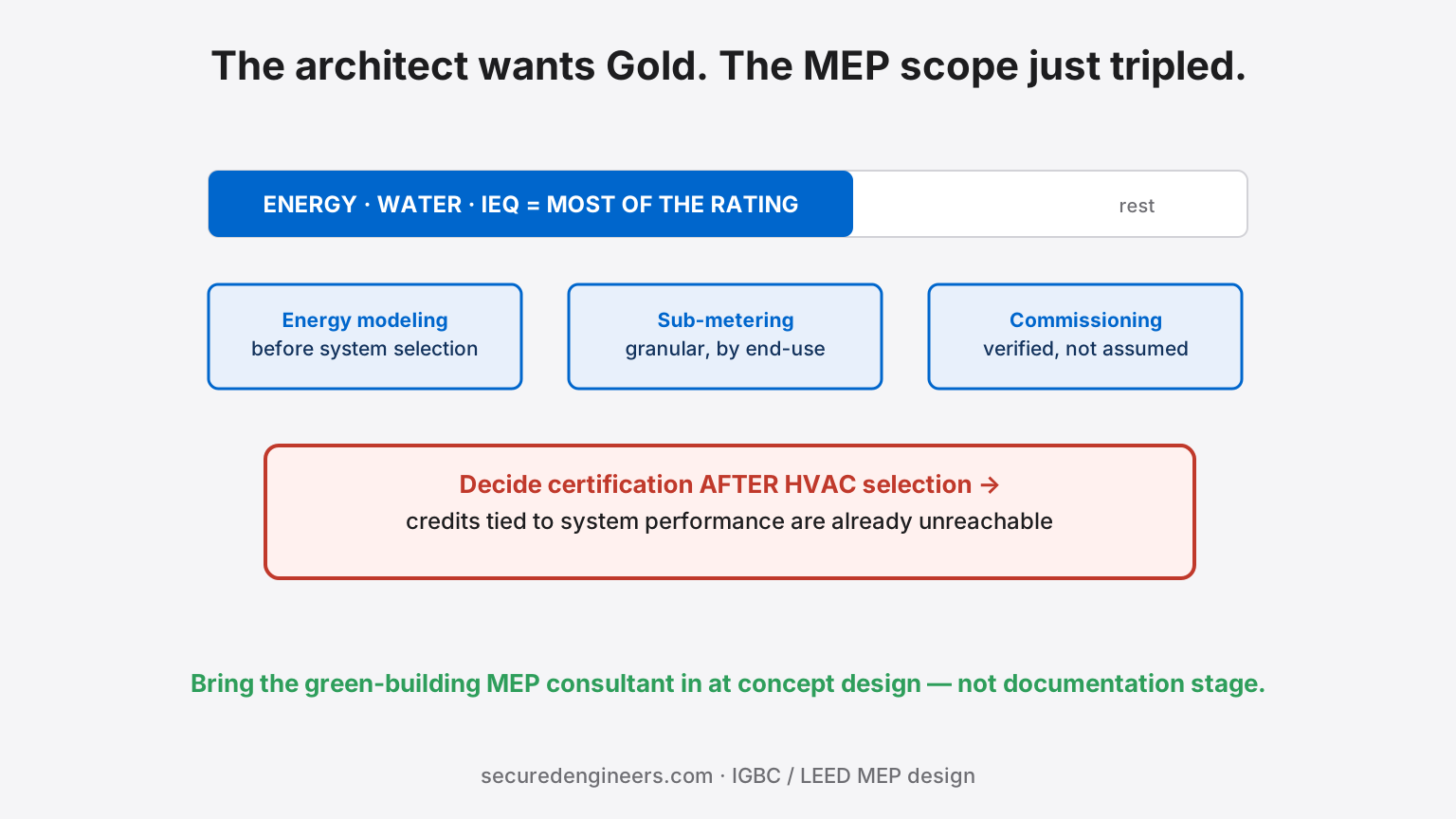
The Architect Wants Gold Certification. The MEP Scope Just Tripled.
Green building certification isn't a plaque you add at the end — it's a set of MEP design and commissioning requirements that reshape HVAC, metering, water and controls from day one. Commercial developers chasing IGBC or LEED without understanding the MEP implications routinely find out too late, when the credits they need are already impossible to achieve.

The Hospital Passed Its Medical Audit. The Building Failed Its Own.
NABH assessors and fire officers now walk straight past the ICU equipment and into the plant rooms — checking pump logs, medical gas manifolds, OT air changes and electrical safety in patient areas. Why hospital buildings fail audits their clinical teams never see coming.

Pharma Cleanroom HVAC Upgrade: A Brief for Expansion Projects
A pharma expansion’s HVAC is defined by the product, not the tonnage: room-by-room requirements, a pressure and filtration strategy, segregation and cleanable construction, and qualification under revised Schedule M. A brief to settle before an HVAC contractor prices the work.

Factory CCTV Expansion Planning: Cameras, Access Control and the Fire Alarm
When a site expands, new cameras and doors get added to systems bought years apart. Settle each camera’s purpose and privacy limits, the network, storage and PoE capacity, who owns the fire-alarm interface, and the acceptance tests and operating ownership before you buy.

Year 1 Was Free. Year 2 Was Cheap. Year 3 Is Eating Your Budget. Here Is the Curve.
Every new building lives the same cost story: the defect-liability year feels free, year two runs on youth, and from year three the breakdowns, energy drift and emergency repairs compound — because maintenance was treated as a cost to minimise instead of an asset to manage. The lifecycle economics, honestly.
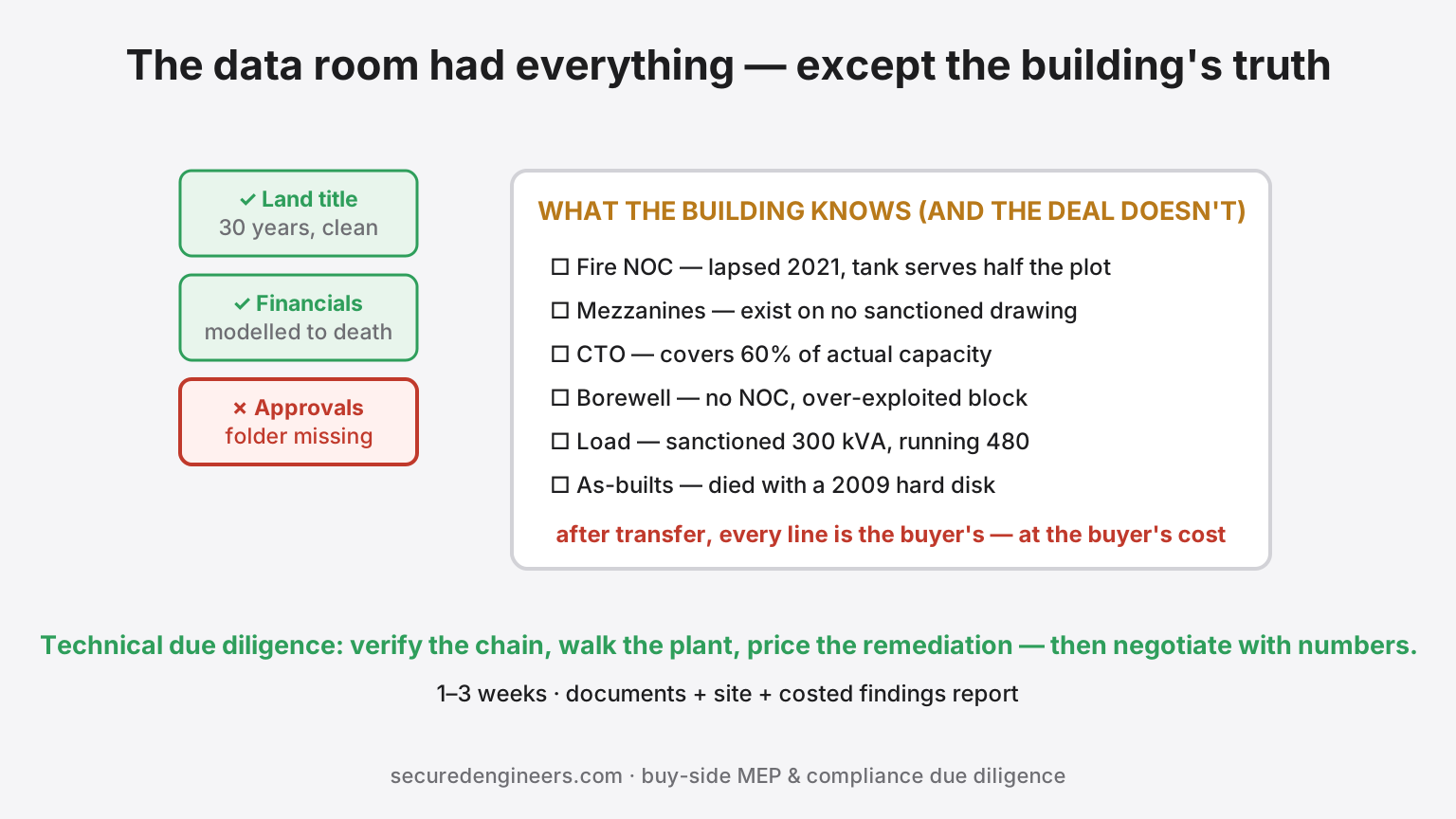
Factory MEP Due Diligence Before You Buy or Lease
A factory’s price assumes its power, fire, water and approvals will carry your production. MEP due diligence checks supply capacity and ownership boundaries, asset condition, and approvals against the as-built layout, then turns every gap into a priced rectification allowance.

You Have Awarded L1 Five Times. It Has Backfired Five Times. The Problem Is the Method.
Every project, the same movie: award the lowest bid, watch quality sag, fight variation claims, finish late — then write a tighter tender and do it again. L1 is not bad luck; it is a procurement design that selects for exactly these outcomes. Here is how to fix the method, not the vendor.

MEP tender BOQ checklist: close every ambiguity before it becomes a variation claim
A tender BOQ is the rulebook for every commercial argument on the project. Write the quantity basis, the specifications, the priced tests and the variation and acceptance rules into it while you hold the leverage — or meet each gap later as a claim.

MEP project timeline from design to handover: the dependencies, long-lead orders and hold points that set the date
The civil programme says when the shell is ready; MEP decides when the building can be used. The design dependencies, approval and procurement constraints, installation sequence and testing and energisation hold points that set the real handover date — and how to put them on the programme.

Your Server Room Is Cooled Like an Office. That Is Why It Keeps Failing.
A split AC over the rack, set to 18°C, running flat out — and still the UPS room smells hot, drives fail early and the panel trips on humid August nights. Comfort cooling and precision cooling are different machines for different physics. What a small critical room actually needs.
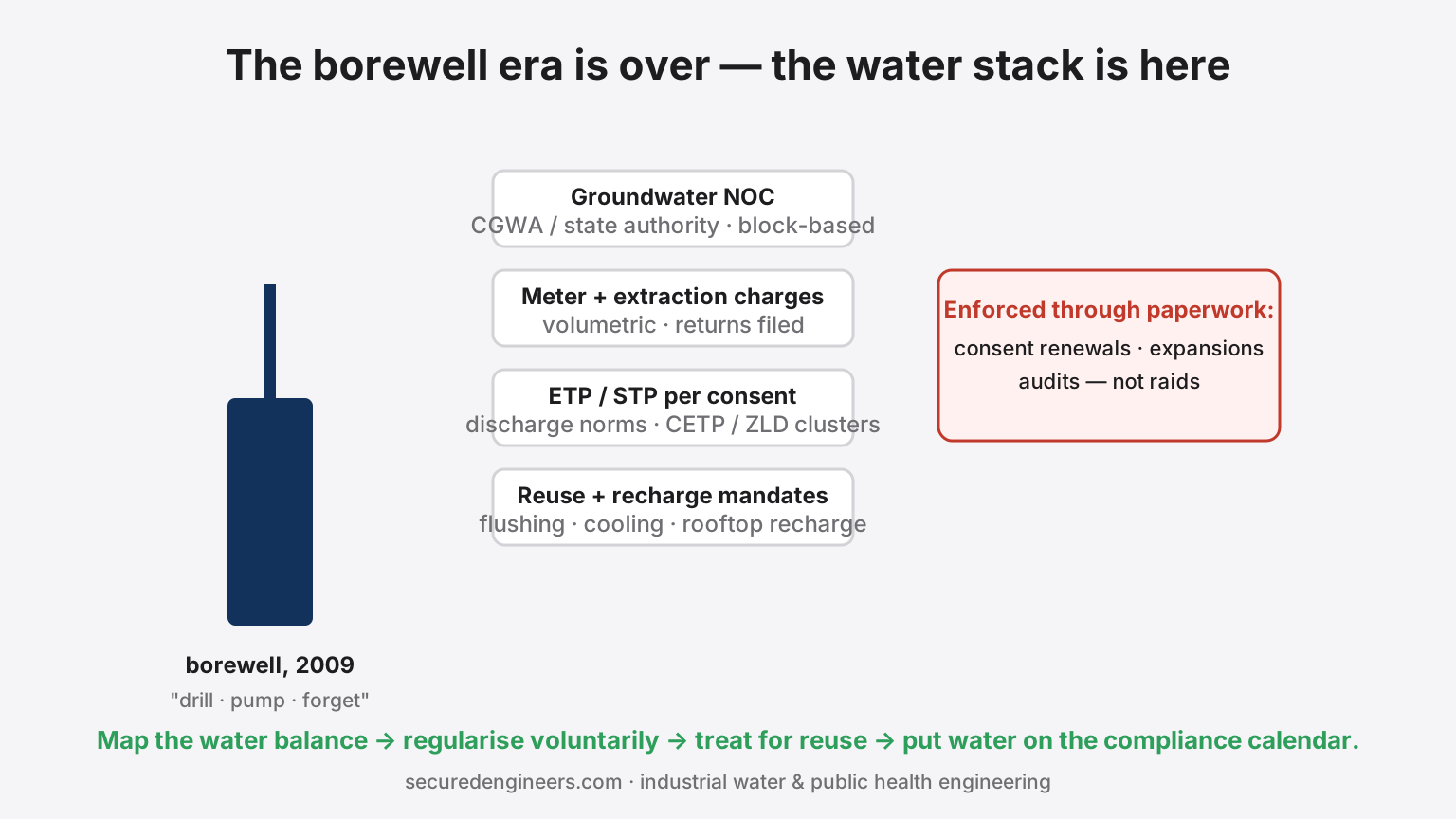
The Borewell You Drilled in 2009 Now Needs a Licence. And a Meter. And a Fee.
For decades, industrial water in North India was simple: drill, pump, forget. That era is over — groundwater NOCs, extraction charges, meters, recharge obligations and effluent-reuse mandates now stack on top of each other, and enforcement runs through your consent renewals. The water compliance map, decoded.

Your DG Is a ₹30/kWh Habit. Here Is What Every Unit Actually Costs.
Factories treat the DG as free backup and the bill as fate. Line up diesel, grid and rooftop solar on one table and the picture is brutal: every DG hour is the most expensive electricity you will ever buy. The honest per-unit economics, and the load strategy that follows.

The Jockey Pump Died in March. You Will Find Out in a Fire.
Fire systems fail silently: a tripped jockey pump, a bypassed panel zone, hydrant valves painted shut. Nothing stops production — until the NOC renewal inspection, the insurance surveyor, or the fire itself. Why fire AMC is the cheapest risk contract in your building.

Warehouse Racking Changes and Fire-Protection Design
Racking, stacking height and what sits on the pallets are inputs to a warehouse sprinkler design. A commodity checklist, a decision table of what each change can trigger, and what to send a fire engineer before the racks are ordered.

The Plant Is Ready. The Power Isn't. Decoding HT Connection Delays in North India.
Machines installed, staff hired, trial orders waiting — and the HT connection is "under process" for the fourth month. Where connections actually get stuck at PSPCL, UHBVN/DHBVN and UPPCL/NPCL, which delays are the applicant's own fault, and how to run power as a critical path.

Your Solar Plant Has Been "Awaiting Meter" for 11 Weeks. Here Is Why.
The panels are up, the inverter hums through commissioning mode — and the plant cannot legally export a unit because the bidirectional meter and synchronisation approval are stuck. Why net-metering files stall at North Indian DISCOMs, and how to sequence solar so the paperwork finishes with the plant.

Two MEP Quotes. Same Building. 40% Apart. Which One Is Lying?
One contractor quotes ₹4.2 crore. Another quotes ₹6 crore for the same drawings. Neither number is random — they are answering different questions. How to read an MEP quote, what drives the spread, and the checklist that makes quotes comparable.

Five Contractors, One Ceiling: Why Your Duct, Cable Tray and Sprinkler All Want the Same Spot
The HVAC contractor blames the electrical contractor. The electrical contractor blames the fire contractor. Everyone blames the drawings. Why multi-contractor MEP projects clash — and what coordination actually costs when nobody owns the ceiling.

Factory Power Factor Correction: Read the Bill, Size the kVAr, Check for Resonance
Before adding production load, find out what power factor costs you under your tariff and how much transformer and contract-demand headroom it uses. Read the bill terms, size kVAr from measurements, and review harmonics first.
Ready to start your project?
Get a free consultation and quote. We design, prepare and file your approvals, and execute — you deal with one team.
Related guides
- Three Vendors, One Roof, Three Different Generation Figures.
- Your BOQ Said 1,000 M. Site Said 1,470 M. Who Pays for the Missing 470 M?
- Perovskite Cells Promise 30%+ Efficiency. Your Roof Doesn't Have Ten Years to Wait and See.
- The Future of MEP Engineering: 5 Technologies to Watch
- The MSME Act Just Changed. Here Is What It Means for a Factory Owner.
- Solar EPC for Factories in Bihar: DISCOM Rules, Approvals and Cost